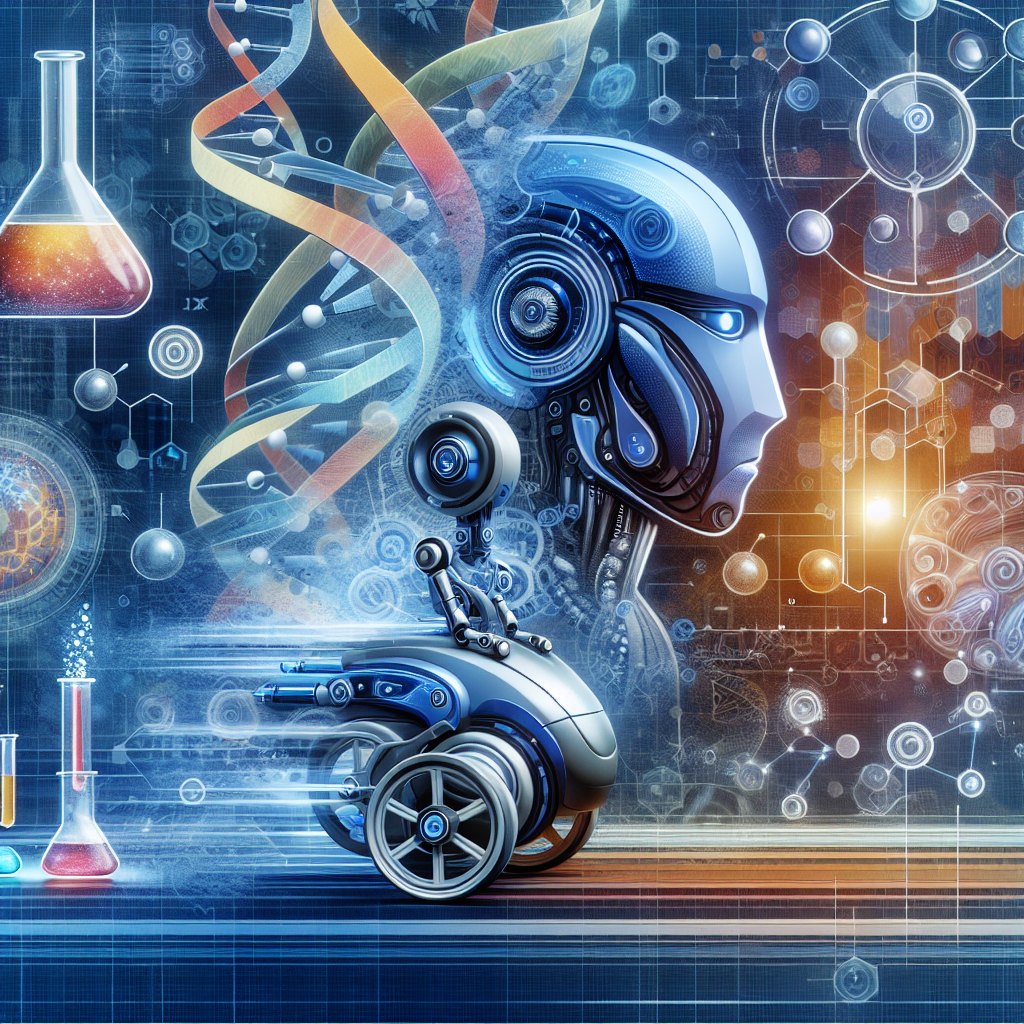
With the release of its latest artificial intelligence (AI) program, Google has once again set the stage for new bounds in the tech sector. The new AI scientist named “GenAI X”, aims to redefine collaborative scientific research by simulating higher-level reasoning and problem-solving skills typically associated with human experts.
Developed by a team of researchers at Google, the GenAI X is designed to not only enhance data analysis capabilities but also to contribute creatively to scientific discussions, potentially co-authoring research papers. The AI’s ability to understand and generate human-like text is built upon advanced machine learning algorithms and vast sets of scientific data.
This development comes at a pivotal time when the utilization of AI in science and research has been increasingly promising, yet peppered with ethical and practical concerns. High on this list is the concern regarding data bias and the replicability of AI-driven results, alongside the broader implications of intellectual property rights in works co-created by AI systems.
The innovative grounding of GenAI X lies in its dual capability to learn and adapt from iterative feedback loops—a feature that allows the program to refine its hypothesis and experiment with new ideas, much like a human scientist in a real-world laboratory setting. Specifically, the program is trained on a diverse corpus of scientific literature and patents, enabling it to stay abreast of cutting-edge research and potentially initiate novel research ventures.
Despite these advancements, the tech community remains cautiously optimistic. As scientists and researchers begin to explore the capabilities of GenAI X, discussions are centered on ensuring transparency in how the AI’s conclusions are drawn, safeguarding against the over-reliance on machine-only diagnostics, and fully understanding the legal ramifications of AI-partnered research outputs.
The integration of AI like GenAI X in scientific research is seen as a double-edged sword. On one hand, it promises to accelerate the pace of research, break interdisciplinary boundaries, and handle the ever-growing data from scientific experiments that are humanly unmanageable. On the other, it poses new challenges in terms of ethics, reliability, and the nature of scientific creativity.
As Google pushes forward with this initiative, the broader scientific community, along with policy makers, must navigate these waters carefully, crafting guidelines that foster innovation while addressing these significant concerns. The evolution of AI tools such as GenAI X marks a notable shift in how research could be conducted in the future, potentially leading to faster breakthroughs but also to new debates about the role of AI in the essence of human-driven science.