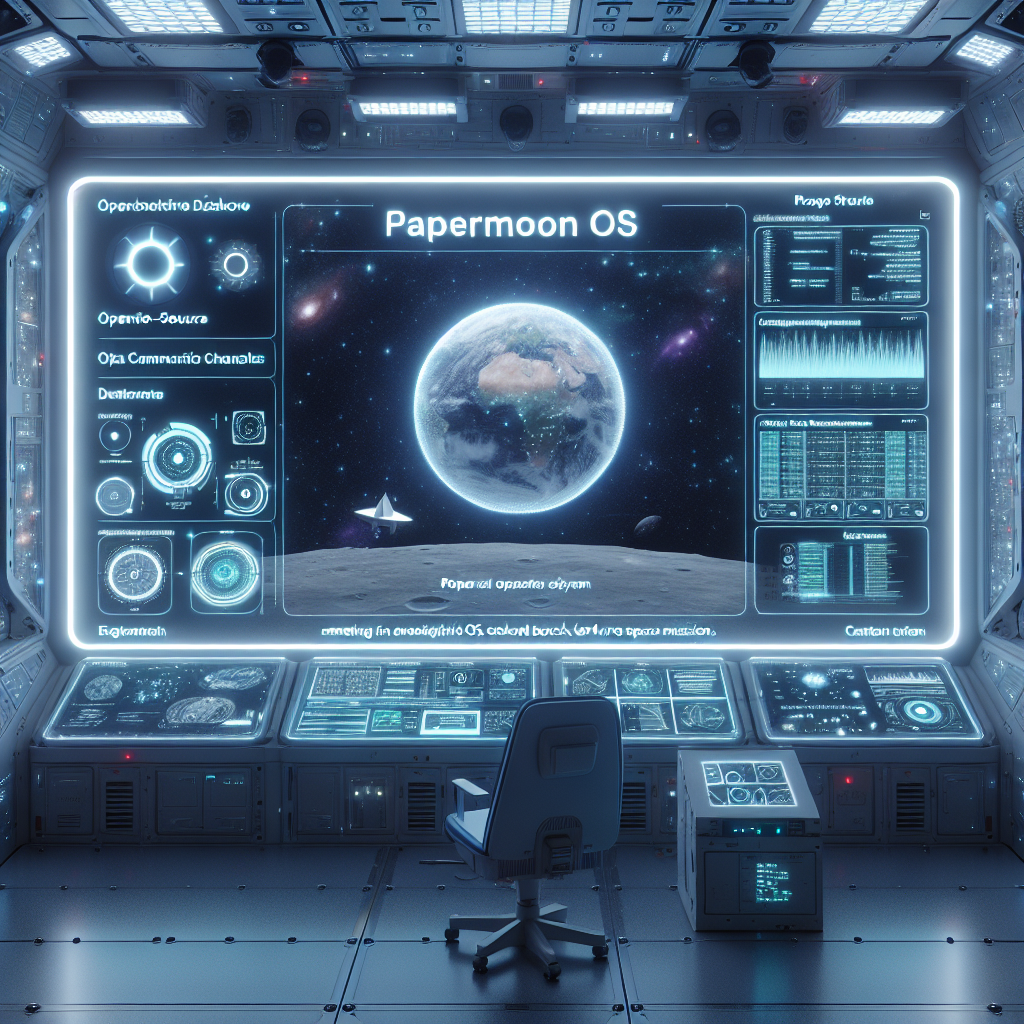
A new operating system designed to meet the demanding conditions of outer space is gaining attention in aerospace and software development circles. As reported in the article “Papermoon: A Space-Grade Linux for the NewSpace Era” by Startup News FYI, the recently unveiled Papermoon OS aims to become a foundational layer for the rapidly evolving NewSpace economy, offering a Linux-based solution tailored specifically for satellites, space probes, and other off-world systems.
Papermoon OS is the product of a small team of engineers and open-source contributors, led by developer and entrepreneur Nina Zhou, who has articulated a vision for a modular, robust, and secure platform that can operate reliably under the extreme conditions of space. Unlike traditional Linux distributions that have been adapted in parts for use aboard spacecraft, Papermoon is purpose-built from the ground up to handle space-specific constraints such as radiation faults, memory corruption, and intermittent communication links.
According to the original report, the operating system introduces hardened kernel-level security, fault-tolerant processes, and a telemetry-first architecture, all of which are intended to accommodate the needs of modern spacecraft design and operation. Zhou’s team sees an urgent demand for more agile and autonomous software frameworks in light of the growing number of commercial satellites and deep-space missions under development by private and public sector players.
Startup News FYI reports that Papermoon OS has already drawn preliminary interest from satellite startups and research institutions, with early testing underway aboard high-altitude balloons and low Earth orbit testbeds. The team plans to release a developer kit and simulation environment in early 2026, potentially enabling more aerospace developers to adopt and adapt the OS for mission-critical applications. A key differentiator, according to Zhou, is the open-source nature of Papermoon and its community-first roadmap, which could reduce current barriers of cost and complexity in aerospace software development.
As the NewSpace sector matures, software reliability and autonomy are becoming central concerns. Traditional flight software—often developed in-house with bespoke solutions—can lag behind in flexibility and maintainability. Papermoon proposes an alternative: a shared, robust foundation anyone in the ecosystem can build upon.
While it remains to be seen how widely adopted the platform will become, Papermoon’s launch marks a significant moment in the intersection of open-source software and commercial spaceflight. As private companies continue to expand the frontiers of space activity, a standardized, space-grade operating system could help propel the industry into a new phase of scalability and innovation.