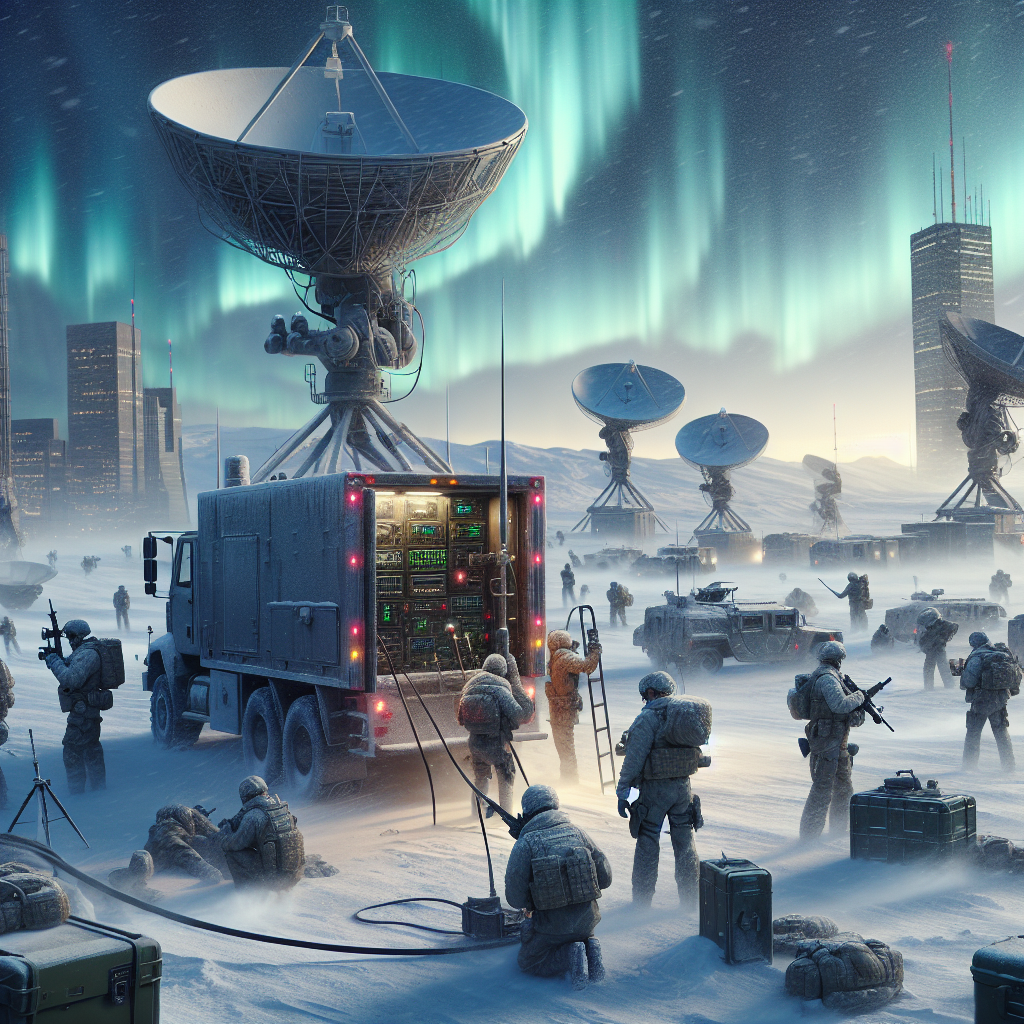
As geopolitical competition intensifies in the far north, military strategists are increasingly sounding the alarm over the unique operational challenges posed by the Arctic. In a recent article titled “Military Planners Dread the Arctic, Where Drones Drop Dead and GPS Goes Haywire,” published by StartupNews.fyi, analysts highlight the profound limitations of current defense technologies in the planet’s polar extremes.
Despite growing policy commitments to Arctic readiness, the region’s environment continues to undermine even the most advanced military systems. Temperatures that routinely plunge below -40°C, erratic magnetic fields, and the near-constant presence of ice and snow limit the deployment of conventional technologies such as surveillance drones, GPS navigation, and satellite communications. As the StartupNews.fyi report points out, drones that function flawlessly in temperate zones often fail to maintain battery life or stable sensors when exposed to the Arctic’s frigid conditions.
The disorientation caused by polar geomagnetic anomalies compounds these difficulties. GPS, a cornerstone of modern military navigation and targeting, has been shown to perform unreliably near the North Pole due to signal interference and satellite positioning challenges. This unreliability not only hinders situational awareness but also threatens the safety and coordination of troops operating in remote Arctic theaters.
These technical hurdles come at a time when the Arctic is becoming a theater of increasing strategic interest. Climate change is reshaping the geopolitical landscape as melting ice opens new maritime routes and access to previously unreachable natural resources. Nations including Russia, China, and the United States are all attempting to assert influence in the region, with Russia significantly ramping up its Arctic military infrastructure over the past decade.
However, possessing the strategic will is not the same as having the practical capability. Military planners across NATO have begun to acknowledge that existing equipment, designed primarily for mid-latitude conflicts, often fails in the Arctic. This has prompted renewed calls for specialized hardware adapted to extreme cold, expanded cold-weather training for troops, and deeper interoperability between allied forces experienced in Arctic operations — notably Scandinavian countries and Canada.
Defense technology firms are also under pressure to deliver cold-weather-optimized platforms. Yet innovation has lagged behind operational needs, due in part to the high costs and technical challenges involved. Without significant investment in research, development, and field testing, current capabilities may remain insufficient to project sustained force in such a hostile domain.
The article from StartupNews.fyi underscores this critical gap and raises broader questions regarding preparedness. With global power dynamics increasingly intersecting at the top of the world, the Arctic is no longer a remote backwater but a geopolitical frontier fraught with risk. As the region becomes more accessible—and more contested—the urgency to overcome these technological and logistical obstacles becomes paramount. For strategists and defense planners, the Arctic remains as formidable as it is unavoidable.