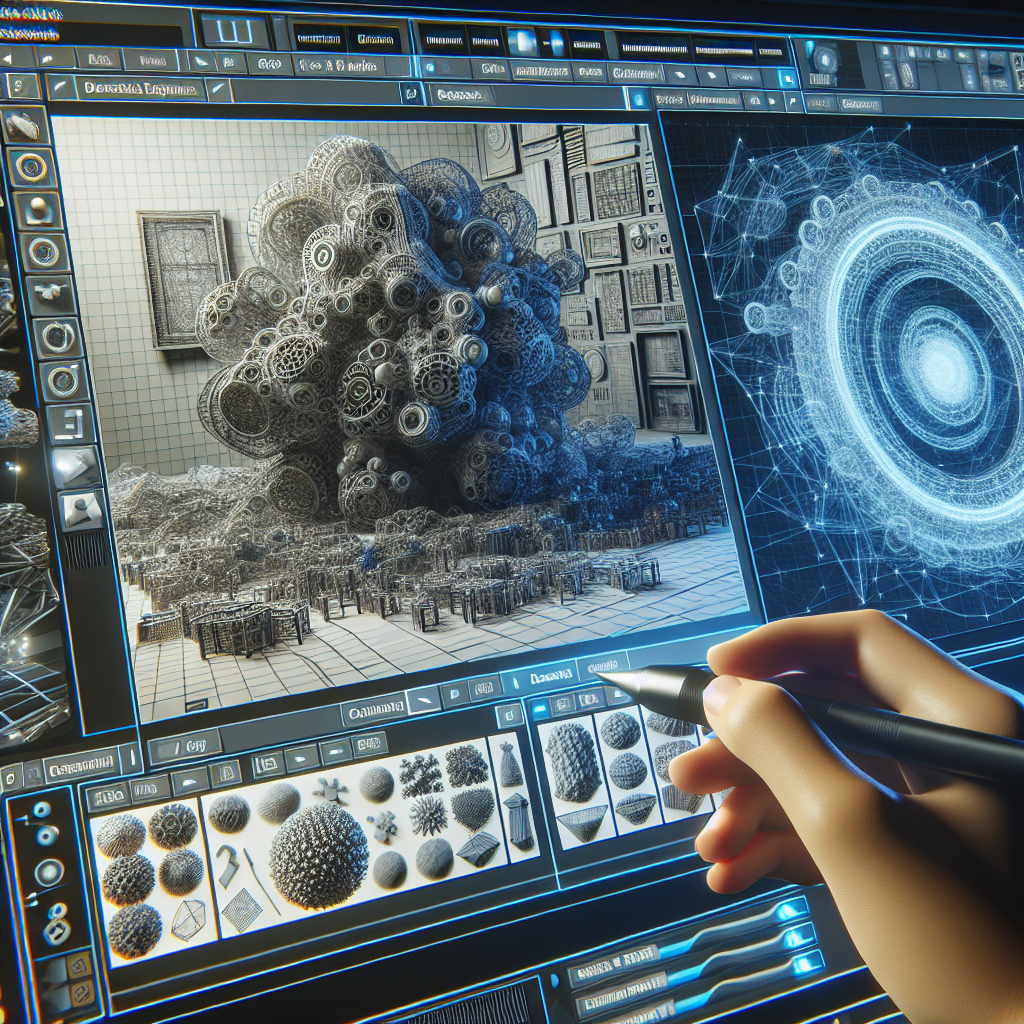
A team of researchers has developed a novel AI-based 3D modeling technique that significantly improves the precision and efficiency of mesh editing—an essential process in computer graphics, digital design, and virtual reality development. Their work, described in the Tech Xplore article titled “AI-based 3D method enables finer, precise editing of meshes,” presents a potential leap forward in how three-dimensional digital objects are constructed and manipulated.
Traditional 3D mesh editing relies heavily on manual adjustments and heuristic algorithms, often requiring extensive input from skilled designers and still frequently falling short in handling complex geometries or creating subtle refinements. The new method, spearheaded by scientists at the University of Science and Technology of China alongside collaborators from institutes in Singapore and the United States, replaces these conventional approaches with a machine-learning framework capable of dynamically predicting and refining mesh details.
At the heart of the system lies what the team calls “Mesh-Aligned Implicit Surface” (MAIS), an innovative neural representation that allows for the conversion of coarse digital mesh structures into detailed surface forms with unprecedented accuracy. Unlike previous techniques that translate a full mesh into a singular implicit function—an equation that represents a 3D shape via continuous data—MAIS aligns these functions locally across different mesh regions, preserving both the global structure and local surface nuances.
This advancement is particularly significant given the growing demand for highly detailed, adaptive 3D models in fields such as augmented and virtual reality, digital entertainment, prosthetic design, and architectural simulation. By enabling real-time, highly fine-tuned edits, the approach could reduce production time and costs while broadening design possibilities.
In their experiments, the researchers demonstrated that their method not only outperformed existing models in accuracy and continuity of surface reconstruction but also maintained computational efficiency. Key to its effectiveness is its ability to address the longstanding challenge of maintaining “mesh fidelity”—ensuring that edited models closely match the intended geometry—while avoiding common artifacts such as surface distortions or unnatural bumps.
The team envisions future applications extending beyond the artistic and entertainment sectors. For instance, the ability to rapidly and accurately manipulate 3D surface data could prove invaluable in medical imaging, where anatomical modeling requires a combination of precise structure and pliable editing.
As 3D content generation becomes increasingly central to digital experiences, tools that advance both the fidelity and usability of mesh modeling will be crucial. This AI-powered method marks a notable step in that direction, suggesting a future in which high-resolution, customizable graphics can be developed with greater ease and precision.
While further real-world testing and refinement will be necessary before broad implementation, the early results underscore the potential for artificial intelligence to enhance not only efficiency in digital workflows but also the fidelity of virtual environments. As noted in the original Tech Xplore article, this innovation positions itself at the intersection of computer graphics research and deep neural computation, signaling a promising trajectory for the evolution of digital modeling technologies.