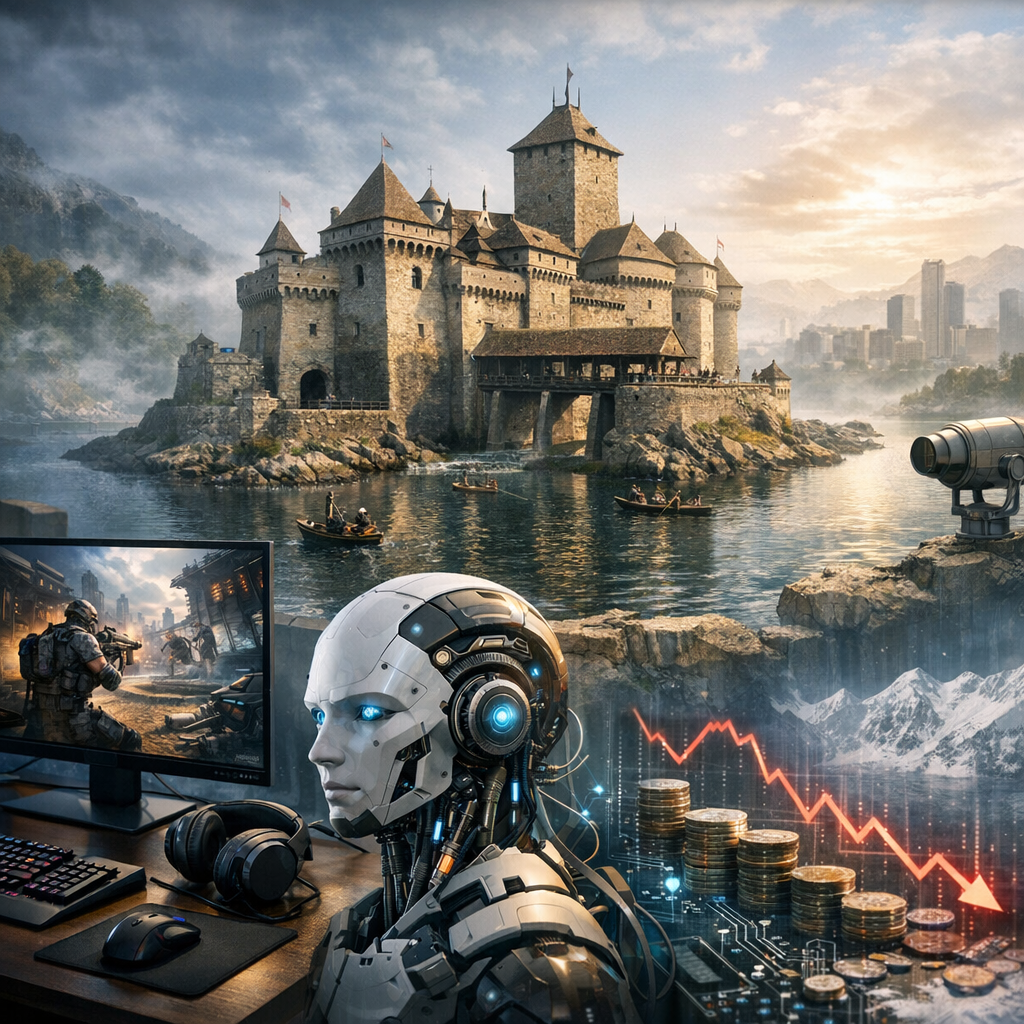
Gaming executives entering 2026 are confronting a rare double squeeze: a technology shock that is rapidly reshaping how games are made and discovered, and a financing environment that remains far less forgiving than the boom years. Those themes were laid out starkly in the VC Café article “In 2026 Gaming Companies Must Deal With AI Supercycle and VC Winter To Find New Moats,” which argues that the industry’s next phase will reward firms that can build defensible advantages while operating under sustained capital discipline.
Artificial intelligence is moving from a productivity enhancement to a structural force, changing both unit economics and competitive dynamics. In development, generative tools are enabling smaller teams to produce more content, iterate faster, and personalize player experiences at scale. That same acceleration, however, threatens to commoditize parts of the production pipeline that once differentiated studios, as asset creation, basic coding tasks, localization, and marketing materials become cheaper and more widely available. The net effect is a rising baseline of quality and output that can make it harder for any single title to stand out—especially in saturated genres and crowded distribution channels.
At the same time, the financial backdrop remains chilly. Venture investors have become more selective since the market reset, pushing game companies to emphasize profitability, predictable retention, and durable monetization rather than growth at all costs. This “VC winter” dynamic is reshaping what kinds of studios get funded, on what terms, and with what expectations. Companies that once relied on frequent fundraising rounds to sustain long development cycles are being forced to shorten time to market, reduce burn, or pursue alternative financing arrangements including revenue-based structures, strategic partnerships, and co-development deals.
The collision of these forces is intensifying the search for “moats,” the defensible strategic advantages that can protect margins and market share as AI reduces the scarcity of certain capabilities. The VC Café piece frames moats less as proprietary tools alone and more as comprehensive systems: recognizable intellectual property, community and creator ecosystems, distribution leverage, and deep operational expertise in live services. In practice, that means studios may need to demonstrate not only that they can build games efficiently, but also that they can sustain engagement over years, manage economies and content cadences responsibly, and maintain trust with players amid rising scrutiny over data usage and algorithmic design.
Discovery is poised to become even more challenging. If AI lowers production barriers, it also expands the volume of new games competing for attention. Platforms and storefronts, already gatekeepers, become still more influential through recommendation algorithms, feature placements, and cross-promotion. For developers, that increases the value of brand recognition, existing audiences, and direct-to-consumer channels such as community hubs, newsletters, and social presences that reduce dependence on any one platform’s shifting incentives.
Labor and organizational design are also in flux. AI-driven workflows may reduce demand for certain routine tasks while increasing demand for hybrid talent that can combine creative direction with technical fluency and strong product judgment. The industry could see more compact teams, greater use of contractors and specialist partners, and a rebalancing of roles toward world-building, narrative cohesion, economy design, and community management—areas where human taste and accountability remain difficult to automate. Yet these shifts carry risks, including uneven quality control, creative homogenization, and heightened pressure on remaining staff to deliver at faster cycles.
Regulatory and reputational considerations may further shape strategy. As generative systems increasingly touch copyrighted material, voice and likeness rights, and user data, studios may face legal uncertainty and operational costs in building compliant pipelines. Larger publishers may treat robust governance and content provenance as a competitive advantage, while smaller studios could be forced to choose between speed and caution—another factor that can influence investor confidence.
What emerges is an industry sorting mechanism. Some teams will use AI to compress development and improve margins, turning capital constraints into a forcing function for sharper execution. Others may struggle as their advantages erode and financing becomes harder to secure. The most resilient companies, as the VC Café analysis suggests, will likely be those that treat AI not as a one-time tool adoption but as part of a broader strategy: investing in proprietary data where appropriate, designing new forms of player-driven content and personalization, and building brands and communities that remain valuable even when the cost of making games falls.
For investors and operators alike, 2026 is shaping up less like a return to pre-reset norms and more like a new equilibrium. Games are still a global entertainment engine, but the path to durable success is narrowing toward studios that can pair creative originality with operational discipline and defensible distribution. In a market defined by rapid automation and tighter capital, the fundamental question is shifting from who can build the most to who can sustain the strongest relationship with players over time.