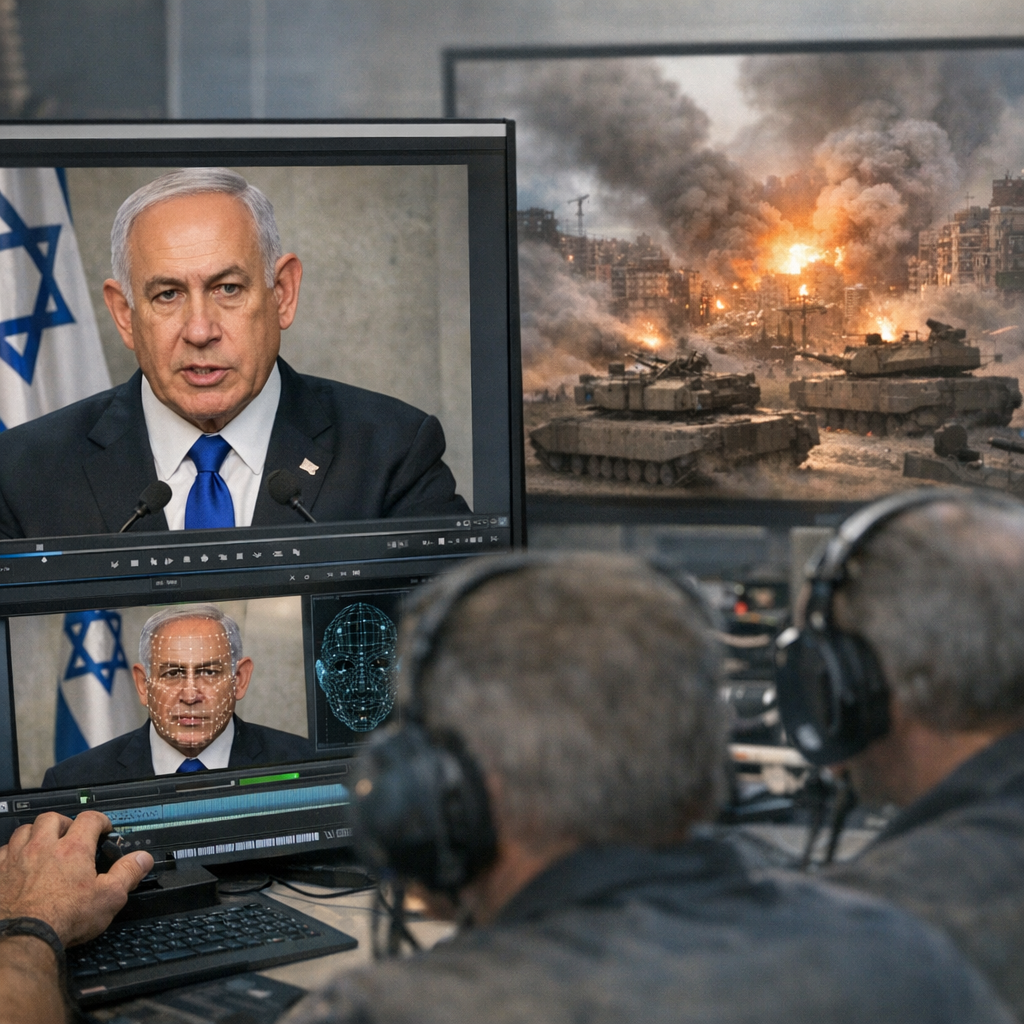
A video clip purportedly showing Israeli Prime Minister Benjamin Netanyahu addressing the public with the words “Yes, I’m alive” has ignited debate over the growing role of artificial intelligence in shaping wartime narratives and misinformation.
The clip, circulated widely across social media platforms, drew immediate attention amid heightened tensions in the region. Its timing and content prompted confusion among viewers, many of whom questioned whether the footage was authentic or generated using AI tools. Analysts and digital forensics observers quickly weighed in, noting inconsistencies that suggested the video may have been manipulated or entirely fabricated.
The Economic Times, in its report titled “Yes, I’m alive’: Netanyahu clip during war triggers debate on AI, fake narratives,” highlighted how the incident underscores a broader concern: the increasing sophistication of AI-generated media and its ability to blur the line between reality and fabrication, particularly during periods of conflict when accurate information is both critical and scarce.
Experts warn that such content can have real-world consequences. In volatile environments, misleading or false messages attributed to political leaders can influence public perception, incite panic, or even affect strategic decisions. The Netanyahu clip has become a case study in how quickly questionable content can gain traction before being verified.
The episode also reflects a shifting media landscape in which traditional verification processes struggle to keep pace with the speed and scale of digital dissemination. Armed with increasingly accessible AI tools, creators of disinformation can produce convincing audio and video content with minimal resources, complicating efforts by journalists, governments, and technology companies to maintain information integrity.
Policy analysts argue that the incident highlights the urgent need for robust safeguards, including improved detection technologies, clearer labeling standards for synthetic media, and greater public awareness. Social media platforms, meanwhile, face mounting pressure to enhance their moderation systems without infringing on free expression.
As conflicts increasingly unfold in tandem with digital information battles, the Netanyahu clip serves as a warning of how easily narratives can be distorted. The challenge for institutions and audiences alike lies in distinguishing credible reporting from engineered illusions in an era where seeing is no longer believing.