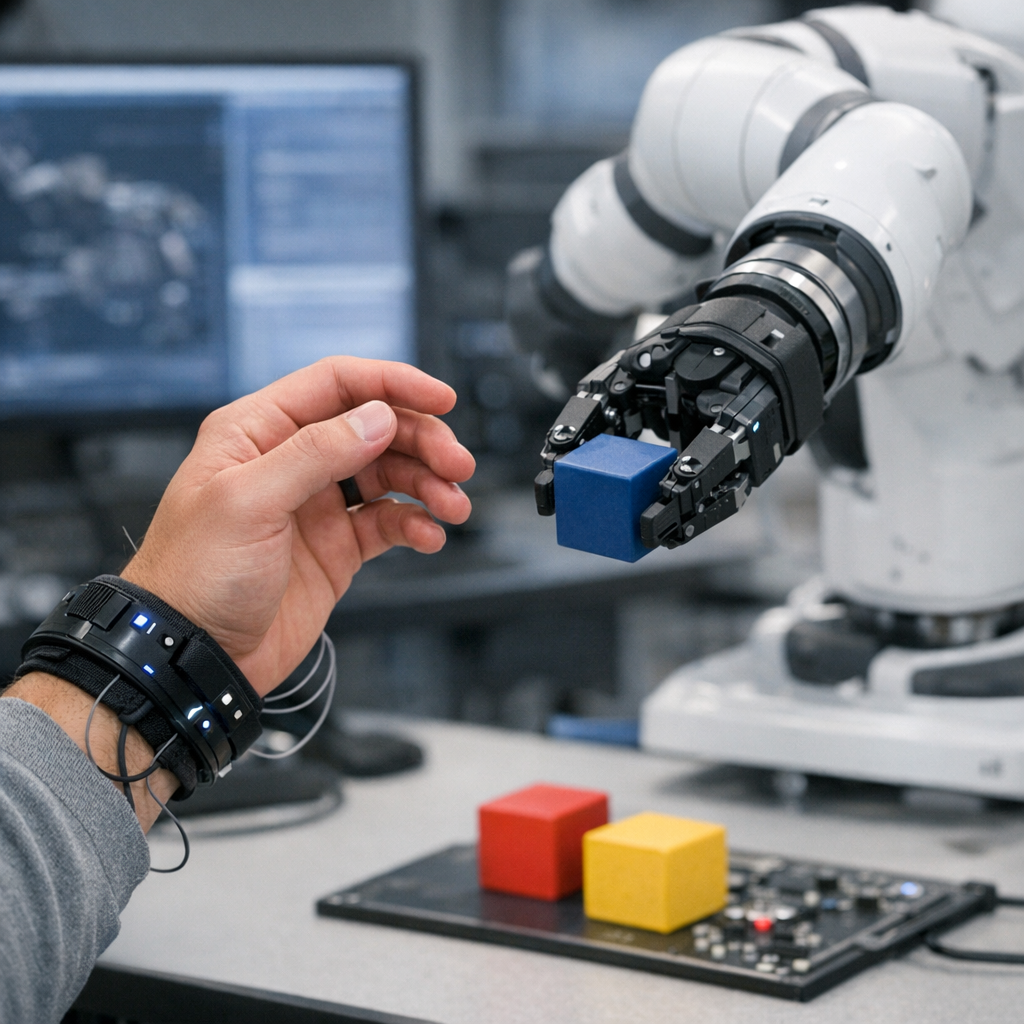
Researchers have developed a wrist-worn device capable of translating human intent into precise robotic movement, a breakthrough that could reshape how people interact with machines in industrial and assistive settings. The innovation, detailed in the Tech Xplore article “Wristband enables wearers to control robotic movements,” points to a future where controlling robotic systems may be as intuitive as moving one’s own hand.
The device functions by detecting electrical signals generated by muscle activity in the wearer’s forearm. These signals, often referred to as electromyographic data, are interpreted by onboard algorithms that translate subtle muscular intentions into digital commands. Rather than requiring large gestures or manual controls, the system can infer intended motion from minimal physical input, allowing for a more seamless and natural interface.
Unlike traditional control mechanisms that rely on joysticks, touchscreens, or complex programming, the wristband removes several layers of friction between human operators and machines. Early demonstrations suggest that users can guide robotic arms, manipulate objects, or perform coordinated tasks with relatively little training. This accessibility could make advanced robotics more usable in environments where speed, precision, and ease of use are critical.
The implications extend beyond industrial automation. In rehabilitation and assistive technology, the system may help individuals with mobility impairments regain functional control through robotic prosthetics or supportive devices. By amplifying subtle muscle signals, the technology could enable movements that would otherwise be difficult or impossible, providing a more responsive and personalized experience than existing solutions.
Researchers emphasize that refining accuracy and reducing signal noise will be key to broader adoption. Human muscle signals can vary significantly between individuals and even within the same user over time, posing challenges for consistent interpretation. Continued advances in machine learning are expected to improve how the system adapts to these variations, making it more reliable in real-world settings.
The development underscores a broader trend toward more intuitive human-machine interfaces, where technology fades into the background and responds directly to natural human intent. As highlighted in Tech Xplore’s coverage, the wristband represents a step toward integrating robotics more seamlessly into everyday life, potentially transforming fields ranging from manufacturing to healthcare.
While still in development, the technology signals a shift away from traditional control paradigms toward systems that respond fluidly to the human body itself. If successfully scaled, such interfaces could redefine the boundaries between human capability and robotic assistance.