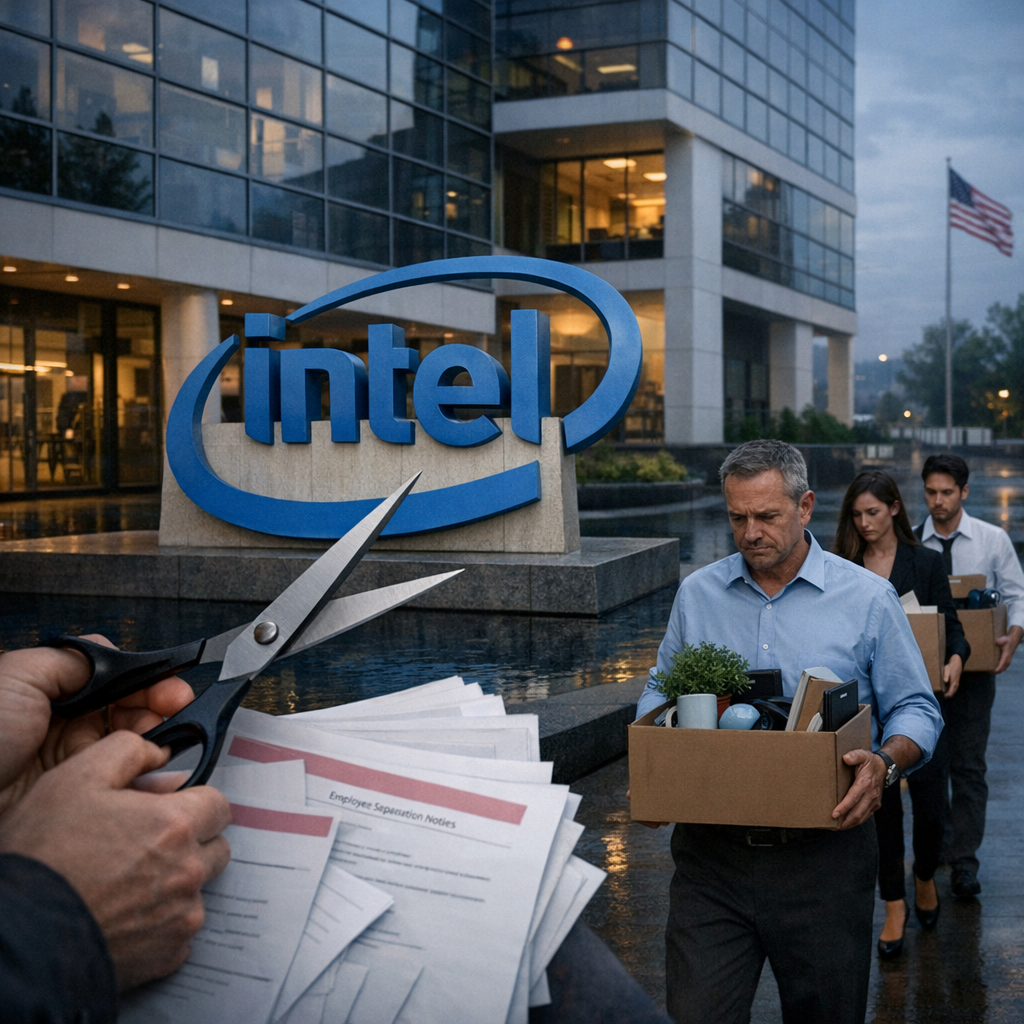
Intel is preparing another round of workforce reductions as it continues an aggressive effort to cut costs and refocus its business, according to a report by TechTime News. The outlet’s article, titled “인텔, 또 대규모 구조조정… 수천명 감원 검토,” said the company is reviewing plans that could eliminate thousands of jobs, underscoring the depth of the restructuring pressure bearing down on the U.S. chipmaker.
The report comes as Intel remains caught between several demanding transitions: rebuilding competitiveness in manufacturing, defending market share in PCs and servers against resurgent rivals, and funding an expensive multiyear push to expand foundry services. Each of those priorities requires capital and specialized talent, yet Intel has also been signaling to investors that spending discipline is non-negotiable after years of missed product cycles, margin compression, and uneven execution.
TechTime News described the contemplated cuts as large-scale and ongoing, rather than a one-off adjustment, reflecting a broader reorganization intended to simplify the company and reduce operating expenses. While Intel has periodically streamlined teams in recent years, the renewed scale suggested in the report points to a more sweeping reset of headcount across functions that may include overlapping roles created during earlier expansion phases.
For Intel, the challenge is that cost cutting alone cannot solve structural issues in a sector where leadership depends on sustained investment, rapid design iteration, and reliable manufacturing output. The company is simultaneously ramping advanced process technologies, reorganizing product roadmaps to regain performance leadership, and courting external customers for its manufacturing arm. Those initiatives demand not only money but stable engineering and operations teams capable of delivering on tight schedules. Significant reductions, if not carefully targeted, can slow decision-making, weaken institutional knowledge, and complicate already complex turnarounds.
At the same time, the competitive environment is unforgiving. In data centers, buyers have been diversifying away from a single-vendor model, weighing alternatives based on performance per watt, total platform cost, and the ability to accelerate AI workloads. In PCs, demand has been uneven and sensitive to macroeconomic shifts, with vendors cautious about inventory. Meanwhile, the rapid rise of AI infrastructure has shifted the industry’s profit pools toward specialized accelerators and tightly integrated platforms, forcing legacy CPU leaders to adapt both product strategy and ecosystem partnerships.
The workforce review described by TechTime News also highlights a broader reality of the semiconductor business in 2026: cyclical demand swings now collide with the need for constant, capital-intensive modernization. Governments in the United States and Europe have encouraged domestic chip production with incentives, but the cost of building and operating cutting-edge fabs remains immense, and returns depend on high utilization and strong execution. For a company trying to be both a leading product vendor and a competitive foundry, routine belt-tightening can become a recurring feature rather than a temporary fix.
Intel has not, in the TechTime News account, detailed the timing, scope, or departmental breakdown of the cuts under consideration. That leaves employees, suppliers, and regional economies that host Intel sites watching closely for signs of how the company will balance austerity with the engineering scale required for its turnaround. If Intel proceeds, investors will likely focus on the potential savings and any accompanying restructuring charges, while customers and partners will look for reassurance that product delivery and support will not suffer.
The report adds to growing evidence that Intel’s transformation is entering a more severe phase, one in which management is prepared to make painful staffing decisions to preserve financial flexibility. Whether those moves translate into improved competitiveness will depend less on the headline number of job reductions than on how precisely Intel aligns its remaining resources with the technologies and products that can restore momentum.