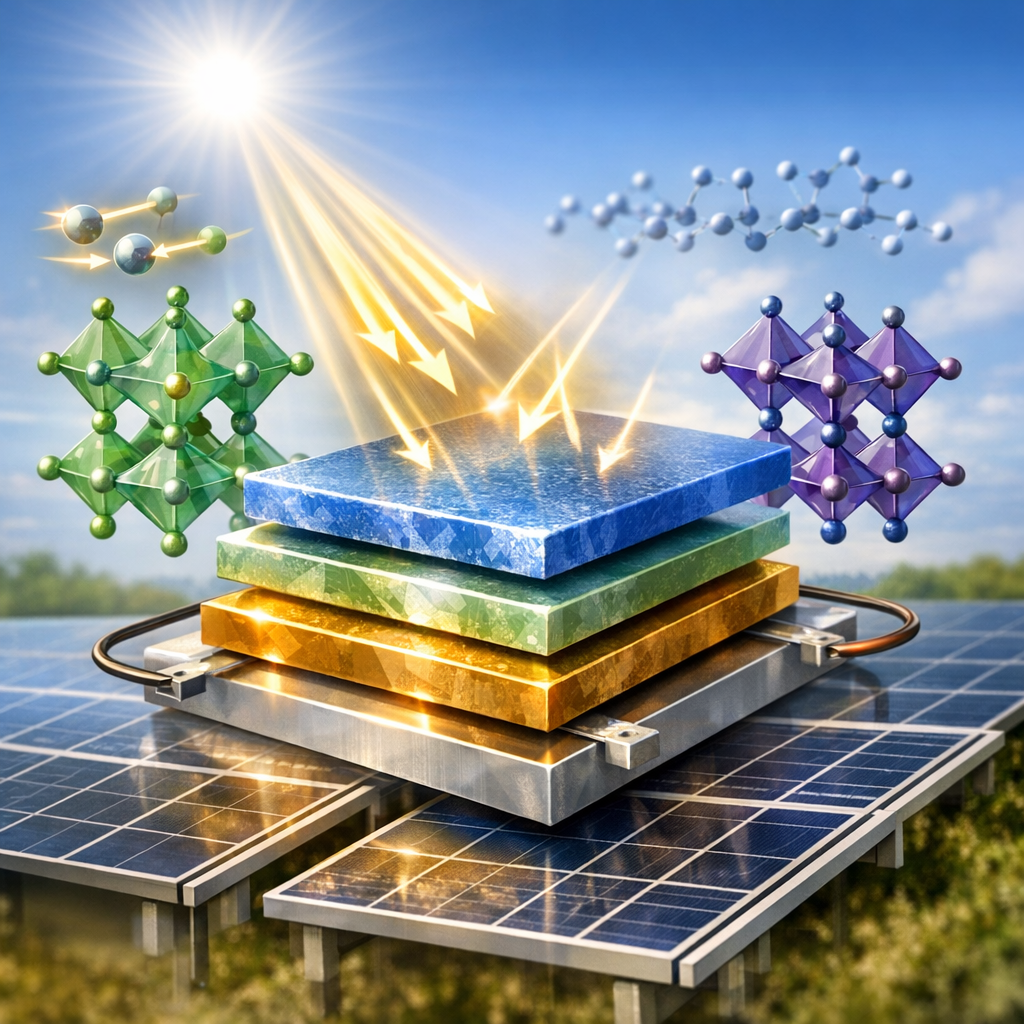
A newly reported advance in solar cell design could help address one of the persistent challenges in tandem photovoltaic technologies, potentially improving both efficiency and stability. According to an article titled “Symmetrical 2D perovskite boosts tandem solar cell performance,” published by Tech Xplore, researchers have engineered a novel material structure that enhances how layered solar cells capture and convert sunlight.
Tandem solar cells, which stack multiple light-absorbing layers to capture a broader spectrum of sunlight, have long been regarded as a promising path to surpass the efficiency limits of conventional single-junction silicon cells. However, their performance is often constrained by instability in the materials used, particularly at the interfaces between layers. Perovskites, a class of materials known for their strong light absorption and tunable properties, have emerged as key candidates for tandem designs, but they can degrade under environmental stress.
The new research centers on a symmetrical two-dimensional perovskite structure that appears to address some of these limitations. By carefully designing the molecular arrangement of the perovskite layer, the researchers achieved improved structural uniformity and enhanced resistance to degradation. This symmetry reduces defects and irregularities that typically act as points of weakness in solar cells, allowing for more efficient charge transport and longer operational lifetimes.
One of the core challenges in tandem cells is maintaining compatibility between different layers, particularly when combining perovskites with silicon. Mismatches in chemical or physical properties can lead to energy losses or accelerated wear. The symmetrical 2D perovskite layer described in the Tech Xplore report appears to create a more stable interface, minimizing these losses and improving overall device performance.
The study also highlights gains in power conversion efficiency, although the precise figures depend on experimental conditions. The improved material not only boosts the initial efficiency of the tandem cell but also helps preserve that performance over time, an important consideration for commercialization.
While the findings remain at a research stage, they contribute to a growing body of work aimed at making tandem solar cells more viable for large-scale deployment. If the approach can be replicated and scaled, it could help lower the cost per watt of solar energy and accelerate the adoption of high-efficiency photovoltaic technologies.
Researchers caution that further work is needed to test long-term durability under real-world conditions and to integrate the material into manufacturing processes. Nonetheless, the development represents a meaningful step toward addressing the stability-efficiency trade-off that has limited perovskite-based tandem cells.
As the solar industry continues to search for ways to push beyond current efficiency ceilings without compromising reliability, innovations like symmetrical 2D perovskites may play a central role in shaping the next generation of photovoltaic systems.