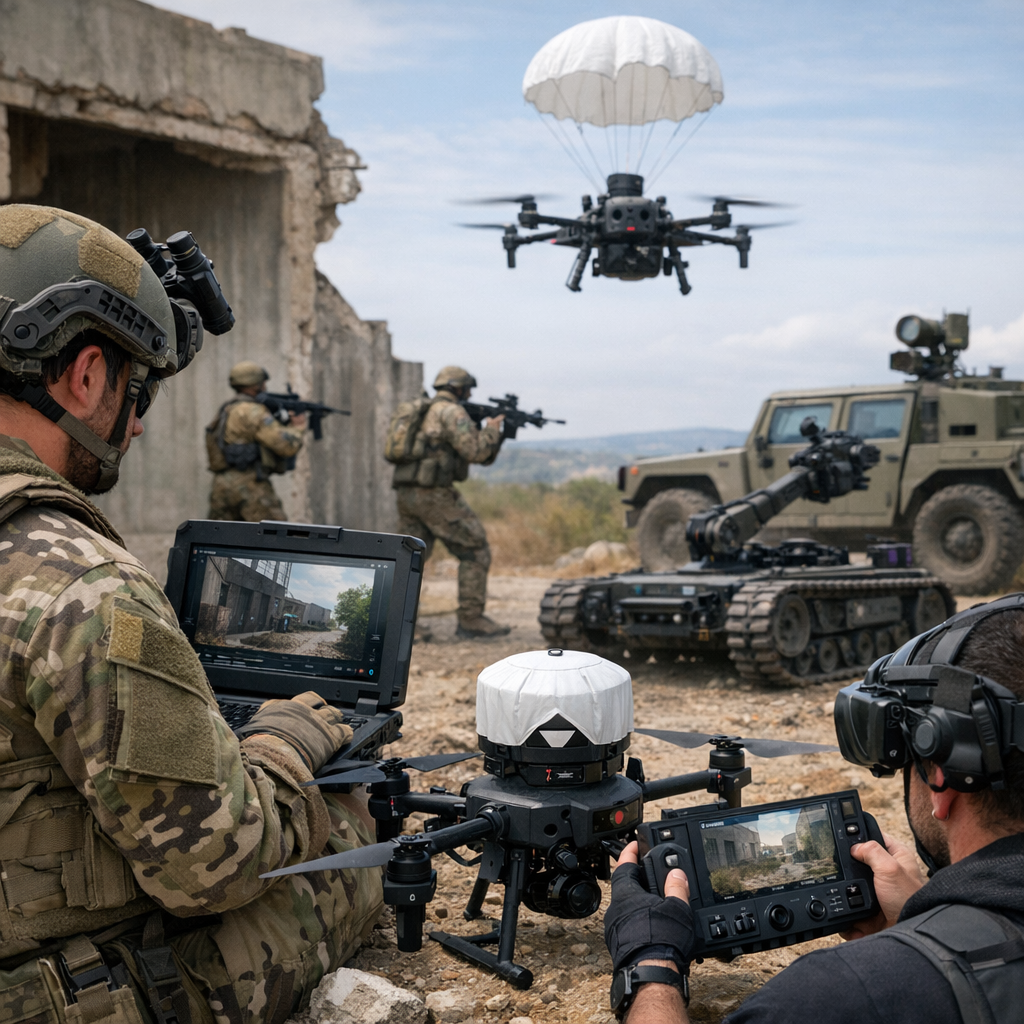
ParaZero Technologies is accelerating a strategic pivot toward defense and homeland security applications, announcing a partnership with Israeli drone company Xtend that will integrate ParaZero’s safety and autonomy systems into Xtend’s human-guided unmanned platforms.
The development was first reported by the website TechTime.News in an article titled “ParaZero deepens defense shift with Xtend partnership,” which described the agreement as the latest step in ParaZero’s effort to broaden beyond its commercial drone roots and align more closely with government and security customers.
Under the partnership, the companies plan to combine ParaZero’s technologies—best known for aerial safety solutions designed to reduce risks during drone operations—with Xtend’s operating concept that keeps a human “in the loop” while enabling advanced control and autonomy. The pairing is aimed at drones used in complex, high-stakes environments where regulators and customers increasingly demand built-in safeguards as well as flexible mission capabilities.
The announcement comes amid a broader shift in the unmanned systems sector, where conflicts and rising homeland security needs have sharpened demand for drones that can be rapidly deployed, operated reliably in dense environments, and adapted to changing conditions. In that context, safety systems such as automated recovery mechanisms and other protective layers are increasingly positioned not just as compliance tools but as mission enablers—particularly for agencies operating near civilians, critical infrastructure, or in contested urban terrain.
For ParaZero, the deal signals a continued effort to reposition its technology portfolio and commercial narrative. The company has historically been associated with drone safety products marketed to commercial operators, but recent moves suggest an emphasis on defense-aligned partnerships and integration opportunities—an approach that can provide larger contract potential and more durable demand, though typically with longer procurement cycles and stringent performance requirements.
Xtend, meanwhile, has built its brand around ergonomic control systems and human-guided drone operations, a model that has gained traction in security settings as agencies seek to balance autonomy with accountability and real-time judgment. By integrating additional safety and autonomy layers, the companies appear to be targeting customers that require both operational effectiveness and a clear risk-mitigation framework.
The partnership also reflects intensifying competition among drone technology providers to become embedded in larger platforms rather than selling standalone components. In the defense market in particular, platform integration can be decisive, as customers favor solutions that arrive preconfigured, interoperable and supportable at scale.
Financial terms and timelines for deployment were not detailed in the announcement. Even so, the move underscores how drone firms are increasingly defining strategy around defense and government demand, where the convergence of autonomy, safety engineering and human-guided control is shaping procurement priorities.