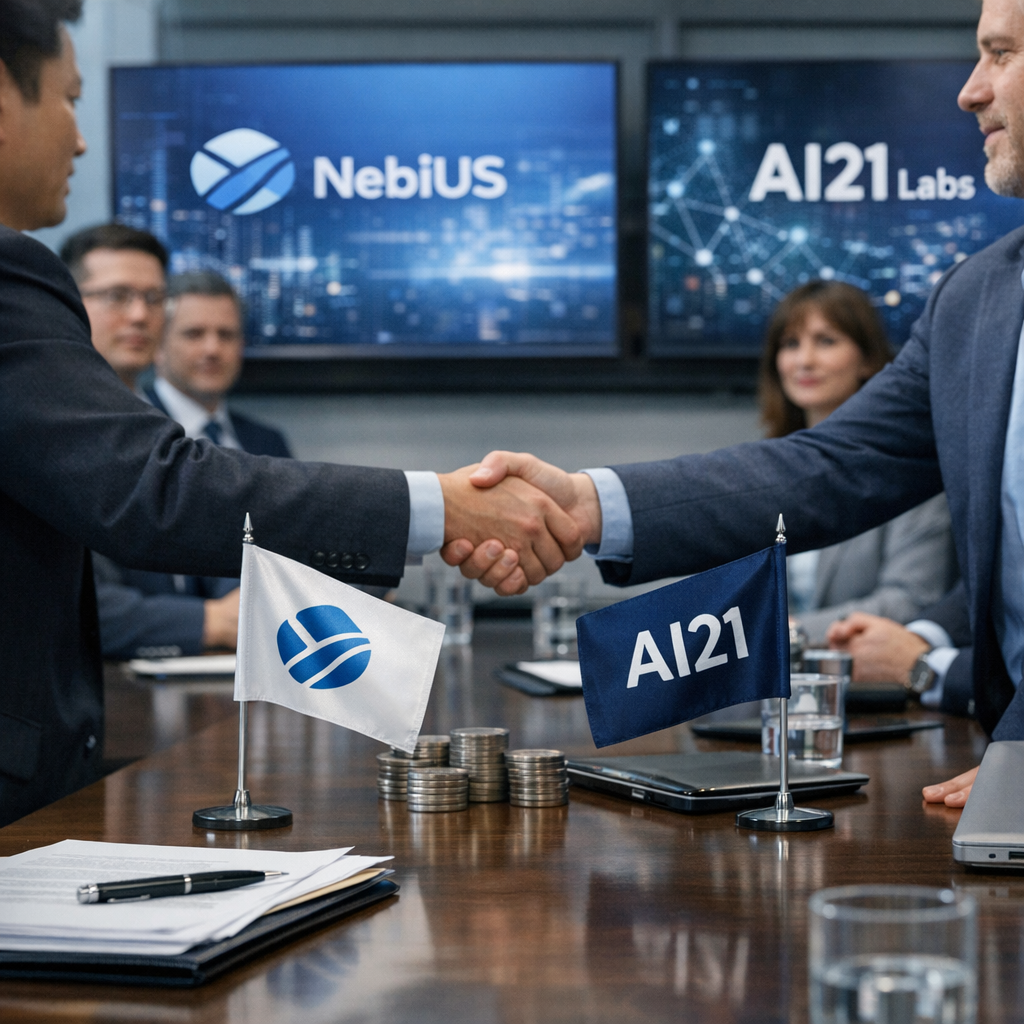
NebiUS Group, the Amsterdam-listed cloud and AI infrastructure company, is in talks to acquire Israeli generative AI startup AI21 Labs, according to a report by the Israeli business outlet Globes. The report, titled “NebiUS in talks to acquire AI21labs – report,” said the discussions point to a possible sale price of as much as $1.5 billion, a figure that would place the deal among the more significant exits in Israel’s fast-evolving artificial intelligence sector.
If completed, the transaction would reflect a broader shift in the generative AI market, where infrastructure providers and cloud platforms are increasingly pursuing proprietary models and enterprise-facing applications to differentiate themselves and secure higher-margin revenue streams. For NebiUS, which has been building out capacity to meet surging demand for AI compute, acquiring a company with established large language model capabilities could offer a faster route to an integrated “full stack” offering than developing comparable assets internally.
AI21 Labs is one of Israel’s best-known generative AI companies, recognized for developing foundation models and tools aimed at business users, with an emphasis on reliability and controllability for enterprise deployments. In a market dominated by a small number of global players, AI21 has sought to carve out space by focusing on use cases such as text generation and summarization tailored for corporate workflows, alongside model access through APIs.
Deal talks at the level reported by Globes underscore the premium still attached to differentiated AI model talent and intellectual property, even as the industry grapples with intensifying competition, high training and inference costs, and questions about long-term pricing power. A purchase price reaching the reported ceiling would also signal confidence that AI21’s technology can be scaled commercially and embedded into larger distribution channels—an advantage infrastructure-centric companies can offer.
The conversations also highlight growing consolidation pressures across the AI landscape. Since late 2023, many startups have faced a tougher funding environment and rising compute expenses, pushing some toward strategic partnerships or M&A as a way to accelerate go-to-market execution. For larger companies, acquisitions can secure specialized research teams and mature product lines amid an ongoing scramble for scarce AI talent.
Any potential deal would still need to clear the typical hurdles associated with acquisitions of AI companies, including the durability of model performance relative to rapidly advancing open-source alternatives, customer retention as pricing and capabilities shift, and the legal and regulatory risks increasingly tied to generative AI systems. In cross-border transactions, additional scrutiny can arise from data governance requirements and the location of sensitive enterprise workloads.
Neither side has publicly confirmed the terms of the negotiations. Still, the fact that talks have surfaced at all reflects the strategic importance of owning not only the compute and infrastructure layers, but also the models and applications that sit above them. In that sense, the reported discussions between NebiUS and AI21 Labs serve as another marker of how quickly the generative AI market is moving from experimentation to platform-building—and how high the stakes have become for companies seeking to control more of the AI value chain.