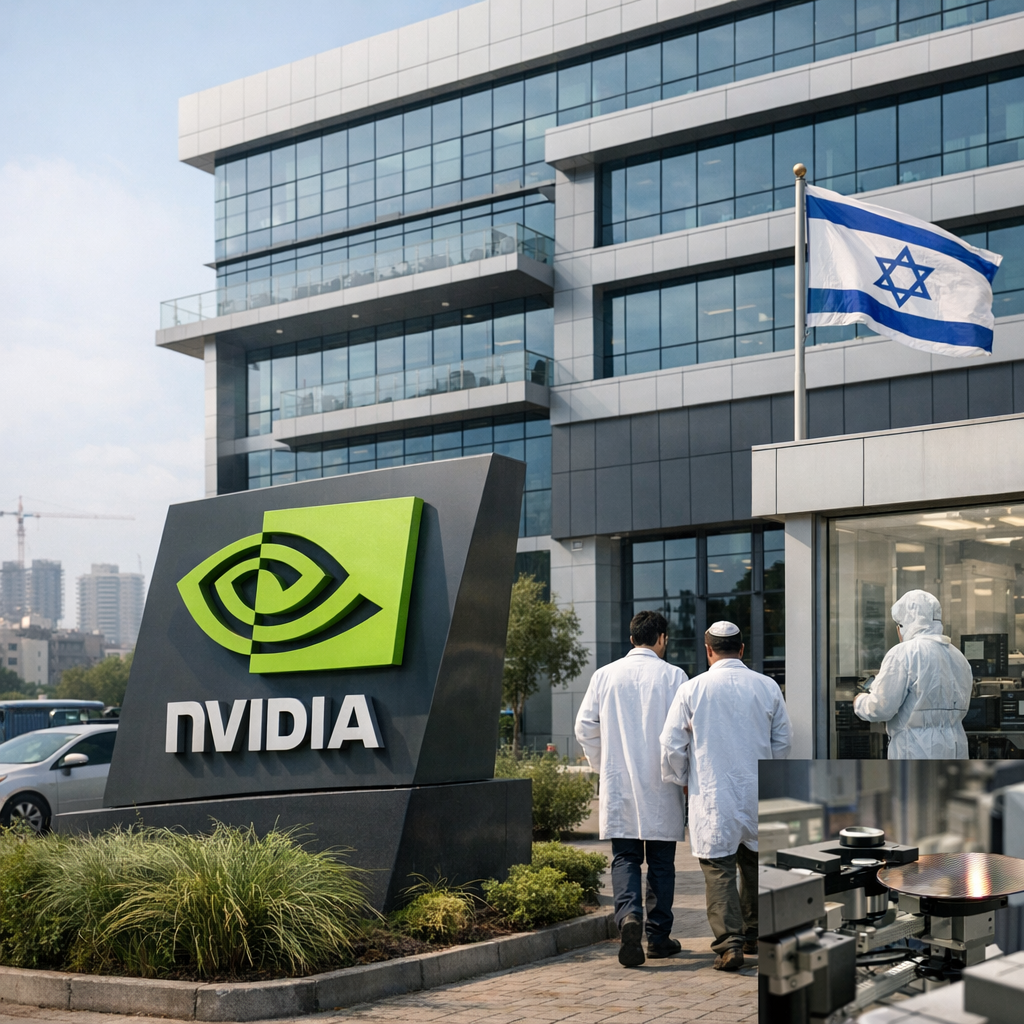
Nvidia is expanding its physical footprint in Israel, leasing additional laboratory space in Rishon LeZion in a move that signals continued investment in local research and development capacity even as the global semiconductor industry weighs costs, supply constraints, and geopolitical uncertainty.
The development was first reported by Globes in an article titled “Nvidia leases space for labs in Rishon LeZion.” According to the report, the company has secured space intended for laboratory activity, adding to a broader presence built in recent years through organic growth and acquisitions. While Nvidia has not positioned the lease as a major strategic shift, the decision to add lab facilities rather than only conventional office space is being read by industry observers as a practical indicator of ongoing engineering work that requires specialized infrastructure, testing environments, and proximity to technical talent.
Israel has become a significant node in Nvidia’s international R&D network, anchored by teams working on high-performance networking, data center technologies, and silicon-related development. The company’s local operations have been shaped in part by previous deals in the country’s chip and networking ecosystem, which helped it scale personnel and technical capabilities. Expanding lab space can support activities ranging from system validation and hardware integration to advanced networking and data center-focused experimentation, areas that have become central to Nvidia’s growth as demand for AI training and inference infrastructure accelerates.
The choice of Rishon LeZion reflects a continued dispersal of high-tech operations beyond the traditional concentration in Tel Aviv and Herzliya, as companies balance costs and accessibility against the need to attract and retain engineers. For multinationals, the ability to secure suitable facilities quickly has become a growing consideration, particularly when labs require power capacity, cooling, security, and space configurations that are more difficult to retrofit in standard office towers.
The expansion comes as Nvidia’s business trajectory is increasingly tied to enterprise and cloud investment in AI compute. That demand has put a premium on rapid development cycles and robust testing capability across hardware and networking stacks. Additional lab capacity can shorten iteration times and reduce bottlenecks associated with shared testing resources, a pragmatic advantage as timelines tighten and product roadmaps become more ambitious.
For the Israeli tech sector, the move carries symbolic weight. In recent years, the domestic market has faced headwinds including tighter global financing conditions and heightened sensitivity among multinationals to operational risk. Against that backdrop, a decision to commit to additional specialized space suggests a degree of confidence in the continuity of core engineering activity. It also reinforces the competitive position Israel maintains in domains aligned with Nvidia’s priorities, including advanced networking, systems, and semiconductor-adjacent engineering.
While the full scope of the labs’ intended use has not been publicly detailed, the lease underscores a pattern in which global technology companies deepen their Israeli operations not only through headcount but through infrastructure that supports long-term product development. In an industry where engineering capacity is constrained as much by facilities as by talent, the addition of lab space is a concrete signal of intent: to keep building where the company believes it can sustain an edge.