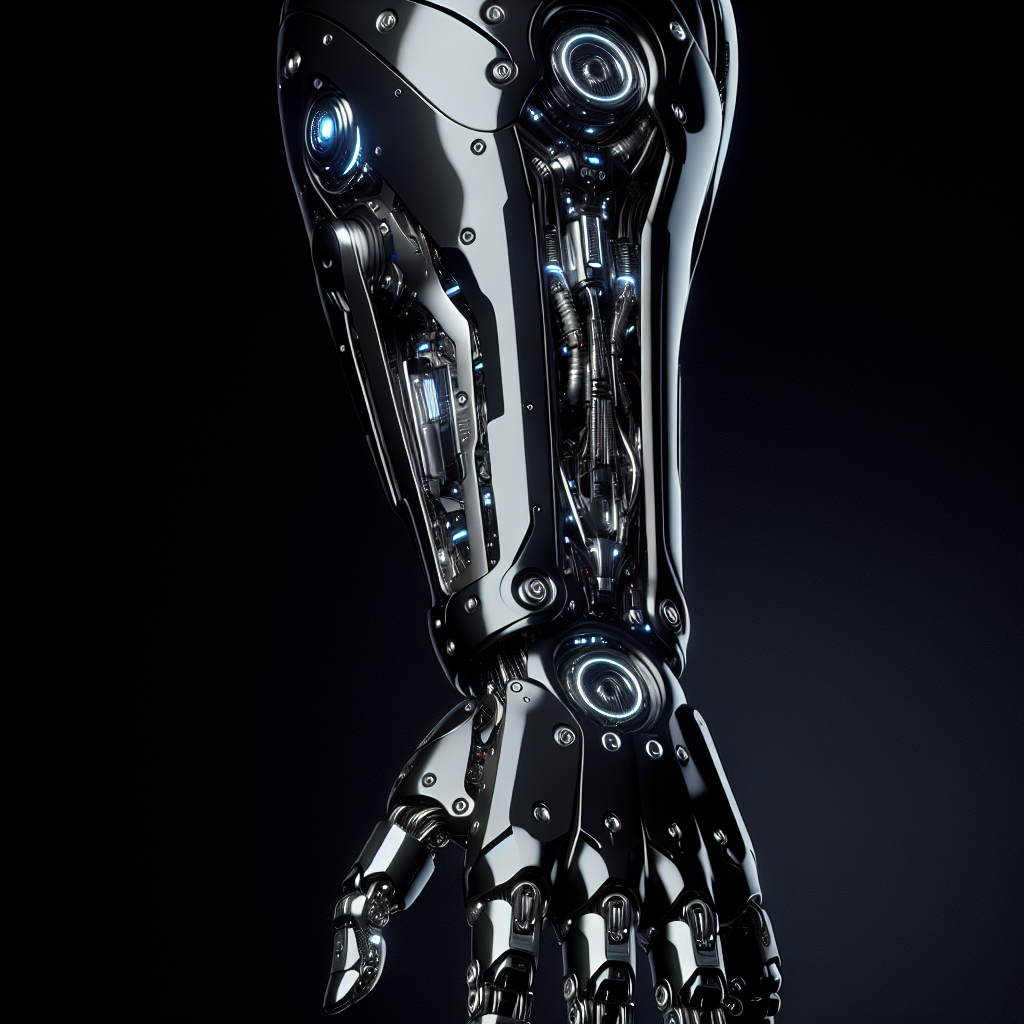
In a development that may significantly expand the capabilities of assistive and wearable robotics, researchers in Japan have unveiled an autonomous robotic arm that operates independently of the user’s own limbs, promising new possibilities for enhanced human-machine integration. As reported in the article “Autonomous robotic arm adds a new body part” published on Tech Xplore, the device represents a compelling advance in the pursuit of artificial “supernumerary limbs”—prosthetic appendages designed not to replace lost limbs, but to augment the human body.
Developed by a team led by Professor Masahiko Inami at the University of Tokyo, the system features a robotic arm mounted near the user’s shoulder, controlled by artificial intelligence rather than direct human input. It is engineered to understand and anticipate cooperative tasks, functioning as a self-directed co-worker rather than a tool obeying manual commands. The research, detailed in a study published on February 8 in Science Robotics, integrates motion capture technology and pre-trained behavior algorithms to allow the arm to act autonomously in response to contextual cues and the user’s goal-oriented actions.
This experimental concept draws from long-standing ideas in science fiction and human augmentation theory, but the Japanese team emphasizes its practical application in real-world scenarios. By freeing the user from having to consciously direct the robotic limb, the device aims to reduce cognitive burden while enhancing functional capabilities in activities requiring multiple points of interaction—such as holding objects steady, assisting with complex assembly, or offering support during precision tasks.
Early trials demonstrated the arm’s ability to recognize shared objectives with its human partner and act accordingly, such as holding down an object while the user cuts it, or passing tools at appropriate moments. Through this collaborative operation, the system resembles not an extension of the user’s own arm, but a semi-autonomous assistant attached directly to the body.
The research intersects with broader trends in human-robot interaction, especially in the rehabilitation, manufacturing, and service industries. By refining the machine’s capacity to understand social and physical contexts, the team hopes to contribute to a future where wearable robots complement human versatility rather than sharply delimit task boundaries.
Despite the promising result, the researchers acknowledge several challenges ahead, including ensuring user safety, refining decision-making algorithms, and addressing public acceptance. The psychological impact of having an independently operating device affixed to one’s body is also an area of ongoing investigation.
Still, the findings mark a significant step toward a new category of human-machine collaboration. As Professor Inami noted, the ultimate aim is not to replicate human behavior with machines, but to create a new form of embodied intelligence—what he describes as expanding the “self” through artificial limbs that think and act alongside us.
As interest in augmentative robotics continues to grow, the autonomous robotic arm prototype offers a glimpse into a future where mechanical additions to the human body are not merely responsive, but proactively cooperative.