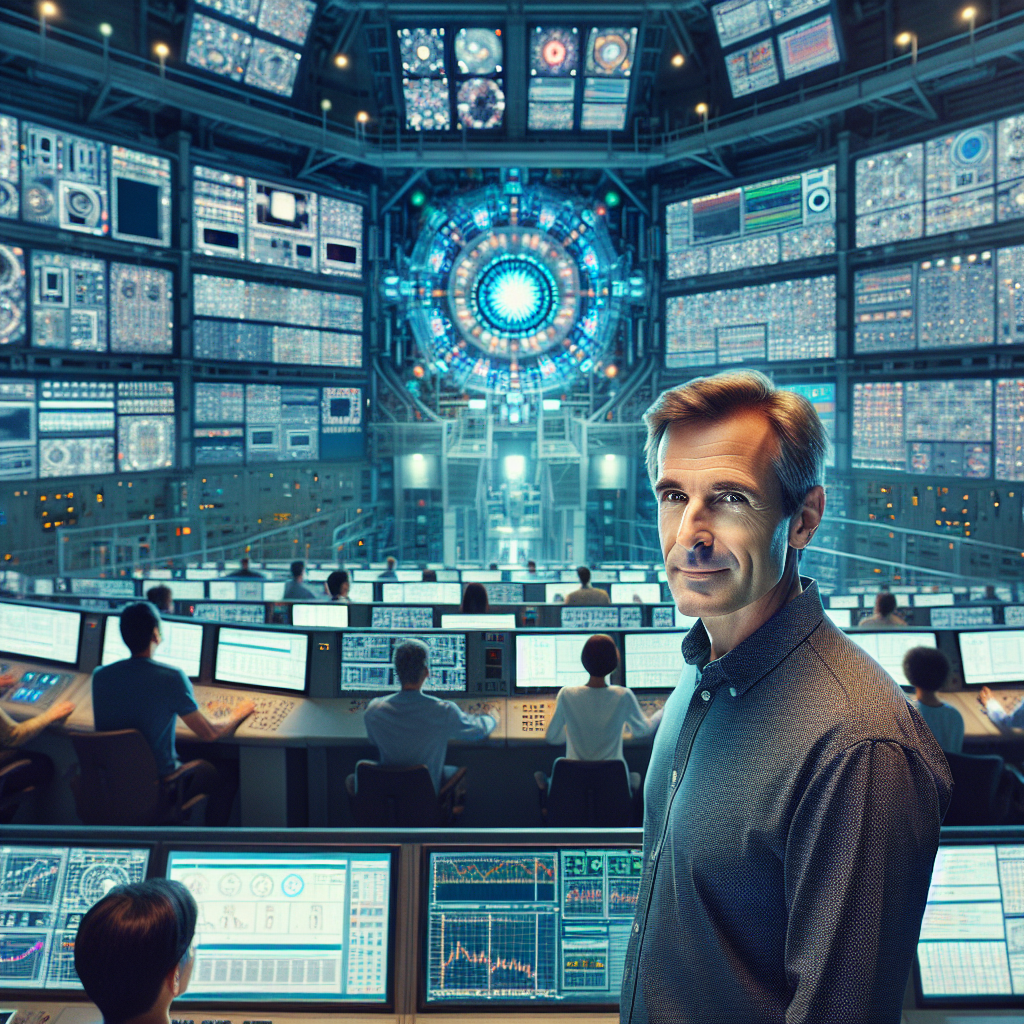
In an era where scientific exploration continues to stretch the boundaries of human understanding, the leadership of landmark research institutions remains pivotal. According to a recent feature titled “The Man Taking Over the Large Hadron Collider,” published by StartupNews.fyi, Dr. Lucas Ehrmann has been appointed as the new Director-General of CERN, the European Organization for Nuclear Research. His stewardship comes at a crucial moment for the world’s most powerful particle accelerator as it prepares to enter its next experimental phase.
Dr. Ehrmann, a German physicist with an extensive background in quantum field theory and high-energy collisions, will oversee operations at the Large Hadron Collider (LHC), which lies beneath the Franco-Swiss border near Geneva. Known for its groundbreaking experiments, including the 2012 discovery of the Higgs boson, the LHC is now poised for a series of upgrades and data-intensive projects designed to probe deeper into the fabric of the universe.
As highlighted by StartupNews.fyi, Ehrmann brings not only academic rigor but also a strategic vision aimed at balancing scientific ambition with operational stability. His predecessor, Dr. Fabiola Gianotti, served two consecutive terms and was widely credited with strengthening CERN’s global partnerships and navigating its research agenda through the challenges of the COVID-19 pandemic. Ehrmann’s appointment signals a continuity of purpose but also a potential recalibration as new technologies and theories reshape the field.
Key among Ehrmann’s priorities is the High-Luminosity LHC (HL-LHC) project, set to dramatically increase the collision rate within the accelerator, thereby allowing physicists more precise measurements and a better chance of identifying rare subatomic phenomena. With construction ongoing and a projected operational date of 2029, the HL-LHC reflects the institution’s long-term commitment to fundamental science.
The StartupNews.fyi article notes Ehrmann’s emphasis on interdisciplinary collaboration as central to his leadership. In recent interviews, he has emphasized the importance of data sharing, open-source modeling, and greater cooperation between the public and private sectors. These ambitions resonate with the evolving landscape of particle physics, which increasingly interfaces with artificial intelligence, quantum computing, and advanced materials science.
Ehrmann’s tenure will also coincide with rising questions about the socioeconomic impact and environmental footprint of large-scale scientific infrastructure. Managing public expectations and maintaining funding from CERN’s 23 member states will require diplomatic acumen as well as clear communication about the broader benefits of fundamental research.
As the Large Hadron Collider enters a new chapter, Dr. Ehrmann’s leadership will be watched closely by both the scientific community and the governments that support it. His ability to unite cutting-edge theory with practical execution may determine not only the success of his term but also the trajectory of high-energy physics in the coming decades.