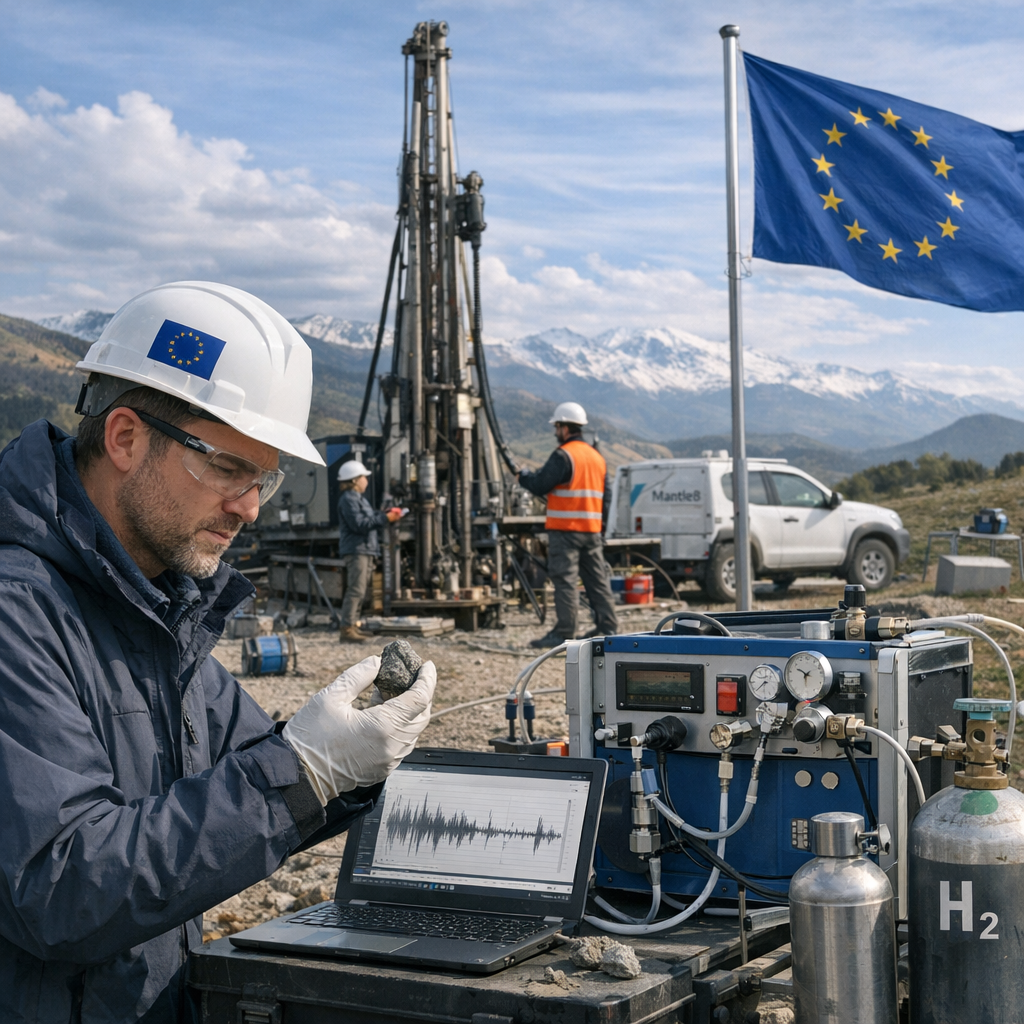
A French start-up working on the emerging field of naturally occurring hydrogen has received significant European support as policymakers seek new pathways to clean energy. According to a report titled “EU awards Mantle8 €2.06m to advance natural hydrogen technologies in Grenoble,” published by the website Innovation News Network, the European Union has awarded €2.06m to Mantle8 to accelerate the development of technologies aimed at identifying and extracting naturally produced hydrogen from the Earth’s subsurface.
Mantle8, based in Grenoble, is focusing on what scientists often refer to as “natural” or “white” hydrogen. Unlike hydrogen produced through industrial processes using fossil fuels or electricity, natural hydrogen forms through geological reactions in the Earth’s crust and mantle. Researchers believe that if these naturally occurring deposits can be reliably located and economically produced, they could provide a low‑carbon energy source with minimal processing requirements.
The EU funding is intended to help the company advance the scientific and technical tools needed to detect these underground hydrogen accumulations. Mantle8 has been developing geoscience models and exploration techniques aimed at understanding how hydrogen is generated and stored within geological formations. The funding will allow the company to refine its subsurface imaging capabilities, expand field research, and build a more comprehensive framework for locating potential hydrogen-bearing zones.
Scientists have increasingly turned their attention to natural hydrogen in recent years as global energy systems look for alternatives that can reduce greenhouse gas emissions. While most hydrogen today is manufactured through energy-intensive industrial methods, natural hydrogen occurs when water interacts with iron-rich rocks deep beneath the surface in a process known as serpentinisation. In some cases, gas generated by these reactions can migrate upward and accumulate in reservoirs.
Although scientific interest has been growing, the sector remains at an early stage. Significant uncertainties remain about how abundant these natural deposits might be and whether they can be produced consistently at commercial scale. Companies such as Mantle8 are attempting to bridge this gap between geological research and practical energy development.
The European Union’s financial backing reflects a broader policy interest in diversifying future hydrogen supply. Hydrogen has been positioned as a key component of Europe’s long-term decarbonisation strategy, particularly for sectors that are difficult to electrify, such as heavy industry and long-distance transport. Supporting early-stage exploration technologies could help determine whether natural hydrogen can become a meaningful contributor to that strategy.
Grenoble, where Mantle8 is headquartered, is known for its concentration of research institutions, engineering schools, and technology-focused companies. The region has become a hub for innovation in energy systems and geosciences, providing an environment where startups can collaborate with academic researchers and industrial partners.
According to the Innovation News Network report, Mantle8 plans to use the EU funding to further develop its exploration platform and expand scientific understanding of natural hydrogen systems. If successful, the work could contribute to a new approach to hydrogen production that relies on the Earth’s existing geological processes rather than carbon-intensive industrial methods.
For policymakers facing the challenge of building large-scale clean energy infrastructure, the possibility of naturally occurring hydrogen resources has attracted growing attention. Projects such as Mantle8’s illustrate how early-stage technological research is beginning to explore whether this largely untapped resource could play a future role in Europe’s energy transition.