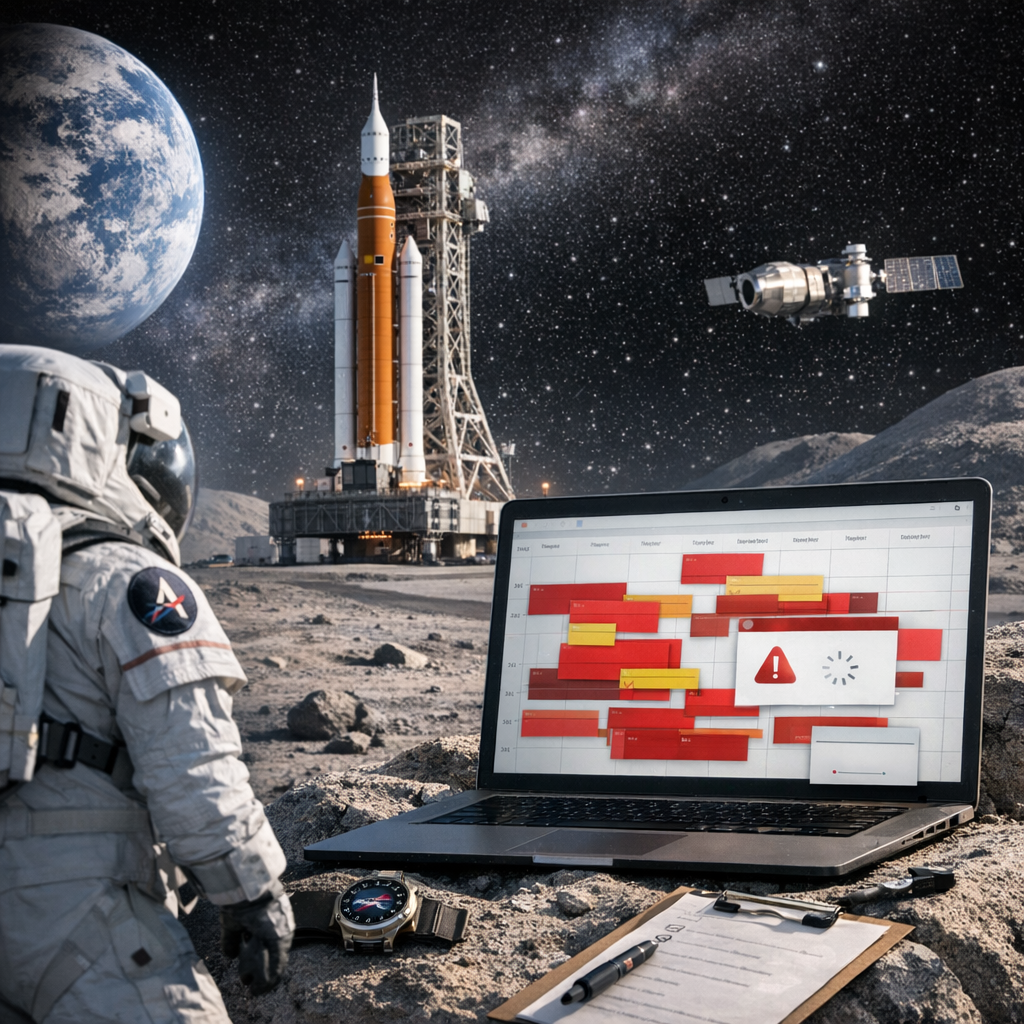
A routine software problem more commonly associated with office workplaces than spaceflight has briefly intersected with NASA’s preparations for its next crewed lunar mission, highlighting the increasingly complex role of commercial technology in human space exploration.
In its article “Artemis II Has a Microsoft Outlook Problem,” Wired reports that NASA engineers and mission planners have recently grappled with issues tied to Microsoft Outlook, the widely used email and calendaring platform, as they coordinate the Artemis II mission. The mission, slated to send astronauts on a crewed flyby of the Moon, represents a critical step in the United States’ return to deep-space human exploration. Yet even as the spacecraft and life-support systems undergo rigorous testing, operational teams on the ground remain reliant on conventional enterprise software to manage schedules, communications, and documentation.
According to the Wired account, the difficulties are not related to spacecraft systems themselves but rather to the infrastructure that supports mission planning and collaboration. Outlook, embedded within NASA’s broader IT ecosystem, has reportedly presented challenges ranging from synchronization delays to scheduling conflicts, complicating coordination across large, distributed teams. While such issues are familiar in corporate environments, their appearance in a high-stakes aerospace context underscores the dependence of modern space agencies on commercial off-the-shelf software.
The Artemis II mission involves thousands of personnel spanning NASA centers, private contractors, and international partners. Maintaining alignment across that network requires precise scheduling and reliable communication tools. Even minor glitches can create friction in workflows that demand exact timing and accountability. Wired notes that these complications have prompted discussions within NASA about redundancy, resilience, and whether traditional productivity tools are sufficient for mission-critical operations.
The episode reflects a broader trend in which space agencies increasingly lean on commercial technologies rather than bespoke, fully proprietary systems. While this approach reduces costs and accelerates development, it also introduces vulnerabilities tied to software not originally designed for mission-critical aerospace environments. As exploration programs scale in complexity, the boundary between everyday digital infrastructure and specialized mission systems continues to blur.
NASA has not suggested that the Outlook-related issues pose any risk to astronaut safety or mission success. Instead, they highlight the often-invisible layer of logistical coordination that underpins major space endeavors. Even as the agency pushes toward long-term lunar presence and eventual missions to Mars, the reliability of seemingly mundane tools remains part of the equation.
The situation serves as a reminder that the success of programs like Artemis II depends not only on rockets and spacecraft but also on the robustness of the digital ecosystems that support them. As Wired’s reporting makes clear, the challenges of deep-space exploration can sometimes begin with something as ordinary as a calendar invite.