:::writing
A recent article published by GeekWire, titled “How AI is changing the business and art of video: from chaos machine to creative catalyst,” examines how rapidly evolving artificial intelligence tools are transforming video production, altering long‑standing creative workflows while raising new questions about quality, authorship, and the economics of media.
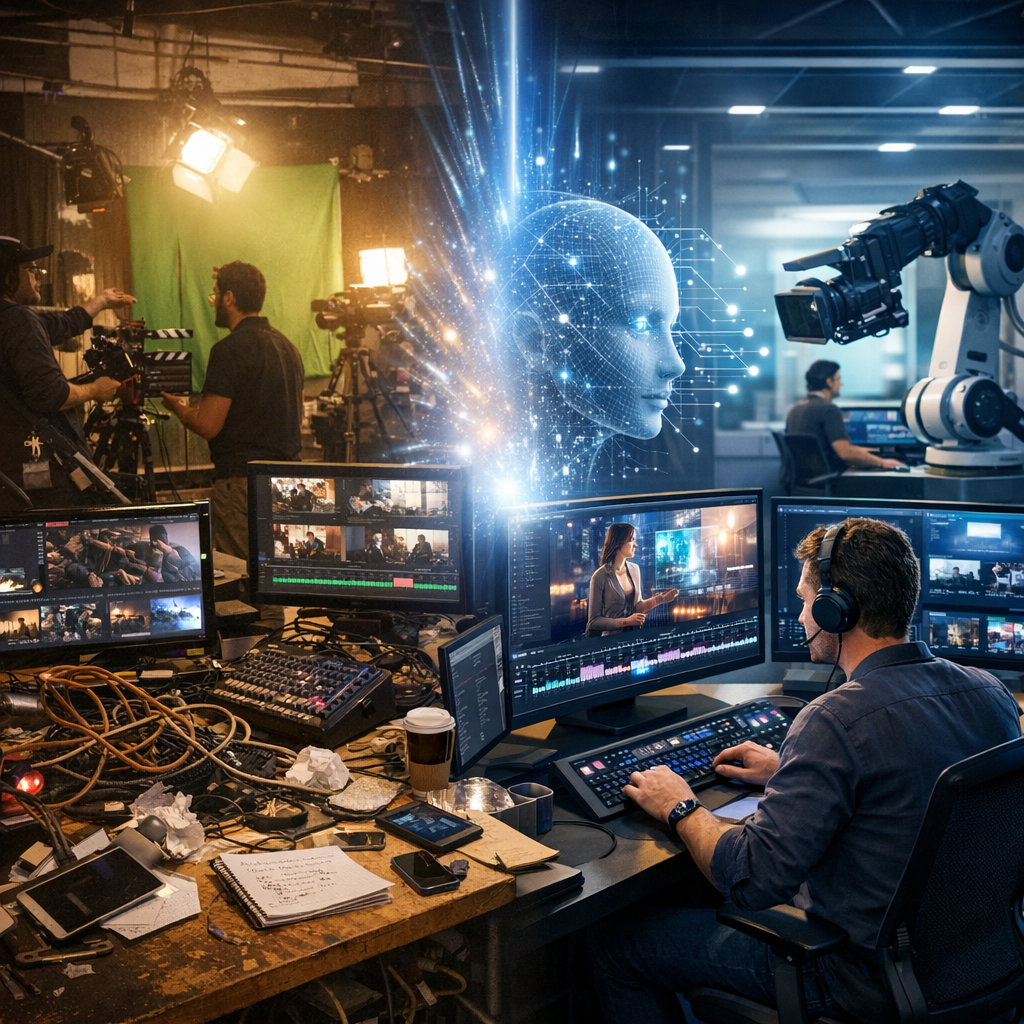
Once viewed primarily as unpredictable experimental tools, generative video systems are increasingly being integrated into professional production environments. Developers and filmmakers say the technology is shifting from what some early observers dismissed as a “chaos machine” into something closer to a collaborative creative tool. The transition reflects the growing capabilities of AI models that can generate imagery, edit footage, simulate camera movement, and assist with script development or storyboarding.
The article describes a period of intense experimentation across the film, advertising, and online video industries. Companies developing generative models are racing to improve realism, control, and continuity in AI‑generated footage. At the same time, production teams are exploring how these tools can reduce costs and accelerate the pace of visual storytelling. Tasks that once required large crews, expensive locations, or complex visual effects pipelines can now be prototyped or even completed with the help of machine‑generated assets.
For many studios and independent creators, the appeal lies in efficiency. Storyboards, animatics, and concept visuals can be generated within minutes rather than days. Advertising agencies are testing AI systems to quickly mock up entire campaigns. Independent filmmakers, who historically faced steep financial barriers, see the technology as a way to compete with larger studios by creating cinematic visuals without comparable budgets.
Yet the technology is far from replacing human creativity. According to GeekWire’s report, many industry professionals treat AI tools less as autonomous creators and more as assistants that accelerate ideation. Directors and designers remain responsible for shaping narrative structure, tone, and artistic direction. What AI often supplies is speed: the ability to iterate through dozens of visual concepts before committing to a final approach.
At the same time, significant challenges remain. One persistent problem is coherence. Early generative video tools could create striking short clips but struggled to maintain stable characters, lighting, or spatial continuity across longer scenes. While newer systems are improving, filmmakers still need to combine traditional production methods with AI outputs to achieve consistent results.
There are also unresolved questions about copyright, ownership, and the training data used to build many generative models. Entertainment companies and creative professionals continue to debate whether AI systems trained on vast media archives are drawing too heavily on existing works without compensation. These concerns overlap with broader labor debates already unfolding across Hollywood and the digital media sector.
Beyond the legal and technical questions, the article suggests that AI is changing how stories themselves may be conceived. Traditionally, visual production followed a linear pipeline: a script would be written, designed, filmed, and edited in sequence. With generative tools, creators can jump between stages of the process, rapidly visualizing scenes or effects while still developing the narrative. That iterative loop, proponents argue, may open new forms of storytelling.
Technology companies, meanwhile, see video generation as one of the most commercially valuable frontiers in artificial intelligence. Video is central to entertainment, advertising, education, and social media, representing a massive global market. As generative models improve, startups and established tech firms alike are investing heavily in tools designed to automate pieces of the video production pipeline.
Still, enthusiasm within the creative community remains measured. Many professionals acknowledge the productivity gains while warning against the assumption that AI can fully substitute for human judgment or artistry. Rather than replacing filmmakers, the most immediate impact may be to reshape creative roles, blending traditional production skills with a growing need to direct and refine machine‑generated output.
As GeekWire notes in “How AI is changing the business and art of video: from chaos machine to creative catalyst,” the shift underway is both technological and cultural. The tools are advancing quickly, but the deeper question is how creators, studios, and audiences will adapt to a world where significant portions of visual media can be generated algorithmically.
For now, the emerging consensus appears to be that AI will not eliminate the creative process so much as compress and reshape it. In that evolving landscape, the challenge for filmmakers and media companies will be learning how to harness the speed and flexibility of generative systems without sacrificing the human insight that gives stories their meaning.
:::