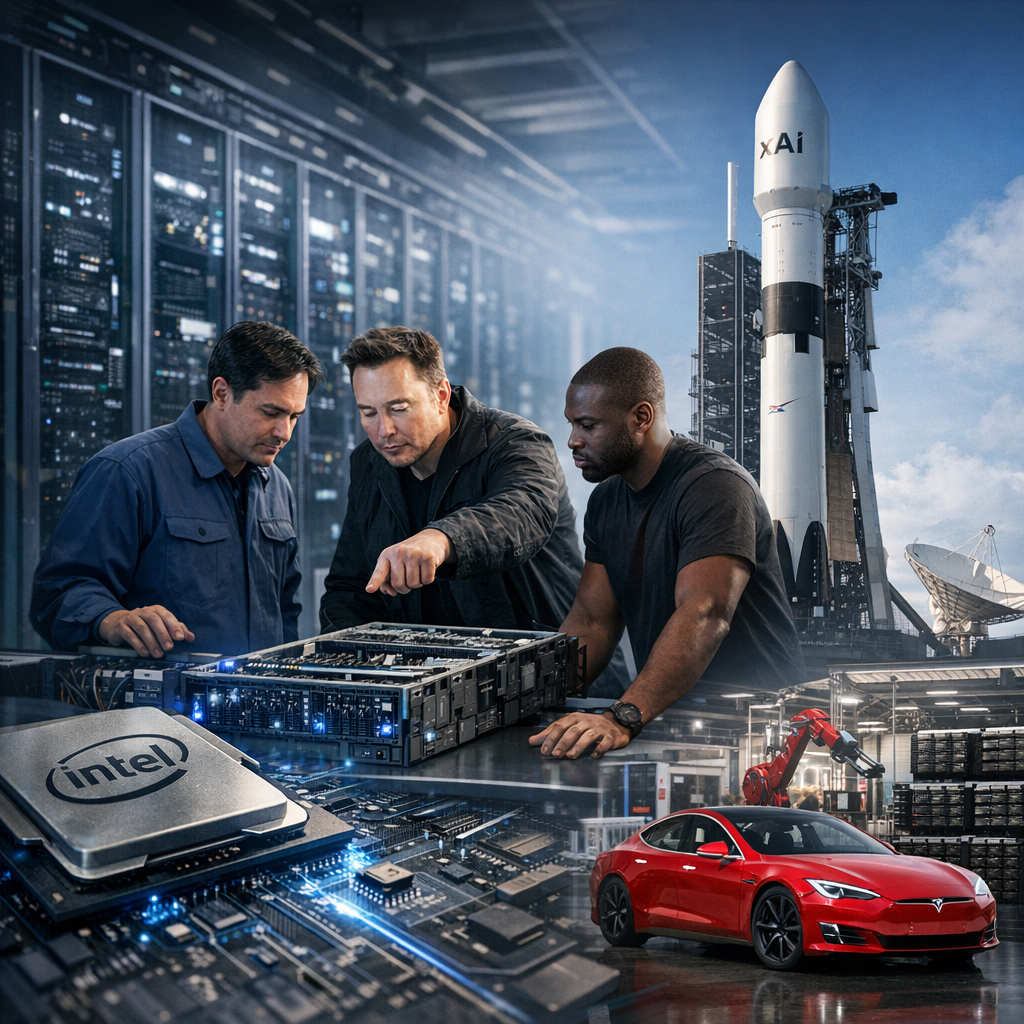
Intel is set to join an ambitious artificial intelligence infrastructure effort alongside SpaceX, xAI, and Tesla, marking a notable convergence of hardware manufacturing and frontier AI development. The move, first reported by The Economic Times in its article “Intel to join the Terafab project with SpaceX, xAI and Tesla,” signals Intel’s intent to reassert itself in a rapidly evolving AI ecosystem increasingly dominated by specialized chipmakers and vertically integrated tech players.
The Terafab project is understood to focus on building large-scale, high-performance computing infrastructure tailored for advanced AI workloads. While detailed specifications remain limited, the collaboration suggests a push toward tightly integrated systems combining compute, energy, and data capabilities. The involvement of Elon Musk-linked ventures—SpaceX, xAI, and Tesla—points to a model that spans terrestrial data centers and potentially space-based or energy-optimized components, aligning with Musk’s broader interest in scaling AI through unconventional infrastructure approaches.
Intel’s participation is significant given its efforts to regain leadership in semiconductor manufacturing and AI acceleration. The company has been investing heavily in new fabrication processes and data center products, but has faced intense competition from Nvidia and other firms whose chips have become the backbone of current AI training systems. By joining Terafab, Intel appears to be positioning itself not just as a chip supplier but as a core partner in next-generation AI platforms.
The collaboration also reflects a broader industry trend toward ecosystem-level competition, where success depends less on individual components and more on integrated stacks of hardware, software, and energy resources. Tesla contributes expertise in power management and large-scale engineering, SpaceX brings capabilities in launch and satellite infrastructure, and xAI represents the frontier model-development layer. Intel’s role would likely center on manufacturing and computing architecture, potentially providing custom silicon or advanced packaging tailored to the project’s needs.
While the commercial and technical timelines for Terafab remain unclear, the partnership underscores the scale of investment and coordination now required to push AI capabilities forward. It also raises questions about how traditional chipmakers can differentiate themselves in a landscape increasingly shaped by vertically integrated competitors.
If successful, the initiative could reshape how AI infrastructure is built and deployed, moving beyond conventional data center models toward more distributed, energy-aware systems. For Intel, the stakes are high: participation offers a path back into the center of AI innovation, but also places the company in a collaborative environment where speed and execution will be critical.