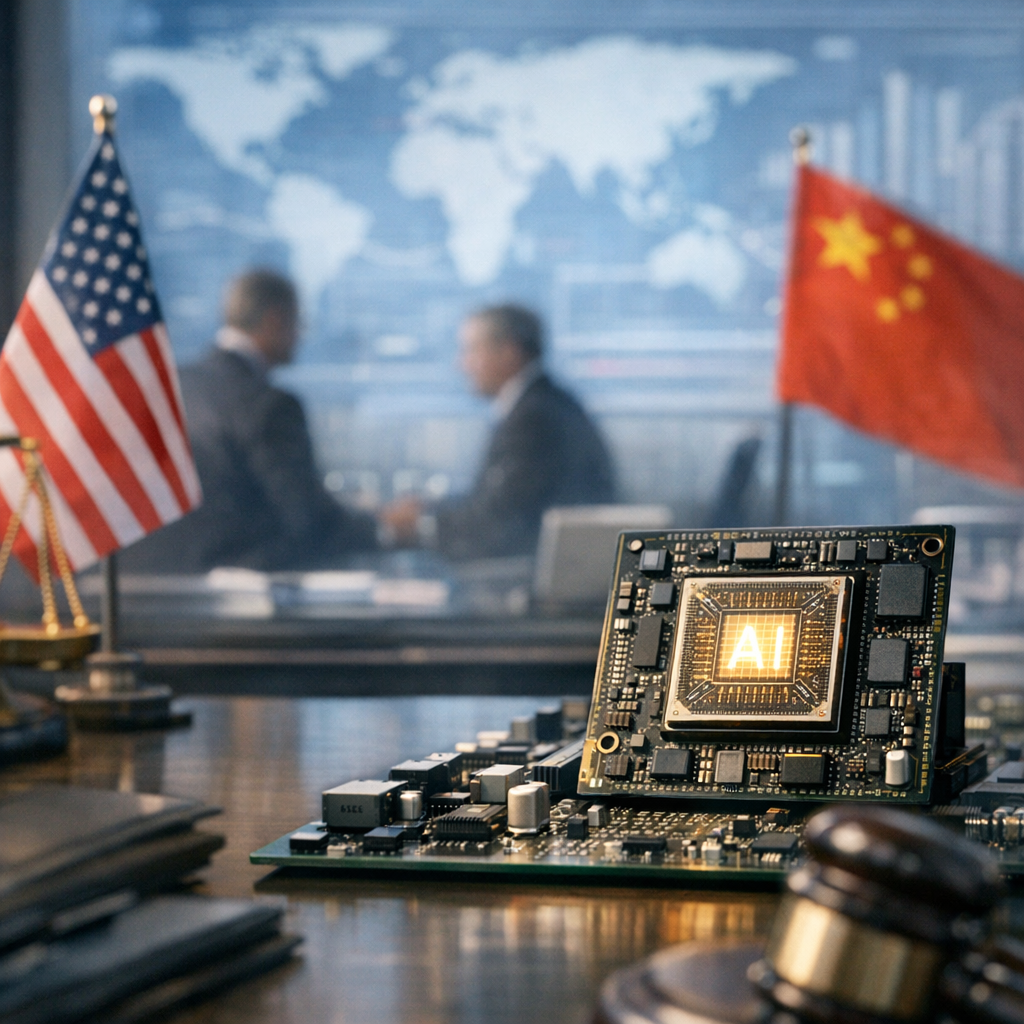
A growing number of governments are treating artificial intelligence not just as a commercial technology but as a pillar of national power, reshaping industrial policy, defense planning, and diplomacy. That shift is driving an emerging competition over what officials and strategists increasingly call “AI sovereignty”: the ability of a state to develop, deploy, and govern advanced AI systems with sufficient independence from foreign suppliers, platforms, and regulations. In an article titled “The Global Race for AI Sovereignty: Where Does Israel Stand?”, published by VC Cafe, the argument is laid out starkly: countries are moving to secure their own compute, models, data access, talent pipelines, and regulatory leverage, and Israel’s standing will depend on how quickly it can convert its research strength and startup dynamism into durable national capabilities.
The concept of AI sovereignty is gaining urgency for reasons that extend well beyond innovation. Modern AI depends on three critical inputs that are increasingly politicized: specialized chips, large-scale computing infrastructure, and large datasets. Each is concentrated in a small number of companies and jurisdictions. As export controls tighten, supply chains fragment, and data governance diverges across regions, states are confronting the risk that access to the building blocks of AI could be constrained by geopolitical disputes, sanctions policy, or market concentration. The result is a new kind of strategic exposure: a country may have world-class researchers and entrepreneurs but still be dependent on external providers for the compute required to train competitive frontier models or to serve critical AI workloads at scale.
The VC Cafe piece frames Israel as a country with significant advantages that do not automatically translate into sovereignty. Israel’s technology ecosystem has long been recognized for applied innovation, cybersecurity depth, and a dense network linking academia, military-derived expertise, and venture-backed entrepreneurship. Those strengths position Israel to build AI products quickly and to integrate AI into security and intelligence applications. Yet the global AI stack is shifting toward scale economics that favor states and firms able to fund massive compute clusters, secure long-term semiconductor access, and operate large platforms. In that environment, the distinction between being an “AI innovator” and being “AI sovereign” becomes critical.
Compute is the most immediate pressure point. Israel’s startup economy has historically thrived by building software and enterprise products without needing vast domestic infrastructure. Frontier AI reverses that logic. Training and operating state-of-the-art models requires continuous access to advanced GPUs, data center capacity, power, and specialized engineering teams. Much of that capacity is controlled by a handful of U.S.-based cloud providers and chipmakers, operating under evolving export and compliance regimes. Even if Israel’s companies can purchase cloud services, reliance on external infrastructure leaves them vulnerable to price shocks, priority allocation decisions, and policy-driven restrictions—particularly as governments worldwide begin to classify certain AI capabilities as dual-use technologies.
This dependency intersects with a second issue: control over foundational models. Israel has a strong record of producing AI research and founding companies, but the market is consolidating around large “foundation model” providers whose platforms become default infrastructure for other industries. Using externally developed foundational models can accelerate product development, but it can also embed reliance on foreign roadmaps, safety policies, and usage constraints. For a country concerned with security applications, critical infrastructure, and sensitive data, the trade-off becomes more complex. Owning at least part of the foundational layer—through domestic models, domestic fine-tuning capability, or joint ventures with guaranteed national access—becomes a strategic question rather than merely a technical one.
Data governance is another front in the sovereignty debate. In many jurisdictions, questions around health records, financial data, biometric information, and government datasets are increasingly tied to both privacy law and industrial policy. Countries seeking AI sovereignty are building frameworks to keep sensitive data within national borders or within approved sovereign clouds, while also enabling enough access to enable training and evaluation. Israel has advanced capabilities in data-intensive sectors, including healthcare and security, but it faces the same dilemma as its peers: restrictive data rules can slow innovation, while permissive frameworks can heighten exposure to surveillance risk, foreign access, and public backlash. The VC Cafe article highlights the need to treat data as an asset that requires governance designed for both national security and economic competitiveness.
Talent, often described as Israel’s most renewable strategic resource, is also under strain in the global race. AI experts are increasingly recruited by hyperscalers and frontier-lab operators with compensation packages and research resources that local firms and universities cannot easily match. Israel’s ecosystem can continue to generate talent, but retaining and scaling it requires stable funding for research, attractive domestic computing environments, and clearer pathways from academic work to nationally anchored industrial capability. Without those supports, a brain drain dynamic can emerge in which the most advanced work migrates to foreign labs, even if the early-stage ideas originate in Israel.
The article’s broader implication is that AI sovereignty is not a single program but a portfolio of coordinated steps. For Israel, that likely means investing in domestic compute capacity that can support both civilian innovation and security needs, while developing procurement and partnership models that ensure guaranteed access to advanced chips and cloud services. It also means strengthening public-private collaboration to move beyond one-off startup successes toward sustained industrial depth—particularly in areas like semiconductor design, specialized AI hardware, and high-reliability systems. Countries that lead in AI continue to blend market dynamism with state-backed infrastructure and policy alignment; the purely venture-led approach that worked in earlier software waves may be insufficient for this era of capital-intensive AI.
Israel’s security environment adds urgency as well as complexity. AI capabilities increasingly shape intelligence analysis, cyber operations, autonomous systems, and decision-support tools. Dependence on external platforms in such domains creates risks: service denial in a crisis, opaque model behavior, or forced compliance with overseas restrictions. Yet building everything domestically can be inefficient, duplicative, and slow. The strategic challenge is to determine which layers must be sovereign, which can be sourced internationally with safeguards, and how to enforce resilience through redundancy and interoperability.
At the same time, the sovereignty push carries potential downsides. Aggressive localization can reduce competitiveness by limiting access to global markets and best-in-class tools. Overregulation can stifle experimentation, while underregulation can erode public trust and invite political blowback. The strongest strategies in other countries are increasingly pragmatic: targeted sovereignty in critical components, diversified supply chains, and standards-based governance that keeps domestic firms connected to international ecosystems.
The VC Cafe analysis lands at a moment when policy choices are becoming harder to reverse. Compute infrastructure takes years to plan and build. Semiconductor supply agreements are long-term. Regulatory regimes, once established, shape investment patterns and can either attract or repel global partners. For Israel, the question is not whether it has technical excellence—it clearly does—but whether its institutions can translate that excellence into control over the inputs and platforms that determine strategic autonomy in AI.
As the global race intensifies, Israel’s standing will likely be judged less by the number of AI startups it produces and more by whether it can secure dependable compute, cultivate and retain top-tier talent, establish credible frameworks for data and model governance, and ensure that critical national systems are not hostage to decisions made abroad. The contest over AI sovereignty is ultimately a contest over resilience and leverage. For small, highly capable countries, it is also a test of whether agility and innovation can be matched with the long-horizon investments that the new AI era demands.