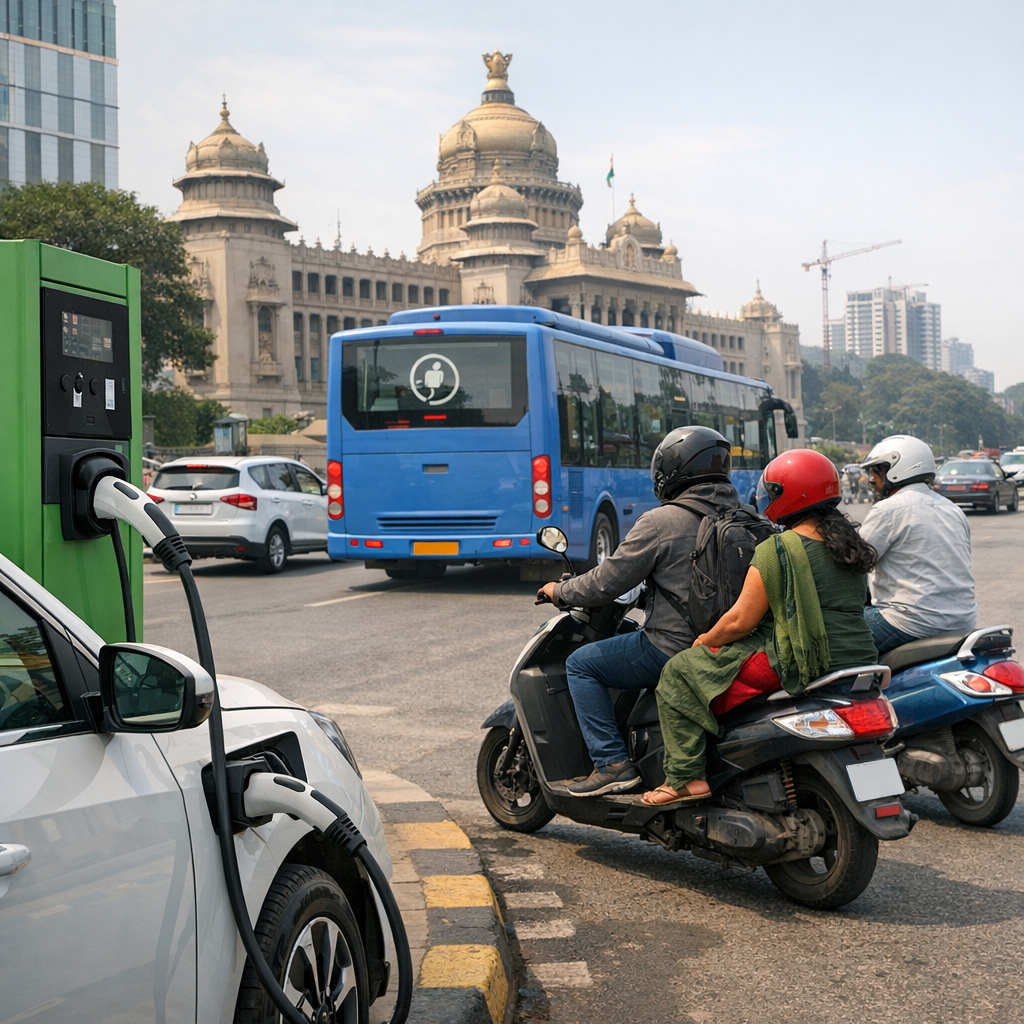
The Karnataka government has moved ahead with a contentious tax policy on electric vehicles, introducing a lifetime road tax on certain EV categories despite opposition from industry stakeholders. The decision, reported by The Economic Times in its article “Karnataka government ignores protests, notifies lifetime tax on EVs, spares two-wheelers,” marks a shift in the state’s approach to electric mobility incentives.
According to the notification, the lifetime tax will apply to electric cars and other higher-end EV segments, while electric two-wheelers have been exempted. The government’s decision comes after weeks of pushback from manufacturers, startups, and clean mobility advocates, who had warned that such a measure could slow EV adoption in a state often seen as a leader in technology-driven policy.
Officials have justified the move as part of a broader effort to balance revenue considerations with environmental goals. With EV penetration gradually increasing, particularly in urban centers such as Bengaluru, the state appears to be recalibrating incentives that were initially designed to accelerate early adoption. The exemption for two-wheelers suggests an attempt to protect mass-market affordability, given that this segment accounts for the majority of electric vehicle sales in India.
Industry representatives, however, have expressed concern that the tax could disproportionately affect premium EV buyers and fleet operators, sectors that have been instrumental in scaling up infrastructure and normalizing EV usage. Some stakeholders argue that policy stability is critical at this stage of the energy transition, and abrupt changes risk undermining investor confidence.
The debate reflects a broader national tension between fiscal realities and climate commitments. While several states continue to offer subsidies and tax breaks to encourage EV uptake, others are beginning to reassess the long-term sustainability of such incentives as adoption grows.
Karnataka’s latest move underscores the complexity of managing this transition. By shielding two-wheelers while imposing new costs on other segments, the government is attempting a calibrated approach, though its effectiveness in sustaining momentum for electric mobility remains uncertain.