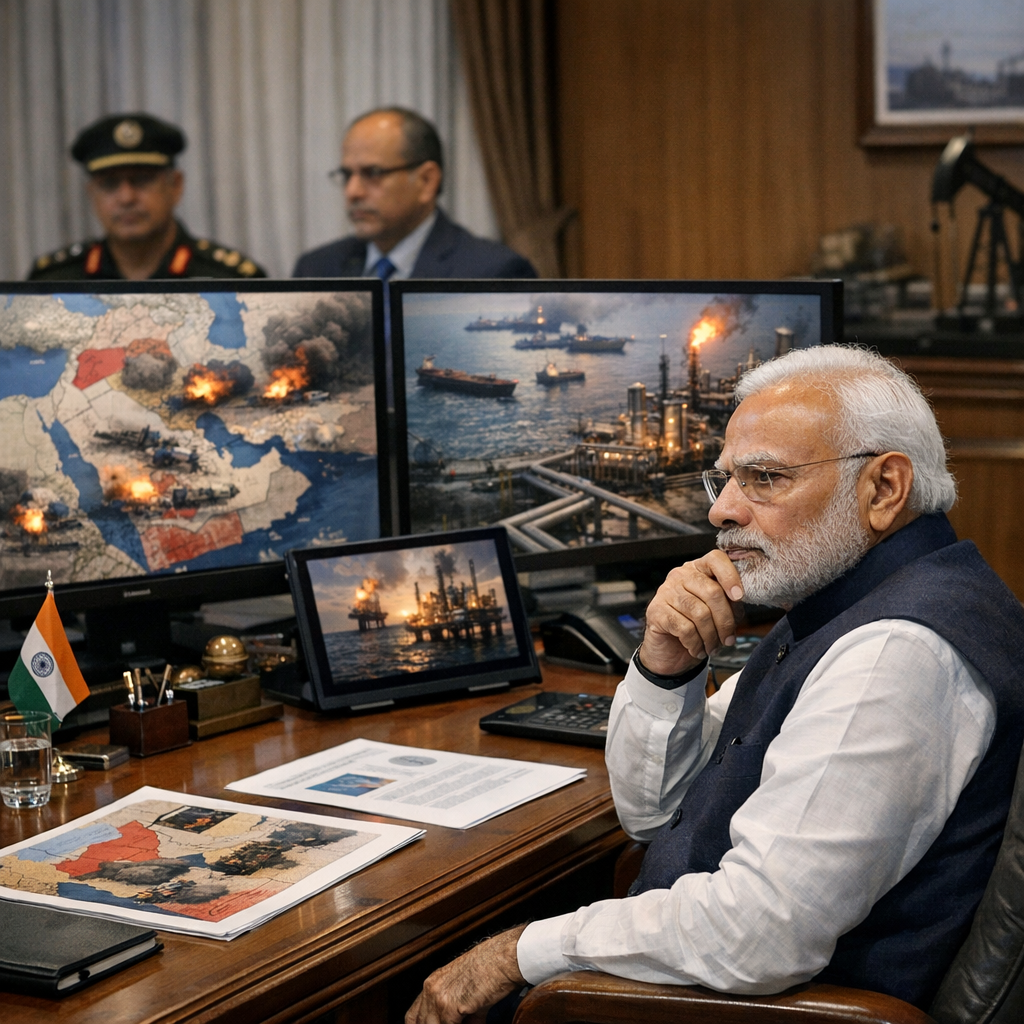
Indian Prime Minister Narendra Modi has convened a high-level meeting to assess the rapidly evolving crisis in West Asia and its potential implications for India’s energy security, according to a report titled “PM Modi calls high-level meeting to review West Asia crisis, India’s energy security” published by The Economic Times.
The meeting brought together senior officials and key policymakers to evaluate the risks arising from escalating geopolitical tensions in the region, which remains critical to India’s oil and gas imports. With a significant portion of India’s energy needs dependent on supplies from West Asia, the government’s review underscores growing concern about possible disruptions to supply chains and price volatility.
Officials are understood to have discussed contingency planning, including diversification of supply sources, strategic reserves management, and mechanisms to cushion the domestic economy from potential spikes in global energy prices. The review also comes at a time when international markets are reacting sharply to instability in key producing regions, raising the prospect of sustained upward pressure on crude oil prices.
India, the world’s third-largest importer of crude oil, has in recent years sought to broaden its energy partnerships and increase resilience against external shocks. However, the scale of its dependence on West Asian suppliers makes developments in the region particularly consequential for fiscal stability and inflation.
The meeting signals a proactive approach by the government to monitor geopolitical risks and coordinate policy responses across ministries. It also reflects the broader strategic imperative to safeguard energy access amid an increasingly uncertain global environment.
Analysts note that while immediate disruptions have not yet materialised, the situation warrants close monitoring. Any escalation could have cascading effects on shipping routes, insurance costs, and commodity markets, complicating India’s economic outlook in the months ahead.
The review is expected to be part of an ongoing assessment process as the government tracks developments and calibrates its response to protect both energy security and economic stability.