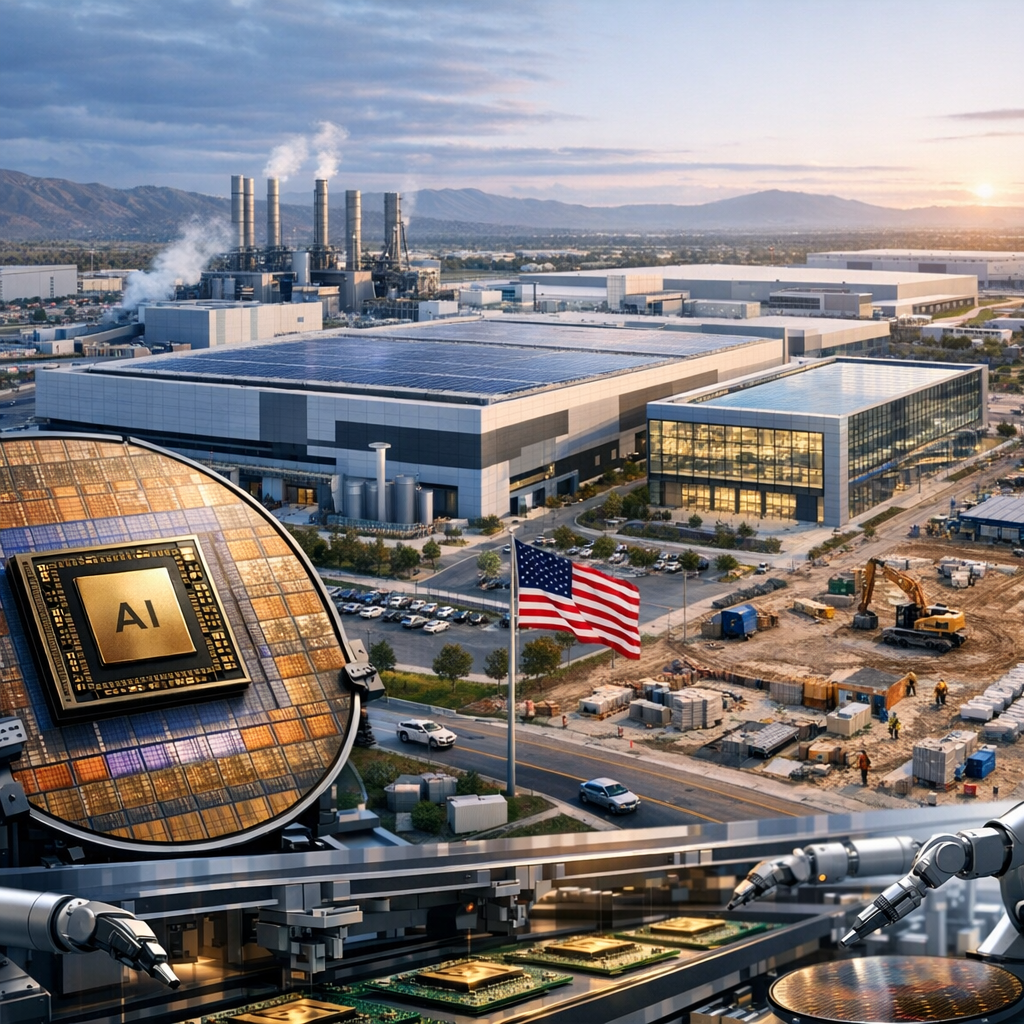
Nvidia is pressing ahead with an unusually aggressive expansion of its manufacturing and infrastructure footprint as demand for AI computing continues to reshape the semiconductor industry. According to TechTime.news, in an article titled “Nvidia Announces Plans to Invest $100 Billion in US Manufacturing and R&D,” the company has outlined a sweeping package of commitments aimed at increasing domestic capacity, accelerating research, and strengthening supply-chain resilience at a moment when governments and corporate customers alike are prioritizing secure access to advanced chips.
The plan, as described by TechTime.news, would span multiple years and encompass investments across chipmaking-related manufacturing as well as research and development efforts tied to Nvidia’s core businesses. While Nvidia is not itself a traditional high-volume chip manufacturer in the way that some rivals are, it sits at the center of the AI hardware ecosystem through its dominance in data-center GPUs and the software stack that supports them. That position has enabled the company to influence where and how AI systems are assembled, tested, and deployed, even when fabrication is carried out by partners.
Industry analysts say the move reflects converging pressures that have been building since the pandemic-era supply disruptions and have intensified with the global AI boom. Customers are asking for more predictable delivery timelines, governments are pushing for strategic industries to locate more production domestically, and investors are scrutinizing whether the AI buildout can continue at speed without hitting manufacturing bottlenecks. A large stated investment initiative is also a signal to partners across the supply chain—from foundries and packaging providers to data-center integrators—that Nvidia intends to keep scaling.
The TechTime.news report frames the investment as an effort to deepen the company’s U.S. presence in both manufacturing and R&D, a pairing that reflects how closely hardware innovation is now linked to the ability to industrialize new designs quickly. Advanced AI accelerators depend not only on leading-edge fabrication, but also on sophisticated packaging, high-bandwidth memory integration, power delivery, and thermal engineering, areas where iterative development and manufacturing readiness often progress in parallel. Expanding domestic capabilities in these domains could help reduce the time between new product architecture and high-volume availability.
Nvidia’s announcement also lands amid a broader rebalancing of global semiconductor supply chains. The United States has been seeking to expand onshore chip capacity through a mix of incentives and policy pressure, while companies are reassessing concentration risk in Asia for critical technologies. For Nvidia, which sells high-value products to hyperscale cloud providers, enterprises, and government customers, a narrative centered on U.S. investment and resilience may carry strategic benefits beyond pure operations, including regulatory goodwill and more flexibility in meeting customer procurement requirements that increasingly emphasize supply-chain security.
Still, the practical impact will depend on how the commitment is structured, how much is incremental versus already planned spending, and the extent to which it translates into tangible capacity for the advanced packaging and system-level manufacturing that AI hardware requires. Large investment figures can encompass a range of activities—from facility buildouts and equipment purchases to long-term contracts, partnerships, and workforce development—and companies often stage spending against demand. In the near term, the tightest constraints for AI accelerators are frequently found not in chip design, but in packaging lines, memory supply, and the ability to stand up complete systems quickly at scale.
The TechTime.news article comes at a time when Nvidia’s market influence is already reshaping data-center roadmaps across the industry. With AI workloads driving unprecedented infrastructure spending, any shift in Nvidia’s manufacturing strategy is likely to reverberate through suppliers and competitors. If the investment produces measurable gains in U.S.-based capacity for advanced assembly, testing, and systems integration, it could modestly reduce lead times and provide customers with an additional layer of assurance that supply can keep pace with AI adoption.
For policymakers, the reported plans underscore how the AI race is accelerating industrial policy ambitions. For the chip sector, they highlight that the next phase of competition extends beyond transistor counts and model performance to the industrial capabilities required to deliver complex computing systems reliably. And for Nvidia, the announcement positions the company not just as the leading designer of AI accelerators, but as a central actor in the infrastructure decisions that will determine how quickly AI can be deployed—and where the economic spillovers of that deployment will accrue.