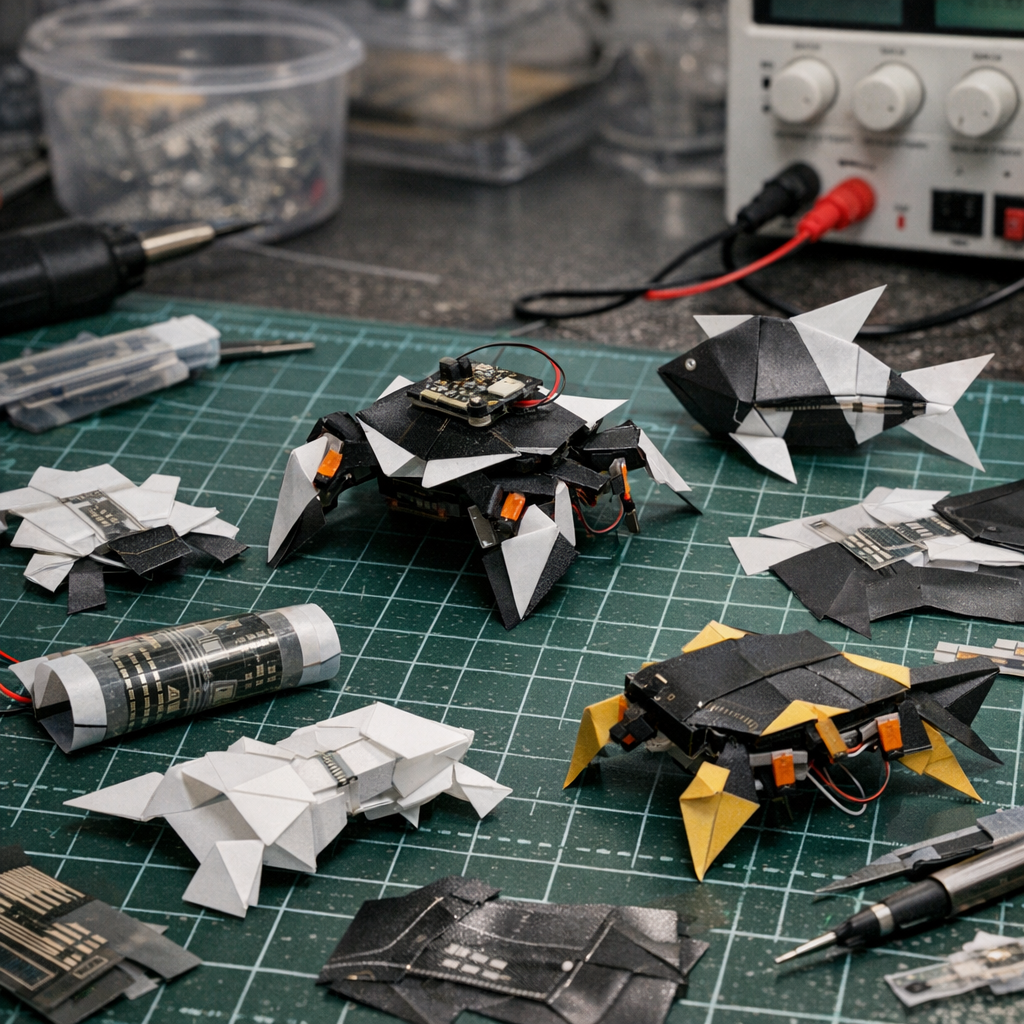
Researchers have unveiled a novel approach to soft robotics that combines origami-inspired design with printable polymer materials, potentially opening the door to low-cost, rapidly deployable machines. The work, reported in the Tech Xplore article “Origami robot built from printable polymers,” demonstrates how folding patterns and advanced fabrication techniques can be used to create compact devices that transform into functional robots when activated.
According to the report published by Tech Xplore, the team developed a system in which flat sheets made from specially engineered polymers can be printed and then folded into intricate three-dimensional structures. These structures are not merely static; they integrate actuation mechanisms that allow the folded forms to move, bend, or crawl. The approach draws on principles of origami, where precise crease patterns dictate how a flat surface can become a complex object, but extends the concept into the realm of programmable materials and robotics.
A key innovation lies in the choice of materials. The printable polymers are designed to be both flexible and responsive, enabling the robots to undergo significant shape changes without compromising structural integrity. This makes them particularly suited for environments where traditional rigid robots would struggle, such as tight or uneven spaces. The fabrication process itself is also significant, as it relies on accessible printing techniques rather than expensive or specialized manufacturing, suggesting a pathway toward scalable production.
The researchers highlighted that these origami-inspired robots can be produced quickly and with minimal waste. Because the designs begin as flat sheets, they are easier to transport and store, only taking on their functional form when needed. This characteristic could be valuable in applications such as disaster response, where lightweight, compact tools must be deployed rapidly and operate in unpredictable conditions.
In addition to mobility, the folding designs allow for embedded functionality. By carefully arranging the geometry of the folds, the team can influence how the robot moves or interacts with its environment. This level of control, combined with the adaptability of the materials, points to a new class of soft robotic systems that are both customizable and efficient.
While the research remains at a developmental stage, it underscores a broader trend in robotics toward soft, flexible, and easily manufacturable machines. The ability to print and fold robots on demand could reduce barriers to entry in the field, enabling more widespread experimentation and application. As the work highlighted in Tech Xplore’s “Origami robot built from printable polymers” suggests, the convergence of materials science, design, and engineering continues to reshape what robots can be and how they are made.