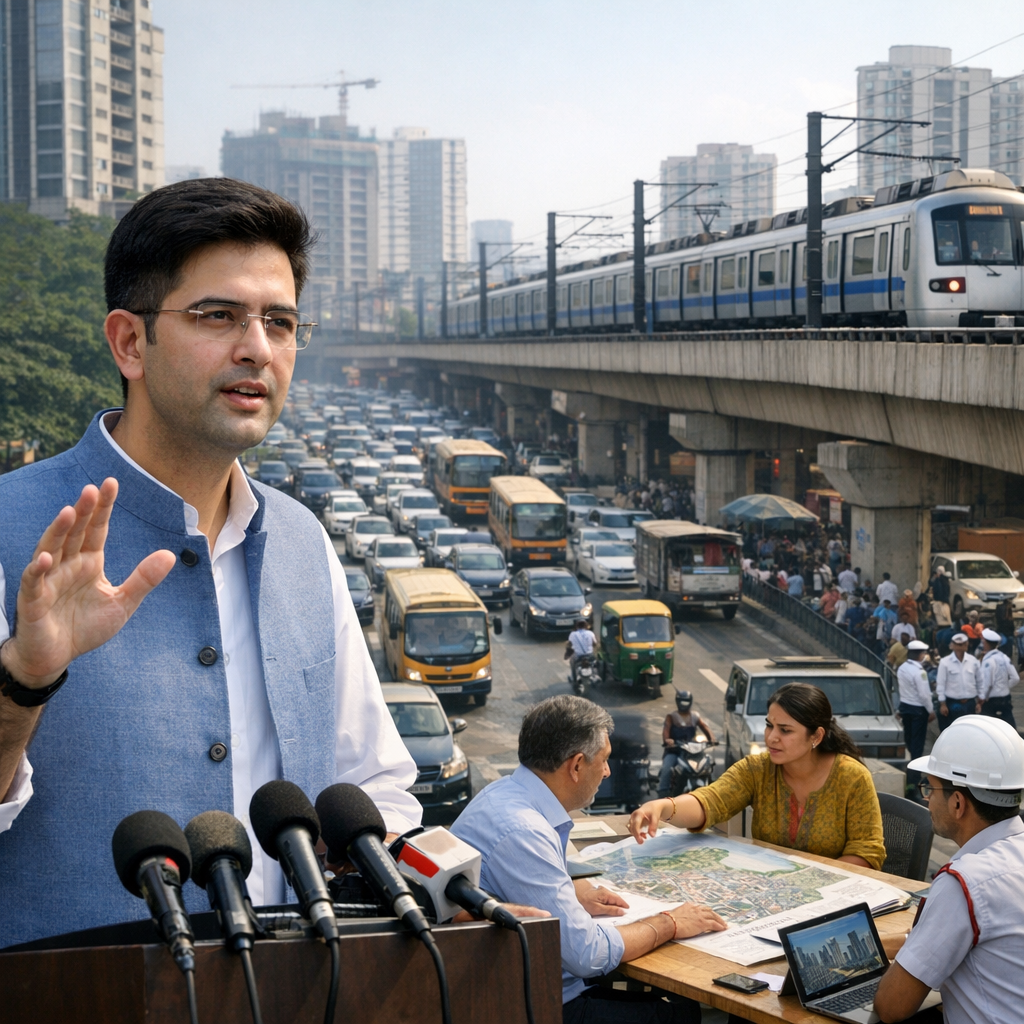
A growing sense of urgency around urban congestion in India has entered the national political conversation, with Aam Aadmi Party leader Raghav Chadha calling for a coordinated central response to what he described as a debilitating crisis across major cities. His remarks, highlighted in the Economic Times video report titled “India’s cities are giant parking lots: Raghav Chadha demands national urban decongestion mission,” reflect mounting concern over the economic and social costs of unchecked urban sprawl and traffic gridlock.
Speaking in Parliament, Chadha argued that India’s metropolitan areas are increasingly paralysed by traffic congestion, with roads effectively turning into “giant parking lots” during peak hours. He contended that the problem extends beyond inconvenience, pointing to its implications for productivity, air quality, and overall quality of life. According to Chadha, the current pace of urban planning and transport reform is insufficient to keep up with rapid urbanisation and rising vehicle ownership.
The proposal for a national urban decongestion mission signals a push for a more centralized and strategic approach to urban mobility. Chadha suggested that piecemeal solutions implemented by individual cities have failed to deliver meaningful long-term relief. Instead, he called for integrated planning that would include improved public transport networks, better traffic management systems, and stronger incentives to reduce private vehicle usage.
India’s urban centres have struggled for years with infrastructure that has not kept pace with population growth. Congestion in cities such as Delhi, Mumbai, and Bengaluru has become emblematic of broader planning challenges, where strained road networks intersect with limited public transport capacity and fragmented governance. The resulting bottlenecks impose significant economic costs, including lost work hours and increased fuel consumption.
Chadha’s intervention reflects a broader recognition that urban congestion is no longer a localized issue but a national concern that demands coordinated policy action. Experts have long advocated for solutions such as expanded metro systems, bus rapid transit corridors, and last-mile connectivity improvements, alongside stricter regulation of parking and vehicle usage. However, implementation has often been uneven, hindered by funding constraints, bureaucratic fragmentation, and political considerations.
The call for a national mission also aligns with ongoing debates about sustainable urban development. As India continues to urbanize rapidly, policymakers face mounting pressure to design cities that are both functional and environmentally sustainable. Congestion contributes significantly to air pollution, which remains a critical public health issue in many Indian cities.
While the proposal has yet to take concrete form, it underscores the need for a more cohesive strategy that bridges central and state-level efforts. Whether such a mission can translate into measurable improvements will depend on its design, funding, and the ability to coordinate across multiple layers of government.
The Economic Times report brings attention to a problem that is widely experienced but often addressed in fragmented ways. Chadha’s remarks have added political momentum to the issue, potentially setting the stage for broader policy discussions on how to rethink urban mobility in one of the world’s fastest-growing economies.