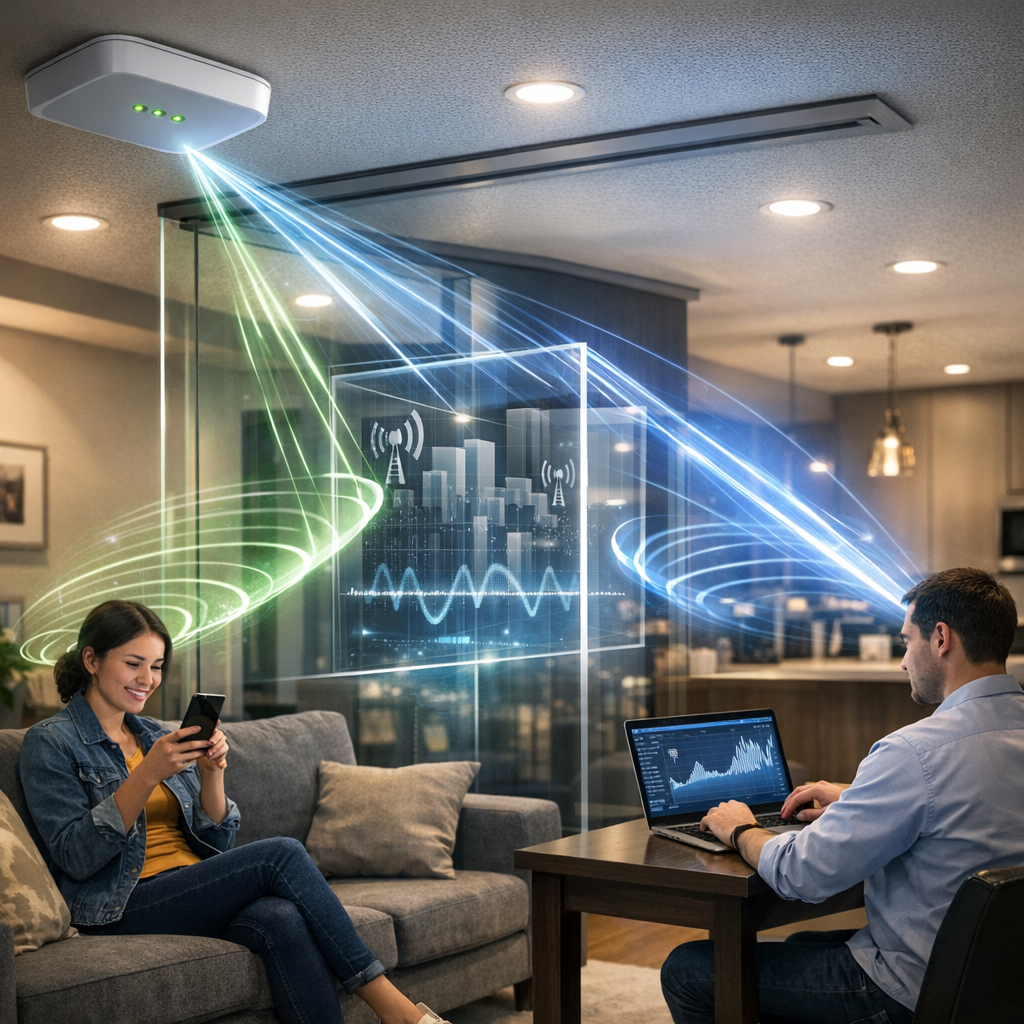
Researchers are advancing a new approach to indoor wireless communication that could significantly improve both speed and energy efficiency, according to a report titled “Faster, greener wireless indoors” published by Tech Xplore.
The work focuses on overcoming long-standing limitations in indoor connectivity, where walls, interference, and crowded networks often degrade performance. Scientists are developing systems that more intelligently manage how signals propagate within enclosed environments, making better use of available spectrum while reducing power consumption.
At the center of the research is a shift toward smarter signal control, using techniques that can dynamically shape and direct wireless transmissions. Instead of broadcasting signals indiscriminately, as conventional systems often do, the new approach allows networks to adapt to the indoor landscape in real time. This leads to stronger, more reliable connections and less wasted energy.
One promising element is the use of advanced materials and surfaces that can reflect and steer wireless signals with precision. These engineered surfaces, sometimes described as programmable or reconfigurable, can be adjusted to optimize how signals move through a room or building. By guiding transmissions along more efficient paths, the system reduces interference and boosts overall performance.
The implications are significant as demand for high-speed indoor connectivity continues to grow, driven by streaming, remote work, smart home devices, and emerging applications such as augmented reality. Current infrastructure struggles to keep up with these demands without increasing power consumption, which has both economic and environmental costs.
The research highlighted by Tech Xplore suggests that smarter indoor wireless systems could address both challenges simultaneously. By improving spectral efficiency and minimizing wasted transmissions, networks could deliver higher data rates while using less energy. This aligns with broader efforts across the telecommunications industry to reduce its carbon footprint.
While the technology is still in development, early results indicate the potential for meaningful improvements over existing wireless standards. Researchers are working to integrate these innovations into practical systems that can be deployed in homes, offices, and public spaces without requiring extensive infrastructure changes.
As the number of connected devices continues to rise, the need for more efficient indoor wireless communication is becoming increasingly urgent. The work described in “Faster, greener wireless indoors,” published by Tech Xplore, points to a future where faster connectivity does not come at the expense of higher energy consumption.