A recent report highlights the growing role solar energy could play in reducing aviation’s carbon footprint, underscoring both its promise and its limitations as the industry seeks viable paths to sustainability.
In “Solar energy could be key to sustainable aviation,” published by Tech Xplore, researchers examine how solar technologies might contribute to powering future aircraft or supporting cleaner fuel production. The article points out that while aviation remains one of the hardest sectors to decarbonize due to its reliance on energy-dense fuels, solar power is increasingly being considered as part of a broader mix of solutions.
According to the report, one of the most immediate applications of solar energy lies not in directly powering large commercial aircraft, but in producing sustainable aviation fuels. Solar-generated electricity can be used to create synthetic fuels, including hydrogen-based options, which can significantly lower lifecycle emissions compared to conventional jet fuel. This approach avoids many of the physical limitations of onboard solar panels, such as weight, surface area constraints, and inconsistent energy generation during flight.
The article also notes experimental efforts to integrate solar panels into aircraft design, particularly for smaller or specialized planes. Solar-powered flight has already been demonstrated in lightweight aircraft capable of extended endurance missions. However, scaling this technology to commercial aviation remains a major technical challenge. The energy demands of large passenger jets far exceed what current solar panel efficiencies can deliver during flight.
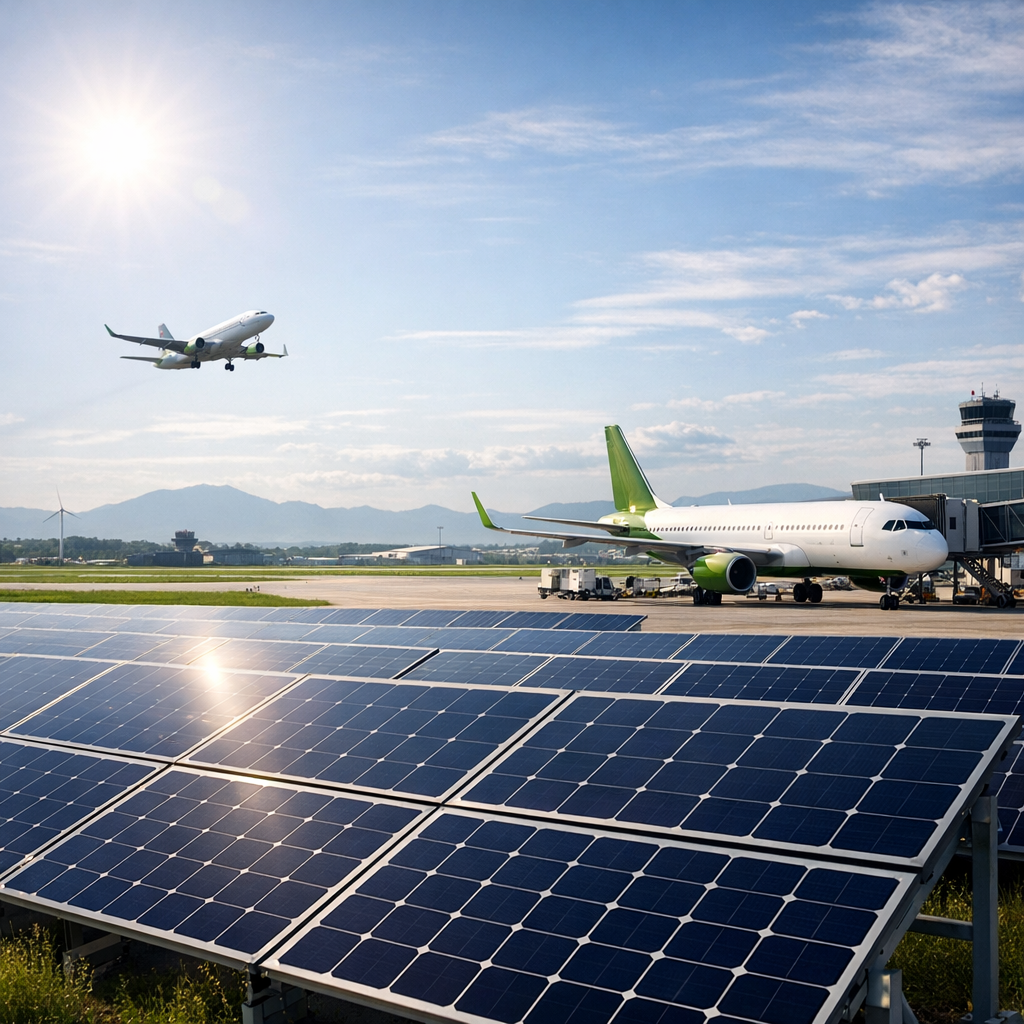
Researchers cited in the Tech Xplore report emphasize that solar energy’s real potential may lie in supporting ground operations and fuel production infrastructure. Airports and aviation fuel facilities could increasingly rely on solar installations to reduce emissions associated with ground handling, maintenance, and fuel synthesis. This indirect contribution could still have a meaningful impact on the sector’s overall carbon footprint.
Despite the optimism, the article underscores that solar energy alone will not solve aviation’s climate challenges. A combination of innovations—including improved battery technology, hydrogen propulsion, and more efficient aircraft design—will likely be required. Policy support and large-scale investment are also identified as critical factors in accelerating adoption.
As pressure mounts on the aviation industry to meet net-zero targets, the findings highlighted by Tech Xplore suggest that solar energy will serve as an important, if partial, component of a broader transition strategy.