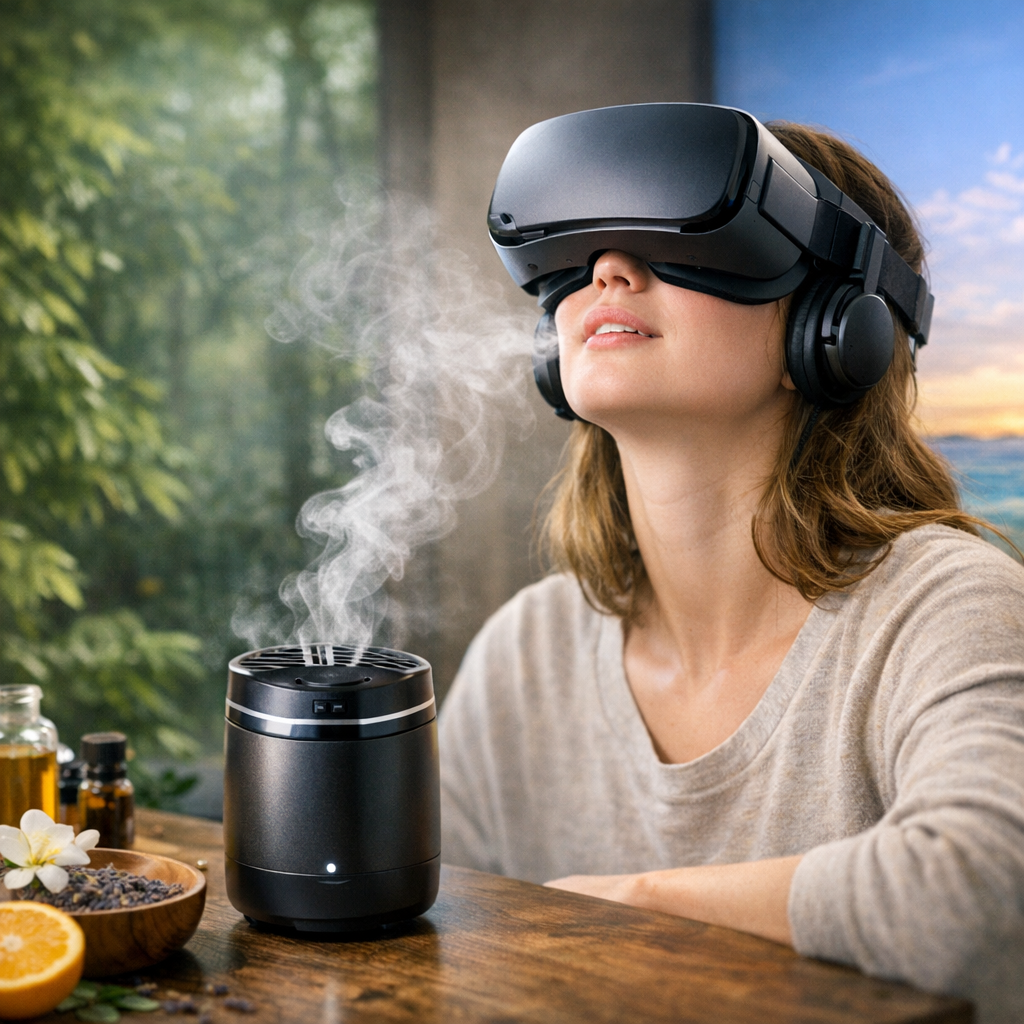
A new advance in virtual reality aims to deepen immersion by engaging a sense long neglected by digital technologies: smell. According to an article titled “VR scent technology blends fragrances,” published by Tech Xplore, researchers have developed a system capable of generating and delivering customized odors in real time, synchronized with virtual environments.
The technology centers on a compact device that can mix a range of base scents to produce a broader spectrum of fragrances. Rather than relying on preloaded cartridges for each distinct smell, the system blends combinations of foundational aromatic compounds, allowing it to simulate nuanced environments more efficiently. The approach mirrors how digital displays create many colors from a limited set of primary hues.
Researchers say the device can be integrated with virtual reality headsets, releasing controlled bursts of scent that correspond with visual and auditory cues. In demonstrations, users experienced environments such as forests, coffee shops, and coastal settings, with smells shifting dynamically as scenes changed. The result, developers argue, is a more convincing and multisensory simulation that enhances presence and realism.
One of the technical challenges addressed by the system is odor persistence. Scents tend to linger, which can blur transitions between virtual scenes. To manage this, the device incorporates mechanisms to disperse or neutralize smells quickly, allowing for sharper changes without overwhelming the user. Precision control over intensity is also emphasized, ensuring that fragrances remain subtle rather than intrusive.
Beyond entertainment, the applications extend into training, therapy, and education. Simulated environments for emergency response training, for example, could incorporate the smell of smoke or hazardous materials. Therapeutic uses may include exposure therapy or memory-related treatments, where scent plays a significant role. Retail and marketing are also frequently cited as potential beneficiaries, with virtual shopping experiences augmented by the smell of products.
Despite its promise, the technology raises practical considerations around cost, maintenance, and user comfort. Questions remain about how widely such systems can be adopted in consumer devices, as well as how individual differences in scent perception might affect usability. There are also concerns about standardization and content design, since developers would need tools to integrate olfactory elements effectively into virtual experiences.
The work highlighted by Tech Xplore signals a broader trend toward multisensory computing, as developers seek to move beyond predominantly visual and auditory interfaces. While still in an early stage, scent-enabled virtual reality reflects ongoing efforts to make digital environments feel less abstract and more physically convincing, potentially reshaping how users interact with virtual worlds.