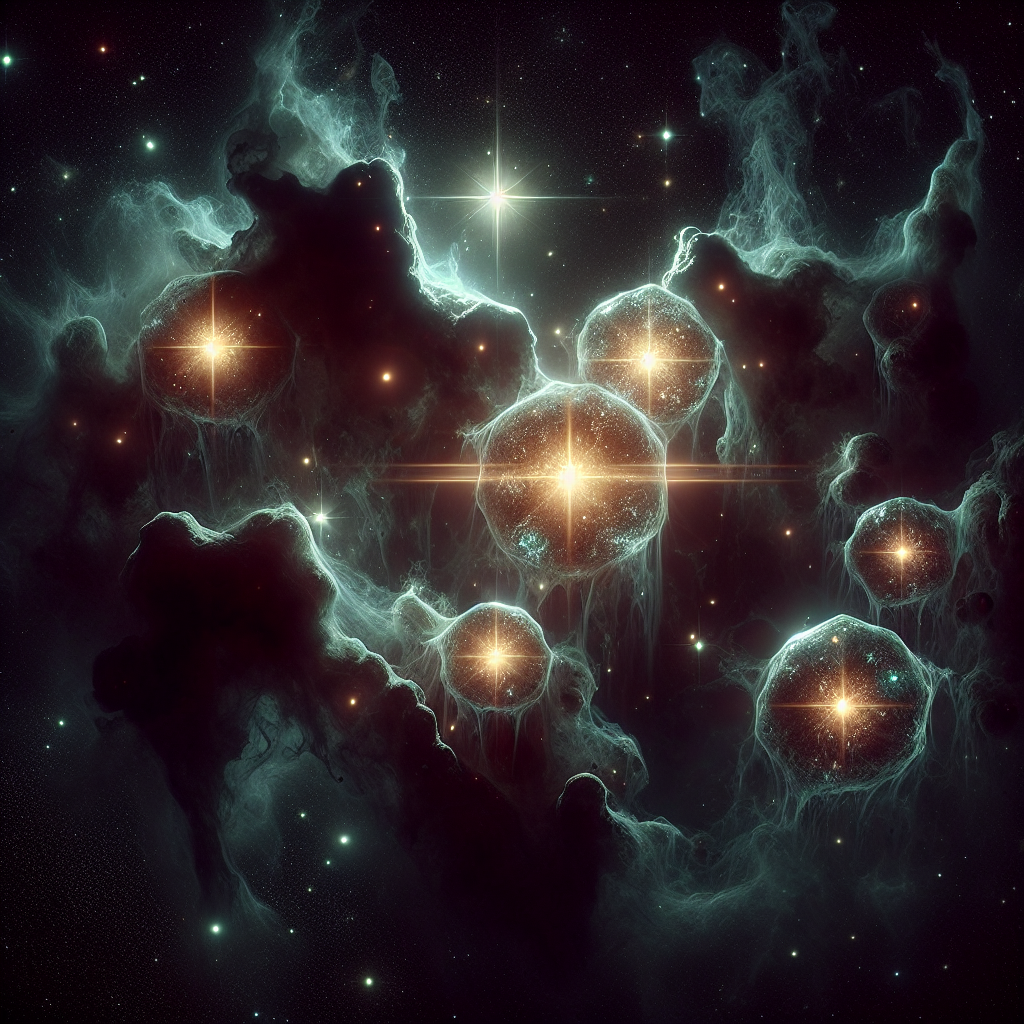
In a provocative development in astrophysics, scientists are turning their focus to so-called “zombie stars” as potential keys to unlocking one of the universe’s most perplexing mysteries: the nature of dark matter. According to a recent article titled “Zombie Stars Might Be a Beacon in Our Search for Dark Matter,” published by Startup News FYI, researchers are beginning to explore the possibility that these unusual stellar remnants might serve as a detectable guide in identifying regions rich in dark matter.
Zombie stars, or stellar remnants that appear to flicker back to life long after their expected demise, are emerging as focal points in this growing body of research. These objects—typically thought to be white dwarfs, neutron stars, or black holes—are known for their unpredictable re-emissions of energy, which standard models of stellar evolution do not easily explain. Some scientists posit that dark matter interactions might trigger these seemingly anomalous bursts of activity.
The new theory rests on the idea that as dark matter particles—still hypothetical in nature—accumulate in the dense cores of dead stars, they may annihilate themselves and deposit energy into the star, causing it to momentarily “reignite.” This radiation may be detected by next-generation observatories, offering indirect but potentially definitive clues about the elusive material that makes up roughly 85% of the universe’s total mass but interacts so weakly that it evades direct detection.
The article from Startup News FYI emphasizes that upcoming instrumentation, including more sensitive X-ray and gamma-ray telescopes, could be instrumental in validating this theory. If confirmed, the phenomenon would not only provide an innovative method for locating dark matter-rich regions but also broaden the understanding of stellar astrophysics.
These revelations could lead to a paradigm shift in both cosmological studies and the search for dark matter. As researchers expand their exploration of these curious astrophysical entities, zombie stars may transition from cosmic anomalies to invaluable tools in unraveling the dark scaffolding of the universe.
Though still largely theoretical, this line of inquiry underscores the creative, interdisciplinary approaches characterizing much of contemporary space science. As efforts to detect and understand dark matter continue to intensify, even the long-dead stars of the cosmos may yet find themselves at the center of scientific discovery.