The United Kingdom has announced a £45 million investment in a new artificial intelligence-enabled supercomputer designed to accelerate the development of nuclear fusion, underscoring the government’s broader ambition to secure leadership in next-generation clean energy technologies. The initiative, detailed in the article “UK unveils £45m Sunrise AI supercomputer to accelerate fusion” published by Innovation News Network, represents a significant step in integrating advanced computing with fusion research.
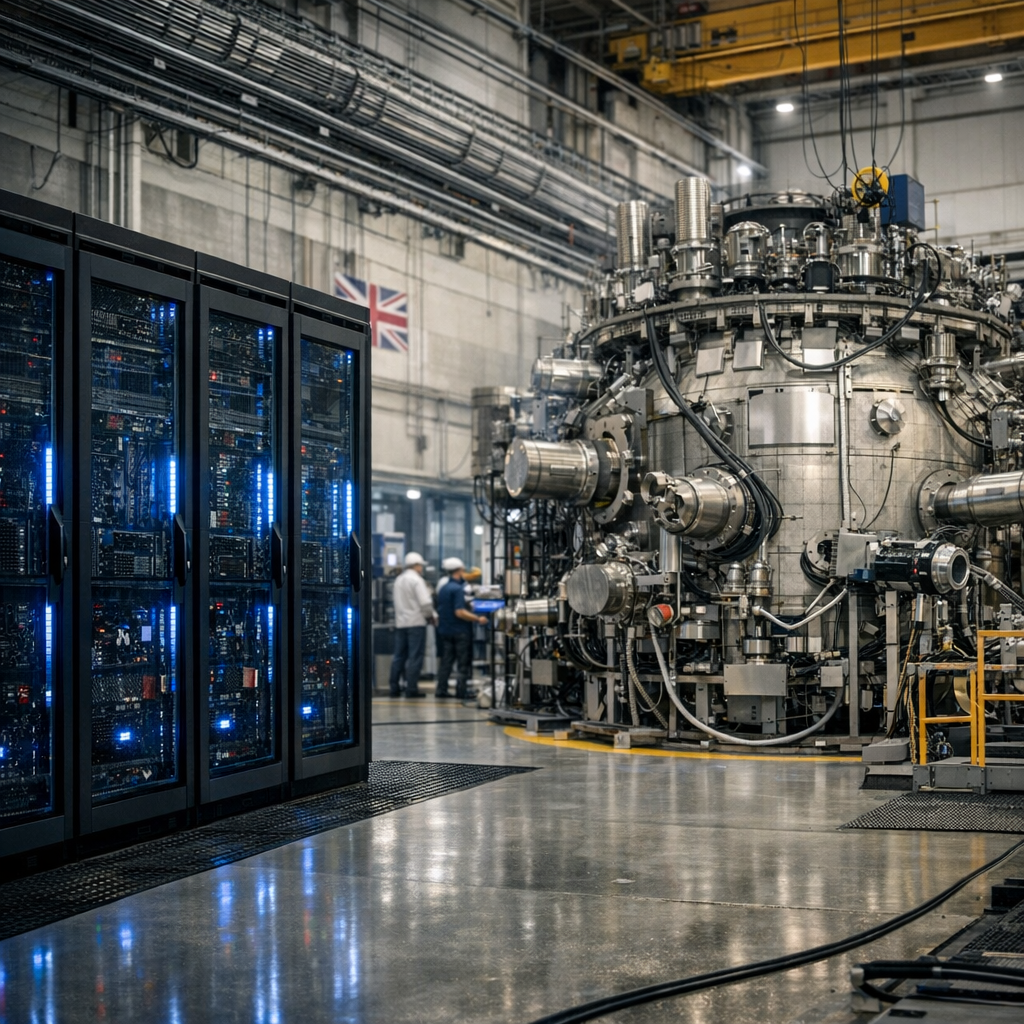
The system, named Sunrise, will be deployed to support scientists working on complex plasma physics and reactor design challenges that have long slowed the path to commercially viable fusion energy. By leveraging high-performance computing combined with machine learning techniques, researchers aim to dramatically reduce the time required to simulate and optimize fusion processes, which are notoriously difficult to predict due to their nonlinear and highly dynamic nature.
Fusion energy, often described as the “holy grail” of clean power, promises abundant, low-carbon electricity by replicating the reactions that power the sun. However, achieving stable and sustained fusion on Earth has proven technically formidable. The Sunrise system is intended to address key bottlenecks by improving modelling accuracy and enabling real-time analysis of experimental data, allowing researchers to refine reactor conditions more efficiently.
According to the report by Innovation News Network, the supercomputer will be based at the UK Atomic Energy Authority (UKAEA), a central player in the country’s fusion programme. The facility is expected to support ongoing projects such as the Spherical Tokamak for Energy Production (STEP), the UK’s flagship initiative to build a prototype fusion power plant.
The integration of AI into fusion research reflects a broader shift across scientific disciplines, where data-driven approaches are increasingly used to complement traditional theoretical and experimental methods. In the context of fusion, AI can help identify patterns in vast datasets generated by plasma experiments, informing decisions that would otherwise require extensive trial and error.
Government officials have framed the Sunrise project as part of a strategic effort to position the UK at the forefront of fusion innovation, alongside international efforts in Europe, the United States, and Asia. Beyond its scientific implications, the investment is also intended to stimulate high-tech job creation and reinforce the UK’s capabilities in advanced computing and energy research.
While the announcement signals progress, significant hurdles remain before fusion becomes a practical energy source. Experts continue to caution that, despite advances in computing and materials science, commercial deployment is likely still years or decades away. Nevertheless, initiatives like Sunrise highlight how emerging technologies such as AI may compress development timelines and bring the promise of fusion closer to reality.
The development illustrates a growing convergence of disciplines, where breakthroughs increasingly depend on the synergy between computational power and physical experimentation. As outlined in Innovation News Network’s coverage, the Sunrise supercomputer represents both an investment in infrastructure and a calculated bet on the transformative potential of AI in solving one of energy science’s most enduring challenges.