An initiative to convert organic waste into reliable energy across African communities is drawing attention as a practical response to both energy scarcity and waste management challenges. The project, outlined in the Innovation News Network article “Reffect Africa: Converting waste into African renewable energy through biomass gasification,” highlights how decentralized technology could reshape local energy systems while addressing environmental pressures.
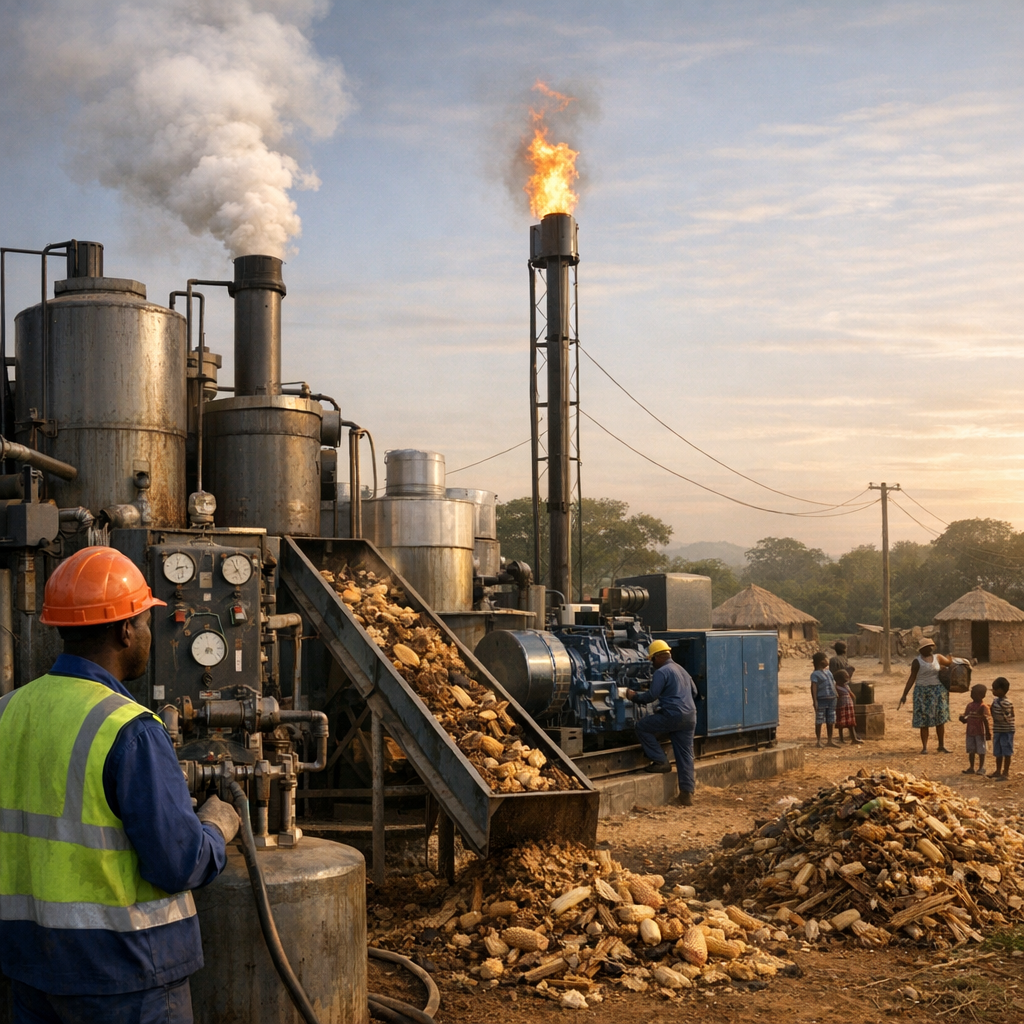
Reffect Africa’s approach centers on biomass gasification, a process that transforms organic waste such as agricultural residues into a combustible gas that can be used to generate electricity. In regions where access to stable grid power remains limited, particularly in rural and peri-urban areas, this model offers a localized alternative that reduces dependence on fossil fuels and costly diesel generators.
The system is designed to operate at a community scale, enabling municipalities and businesses to process waste streams that would otherwise contribute to landfill accumulation or open burning. By converting waste into energy on-site, the initiative aims to create a circular model in which disposal challenges are directly linked to power generation solutions. This approach also addresses public health concerns tied to unmanaged waste while lowering greenhouse gas emissions.
According to the report, Reffect Africa’s technology is tailored to handle diverse waste inputs common across the continent, including crop residues and mixed organic materials. This flexibility is critical in regions where waste collection systems are inconsistent and feedstock quality can vary significantly. The modular nature of the gasification units allows for deployment in different settings, from small communities to industrial operations.
Beyond technical innovation, the project reflects broader shifts in how energy infrastructure is being developed in emerging markets. Rather than relying solely on large-scale, centralized grids, distributed energy systems are gaining traction as a way to accelerate electrification. In this context, biomass gasification offers a dual benefit: it generates power while simultaneously mitigating environmental degradation caused by unmanaged waste.
However, challenges remain. The long-term viability of such systems depends on consistent feedstock supply chains, local technical expertise, and financing models that can support initial deployment costs. Ensuring reliability and scalability will be essential if projects like Reffect Africa are to move beyond pilot stages and achieve widespread adoption.
The Innovation News Network article positions Reffect Africa within a growing ecosystem of clean energy initiatives seeking to adapt technologies to local conditions rather than importing one-size-fits-all solutions. As governments and private entities across Africa intensify efforts to expand renewable energy capacity, biomass gasification could emerge as a complementary strategy alongside solar and wind power.
If successfully implemented at scale, projects like this may not only increase energy access but also redefine how waste is perceived—transforming it from an environmental liability into a valuable resource within a circular economy.