A newly reported certification milestone for perovskite solar cells is drawing renewed attention to a technology long viewed as a promising successor to conventional silicon photovoltaics, though significant hurdles remain before it can be deployed at scale.
According to an article published by Tech Xplore titled “Perovskite solar cells reach new certified efficiency milestone,” researchers have achieved a record level of verified efficiency for a perovskite-based device, marking another step forward in the rapid evolution of this class of materials. Certification, rather than internal laboratory measurement, is widely regarded as a more reliable benchmark, underscoring the significance of the result.
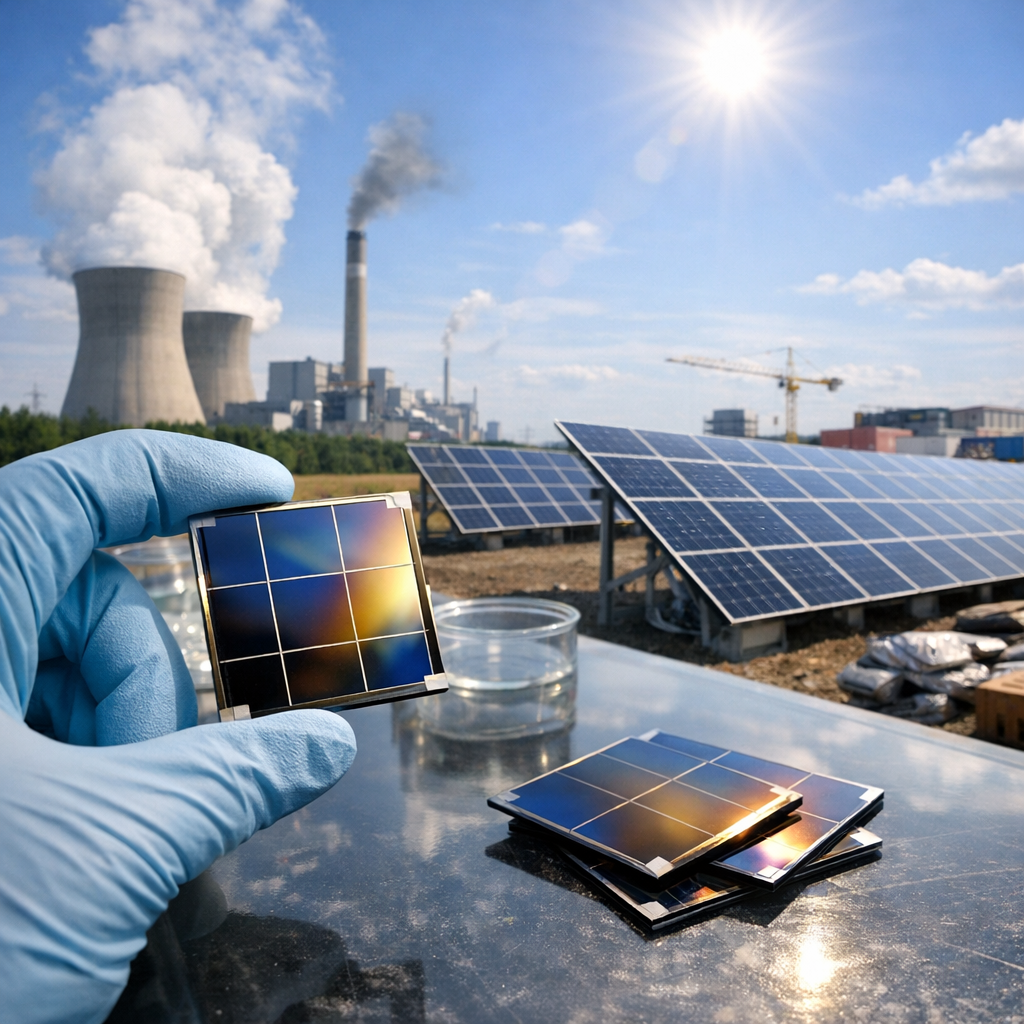
Perovskite solar cells, which are made from a class of crystalline materials defined by their distinctive structure, have attracted intense interest over the past decade due to their high efficiency and relatively low manufacturing costs. Unlike traditional silicon cells, which require energy-intensive fabrication processes, perovskites can be produced using simpler techniques, potentially enabling cheaper and more flexible solar technologies.
The newly certified efficiency figure, while not detailed here, continues a trend of incremental but meaningful gains that have brought perovskites into competitive territory with established photovoltaic technologies. Researchers involved in the work emphasized that improvements in materials engineering and device architecture played a key role in achieving the latest performance level.
However, the path from laboratory success to commercial viability remains uncertain. Stability and durability continue to be the central challenges. Perovskite materials are known to degrade more quickly than silicon when exposed to moisture, heat, and prolonged sunlight, raising concerns about long-term reliability in real-world conditions. Addressing these weaknesses is widely seen as essential before large-scale deployment can occur.
Another area of focus is scalability. While high efficiencies have been demonstrated in small-area devices, maintaining those performance levels when producing larger panels has proven difficult. Researchers are working to bridge this gap, with progress in fabrication techniques offering cautious optimism.
Despite these obstacles, the pace of advancement has been striking. In just over a decade, perovskite solar cells have moved from early-stage research to near-commercial performance levels, a trajectory that has few parallels in the history of energy technology. Recent certification milestones, as reported by Tech Xplore, suggest that further gains may still be within reach.
Industry observers note that hybrid approaches, such as tandem solar cells that combine perovskite layers with silicon, may offer a more immediate route to commercialization. These designs aim to capitalize on the strengths of both materials, potentially delivering higher efficiencies than either could achieve alone while mitigating some stability concerns.
The latest development contributes to a broader effort to expand the global portfolio of clean energy technologies at a time when demand for renewable power continues to grow. While perovskite solar cells are not yet ready to displace silicon as the dominant technology, certified efficiency gains provide a signal that the field is maturing and that long-anticipated breakthroughs may be approaching.
As research continues, the balance between performance, durability, and manufacturability will determine whether perovskites remain primarily a laboratory success or become a central component of the future energy landscape.