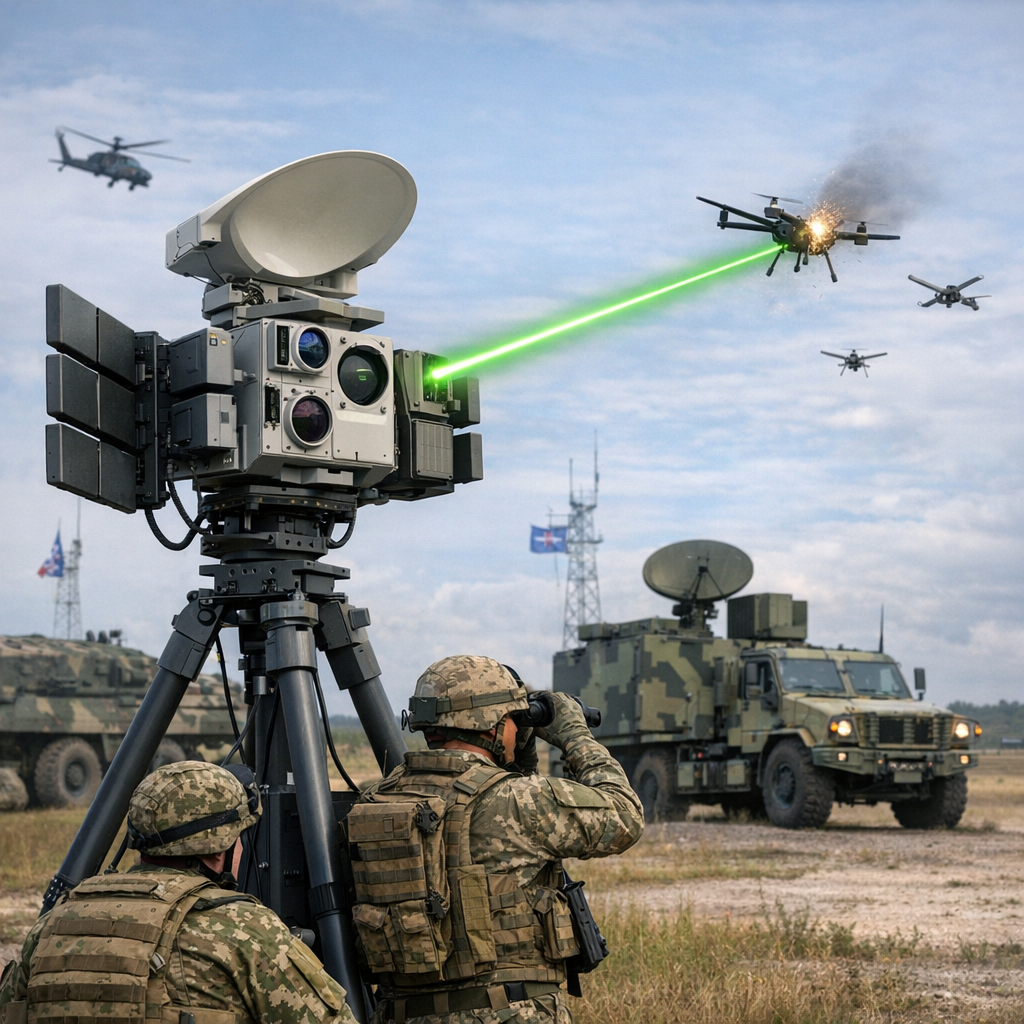
A counter-drone system developed by SkyLock Systems has drawn attention following a recent NATO exercise focused on defending forces and critical sites from small unmanned aircraft, underscoring how quickly anti-drone technology is becoming a baseline requirement for modern militaries. The performance was detailed by the technology news site TechTime.news in an article titled “SkyLock Excels in NATO Counter-Drone Exercise,” which described a field scenario designed to test detection, tracking and neutralization of low-altitude threats under operational conditions.
According to TechTime.news, the exercise evaluated how well participating systems could identify and respond to drones operating in complex environments where clutter, terrain and competing radio signals can degrade performance. Such conditions reflect real-world challenges: small commercial-style drones can be launched with minimal warning, fly close to the ground, and present a difficult target for conventional air defenses. As NATO members and partner nations face an expanding drone threat ranging from reconnaissance to one-way attack systems, exercises of this type have taken on heightened significance, serving both as technology trials and as a means of refining tactics and procedures.
TechTime.news reported that SkyLock’s system demonstrated strong results in detecting and countering drone activity during the drill. While the article emphasized operational success, it also highlighted the broader trend driving procurement: counter-drone capabilities are no longer niche add-ons but increasingly integrated into layered defense architectures. Modern counter-UAS missions typically require more than a single technical function, combining early warning sensors, identification tools, and multiple response options that can be scaled to the setting and rules of engagement.
The report also points to a further lesson drawn from recent conflicts and base protection incidents: electronic warfare has become one of the primary tools for countering small drones, but it is not a complete solution on its own. Drone operators can shift frequencies, use pre-programmed navigation, or employ resilience measures that complicate jamming. This has led many militaries to pursue a mix of approaches, including electronic countermeasures, command-and-control disruption, and kinetic or directed-energy interceptors, depending on the scenario. Exercises that put systems under realistic stress are intended to reveal where each method performs well and where gaps remain.
NATO’s interest in these capabilities reflects the alliance’s need to protect forward-deployed forces, headquarters facilities, logistics nodes and civilian infrastructure that could be targeted in peacetime harassment or wartime strikes. Small drones also raise attribution and escalation questions, particularly when operated by proxies or in gray-zone contexts. The ability to detect and counter them quickly can reduce both physical risk and the chance of miscalculation.
For industry, strong showings in multinational trials can translate into credibility with defense buyers seeking evidence beyond laboratory demonstrations. At the same time, procurement decisions increasingly weigh factors such as interoperability with allied networks, resilience against evolving drone tactics, and the capacity to operate safely around civilian communications. As the TechTime.news account suggests, performance in NATO exercises is becoming a key proving ground for companies competing in a crowded counter-drone market.
While details about the precise parameters of the exercise and the full scope of results were limited in the public reporting, the episode signals a wider reality: inexpensive aerial systems have reduced the barrier to air attack and surveillance, and defenders are now racing to build equally agile, cost-effective protection. In that competitive cycle, the ability to demonstrate effectiveness in a credible operational setting can be as important as any technical specification.