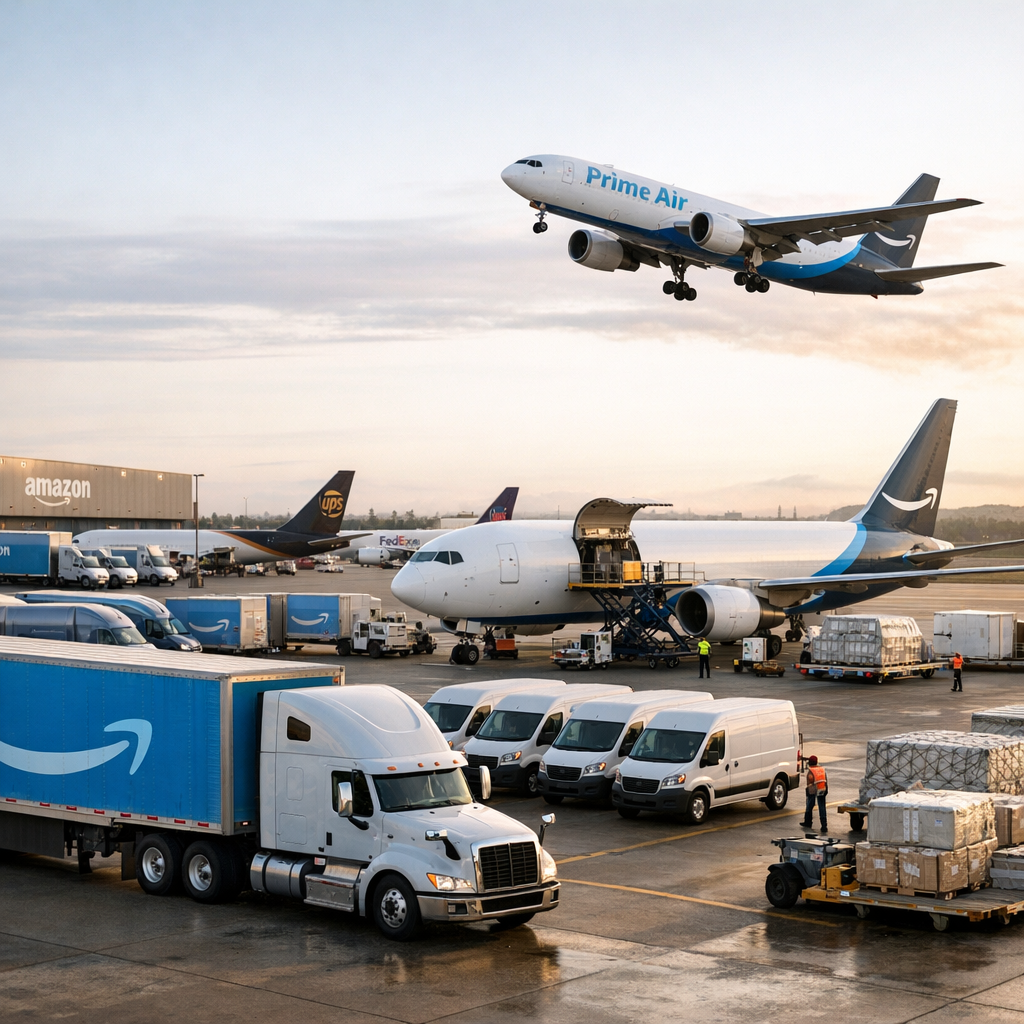
Amazon is expanding the reach of its vast logistics network, positioning itself as a direct competitor to established carriers such as UPS and FedEx, according to a recent report by GeekWire titled “Amazon turns its logistics empire into a new business, taking on UPS and FedEx in freight and shipping.”
The move marks a notable shift in strategy for the e-commerce giant, which has spent years building a sophisticated delivery infrastructure primarily to serve its own retail operations. That internal capability—spanning fulfillment centers, trucks, planes, and last-mile delivery systems—is now being repurposed into a broader commercial service aimed at external businesses.
At the center of this effort is Amazon’s push to offer end-to-end logistics solutions, including freight and shipping services, to third-party merchants and potentially to companies that do not sell on its marketplace. By opening up its network, Amazon is seeking to monetize a system that has required billions of dollars in investment and years of development.
The company’s logistics arm has grown rapidly in scale and complexity. Amazon now operates one of the largest private transportation networks in the United States, with a fleet of cargo aircraft, an extensive trucking operation, and a decentralized system of delivery stations designed to speed up last-mile fulfillment. This infrastructure was built to support fast delivery promises such as one-day and same-day shipping, but it increasingly resembles a standalone logistics provider.
Industry analysts see Amazon’s expansion as a direct challenge to traditional shipping firms. UPS and FedEx have long dominated parcel and freight delivery, but both companies have also relied heavily on Amazon as a customer in the past. As Amazon internalized more of its shipping needs, those relationships shifted, and now the company appears poised to compete more aggressively for the same pool of business customers.
Amazon’s approach differs from legacy carriers in several ways. Its logistics network is deeply integrated with its technology platform, allowing for real-time data analysis, route optimization, and inventory coordination. This integration could offer efficiency gains and potentially lower costs for customers, particularly those already embedded in Amazon’s ecosystem.
However, expanding into a full-service logistics provider presents challenges. Managing external client relationships, ensuring consistent service levels across a broader customer base, and navigating regulatory requirements in freight transportation will test Amazon’s operational discipline. Additionally, established carriers bring decades of experience and entrenched customer relationships that may be difficult to displace quickly.
The broader implications for the shipping industry could be significant. Increased competition may drive innovation and pricing pressure, particularly in areas such as last-mile delivery and integrated supply chain solutions. At the same time, Amazon’s scale and willingness to invest heavily could accelerate consolidation trends or force rivals to rethink their own strategies.
GeekWire’s reporting suggests that Amazon’s logistics ambitions are not merely experimental but part of a deliberate evolution of its business model. By turning a costly necessity into a revenue-generating service, Amazon is extending its pattern of leveraging internal capabilities—such as cloud computing with AWS—into standalone offerings.
As Amazon continues to refine and expand its logistics services, the company’s role in global commerce may deepen further, blurring the line between retailer, technology provider, and transportation company. For competitors and customers alike, the shift signals a new phase in the ongoing transformation of how goods move through the global economy.