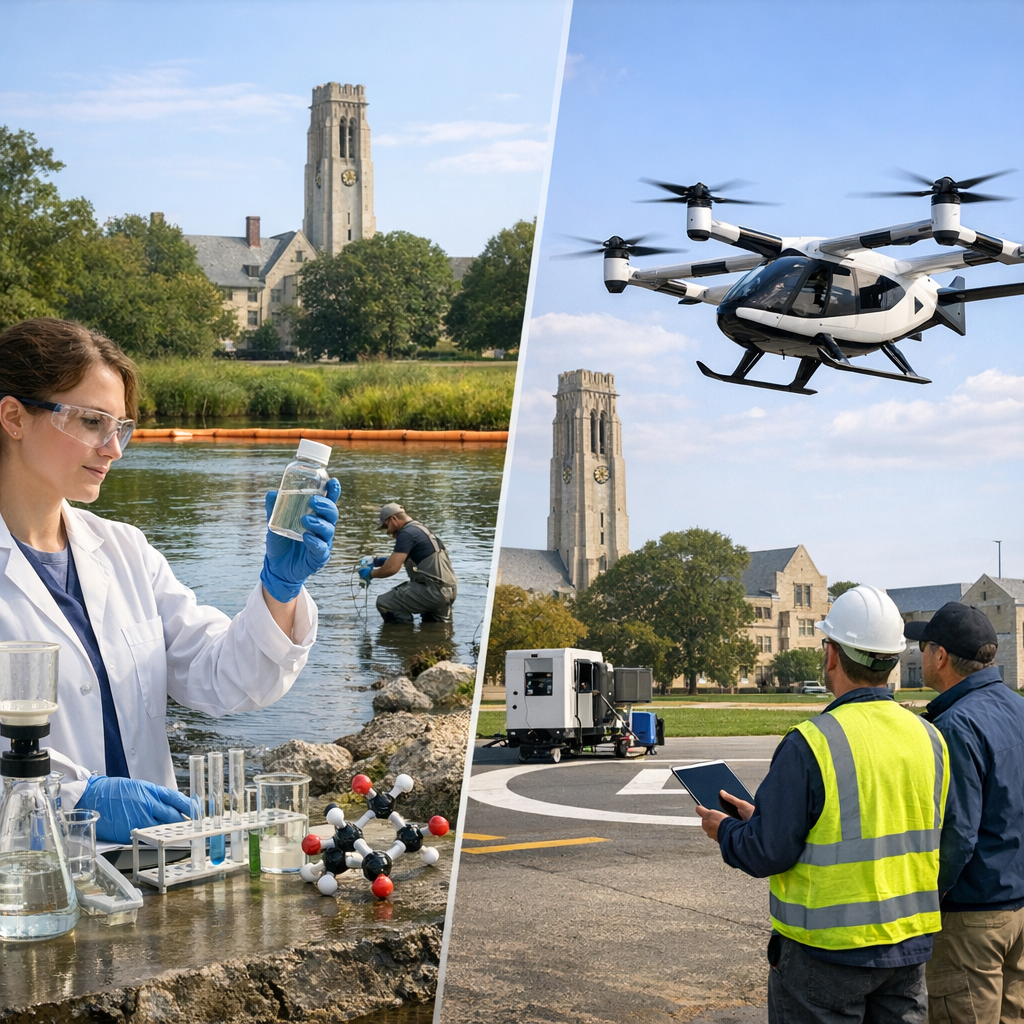
New funding from the University of Toledo is set to accelerate research into both environmental remediation and next-generation aviation, according to a report published by Innovation News Network titled “PFAS destruction and eVTOL projects win first ERS grants from University of Toledo.” The article outlines how the institution’s Emerging Research Support (ERS) program is backing early-stage, high-impact projects aimed at addressing pressing technological and environmental challenges.
Among the first grant recipients is a project focused on the destruction of per- and polyfluoroalkyl substances (PFAS), a class of persistent chemicals widely used in industrial and consumer products that have become a significant public health concern. Often referred to as “forever chemicals” due to their resistance to natural degradation, PFAS have been detected in water supplies across the United States and globally. The funded research seeks to develop more effective methods for breaking down these compounds, moving beyond containment strategies toward permanent elimination.
The Innovation News Network report notes that traditional approaches to PFAS contamination often rely on filtration or sequestration, which can shift rather than solve the problem. The University of Toledo team aims to advance chemical or thermal destruction techniques that could render PFAS harmless, a step that would represent a substantial shift in environmental management practices. If successful, such methods could be adapted for large-scale deployment in municipal water systems and contaminated industrial sites.
In parallel, the ERS program is supporting work on electric vertical takeoff and landing (eVTOL) aircraft, a rapidly evolving sector positioned at the intersection of aerospace engineering and urban mobility. These aircraft are designed to operate with minimal runway requirements and reduced emissions, offering potential applications in passenger transport, logistics, and emergency response.
The funded eVTOL project focuses on technical challenges that remain barriers to widespread adoption, including energy efficiency, propulsion systems, and flight stability. As the Innovation News Network article highlights, overcoming these hurdles is essential for transitioning eVTOL concepts from experimental prototypes to commercially viable transportation solutions. Researchers at the University of Toledo are expected to contribute to improving system reliability and performance, which could help accelerate regulatory approval and market entry.
The ERS initiative itself is intended to provide seed funding that enables researchers to generate preliminary data, strengthen collaborative networks, and compete for larger external grants. By targeting high-risk, high-reward ideas, the program reflects a broader strategy among research institutions to position themselves at the forefront of emerging scientific and technological fields.
The dual focus on PFAS remediation and advanced air mobility underscores the range of challenges the program aims to address, from environmental sustainability to infrastructure innovation. As the Innovation News Network report suggests, these early investments may play a crucial role in shaping both public health outcomes and the future of transportation, particularly as governments and industries seek scalable solutions to complex, long-term problems.
While the projects remain in their early stages, the funding marks a signal of intent from the University of Toledo to support research with clear societal relevance. The outcomes, particularly in PFAS destruction, could have far-reaching implications if the technologies prove effective beyond laboratory conditions.