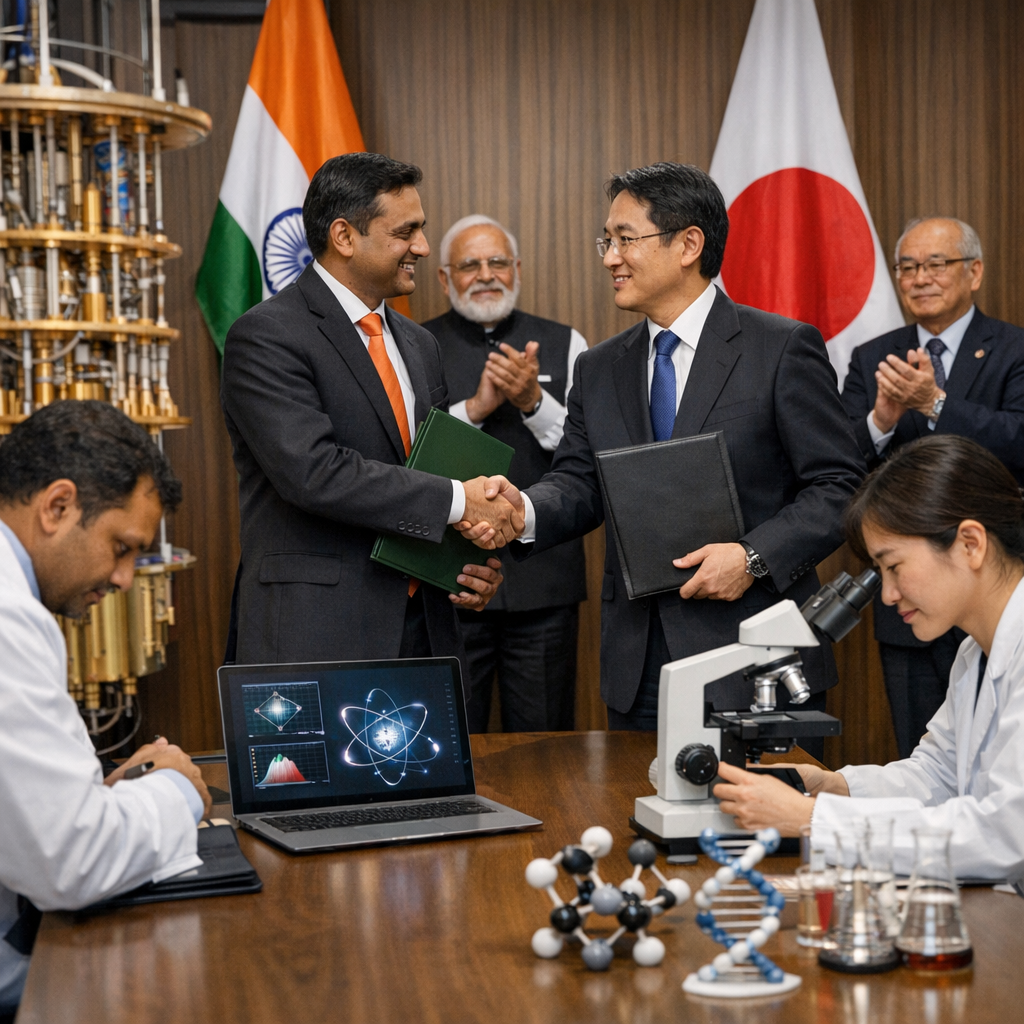
India and Japan have expanded their strategic technology and scientific engagement, signing new agreements focused on quantum technology and health research cooperation, according to a report titled “India, Japan sign agreements in quantum technology, health research cooperation” published by The Economic Times.
The agreements reflect a deepening alignment between the two countries in high-impact, future-facing sectors, particularly as governments worldwide seek to secure technological advantages in emerging fields. Quantum technology, still at an early but rapidly advancing stage, is widely seen as critical to breakthroughs in computing, communications security, and advanced materials. By formalizing collaboration, India and Japan are positioning themselves to jointly develop capabilities that could shape global technological standards.
The cooperation in quantum technology is expected to include joint research initiatives, academic exchange, and potential industrial partnerships. Both countries bring complementary strengths: Japan’s long-standing expertise in precision engineering and advanced electronics, and India’s growing research ecosystem and software capabilities. The agreement signals a shared recognition that pooling scientific resources can accelerate development timelines in a domain where progress is both expensive and technically complex.
Alongside quantum initiatives, the countries also signed agreements to strengthen collaboration in health research. This comes at a time when global health systems are still recalibrating after the COVID-19 pandemic and are increasingly focused on preparedness, biotechnology innovation, and data-driven healthcare solutions. The partnership is likely to involve joint studies, sharing of medical data under regulated frameworks, and cooperation in areas such as disease surveillance and pharmaceutical development.
The move also fits within a broader pattern of strategic convergence between India and Japan, which have steadily expanded ties across defense, infrastructure, supply chains, and digital technologies. Both governments have expressed concerns about the resilience of global supply networks and the need for trusted partnerships in sensitive technological domains.
While the agreements are still at a formative stage, their long-term significance will depend on implementation. Past international collaborations in advanced technologies have often been slowed by regulatory barriers, funding constraints, and differences in institutional frameworks. Effective coordination between research institutions, private industry, and government agencies will be crucial if the partnership is to yield tangible outcomes.
Nonetheless, the timing of the agreements underscores a shared urgency. As competition intensifies globally in both quantum innovation and health security, India and Japan appear intent on ensuring that collaboration, rather than isolation, defines their approach to emerging scientific challenges.