In a recent report, “How Palestinians Are Building a Digital Archive That Can’t Be Erased”, published by Wired, journalists examined a growing effort among Palestinian technologists, archivists, and civilians to preserve cultural memory and historical records in ways that resist destruction, censorship, and displacement. The initiative reflects both a response to immediate conditions on the ground and a longer historical struggle over narrative, identity, and the preservation of evidence.
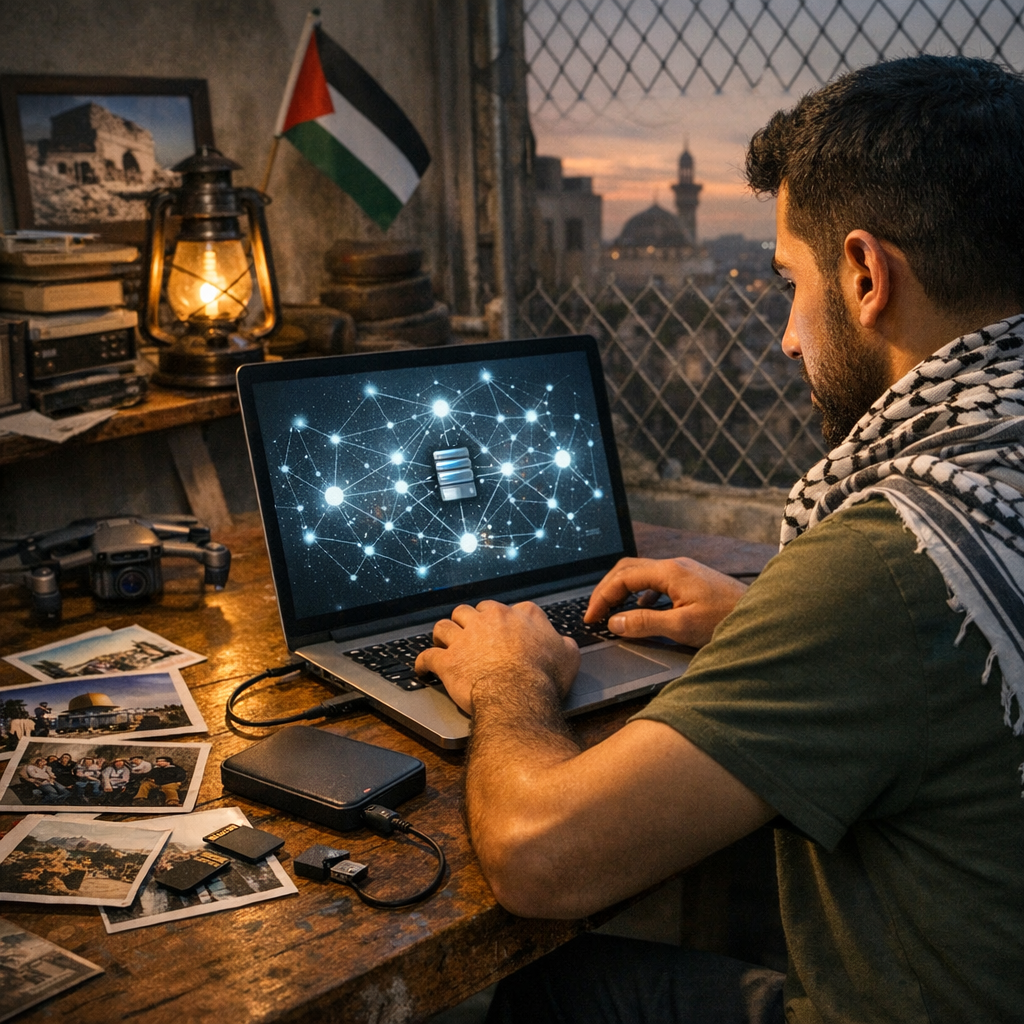
Across Gaza and the West Bank, as well as within diaspora communities, individuals have increasingly turned to decentralized digital tools to document daily life, human rights violations, and cultural artifacts. These efforts include recording testimonies, digitizing family photographs, mapping destroyed neighborhoods, and preserving social media content that might otherwise disappear. The urgency of this work is heightened by repeated cycles of conflict, during which physical archives, institutions, and personal records have often been damaged or lost, as documented by organizations like the International Committee of the Red Cross.
The Wired article highlights how many of these projects are intentionally designed to be resilient. By distributing data across multiple servers, using blockchain-based verification, or relying on globally mirrored storage systems, organizers aim to ensure that no single point of failure can erase the record. This approach is not merely technical but political: it seeks to counter both the physical risks posed by infrastructure destruction and the broader challenge of contested narratives, an issue frequently explored by Human Rights Watch.
Contributors to these archives range from trained historians and software engineers to ordinary residents with smartphones. The accessibility of digital tools has allowed a wider segment of the population to participate in documentation, creating a more expansive and decentralized record. At the same time, this democratization introduces challenges related to verification, metadata accuracy, and long-term curation. Archivists involved in the work often emphasize the need to balance rapid collection with careful authentication to maintain credibility, drawing on best practices from institutions like the Library of Congress digital preservation program.
The report also underscores the emotional dimension of the project. For many participants, archiving is not an abstract exercise but an act of preservation tied to personal loss and collective memory. Safeguarding images of a destroyed home, a family gathering, or a neighborhood street becomes a way to assert continuity in the face of disruption. In this sense, the archive functions both as evidence and as a form of resistance against erasure.
Security concerns remain a persistent issue. Activists and archivists must navigate surveillance risks, potential targeting, and the ethical handling of sensitive material. Decisions about what to publish, anonymize, or restrict require constant deliberation, particularly when documentation could expose individuals to harm. The distributed nature of the archive offers protection in some respects, but it also complicates governance and accountability, especially in contexts monitored by advanced surveillance technologies discussed by groups like the Electronic Frontier Foundation.
Wired’s reporting situates these efforts within a broader global trend toward decentralized archiving in conflict zones, where traditional institutions may be compromised or inaccessible. Comparable initiatives have emerged in other regions affected by war or political repression, suggesting a shift in how historical records are created and maintained in the digital age, similar to efforts supported by UNESCO’s documentary heritage preservation programs.
Ultimately, the Palestinian digital archiving movement reflects a convergence of technology, memory, and political reality. By building systems designed to endure beyond physical destruction, participants are attempting to secure a record that cannot be easily silenced or erased. As the Wired article makes clear, the outcome of this effort will shape not only how current events are understood, but how future generations access and interpret the past.