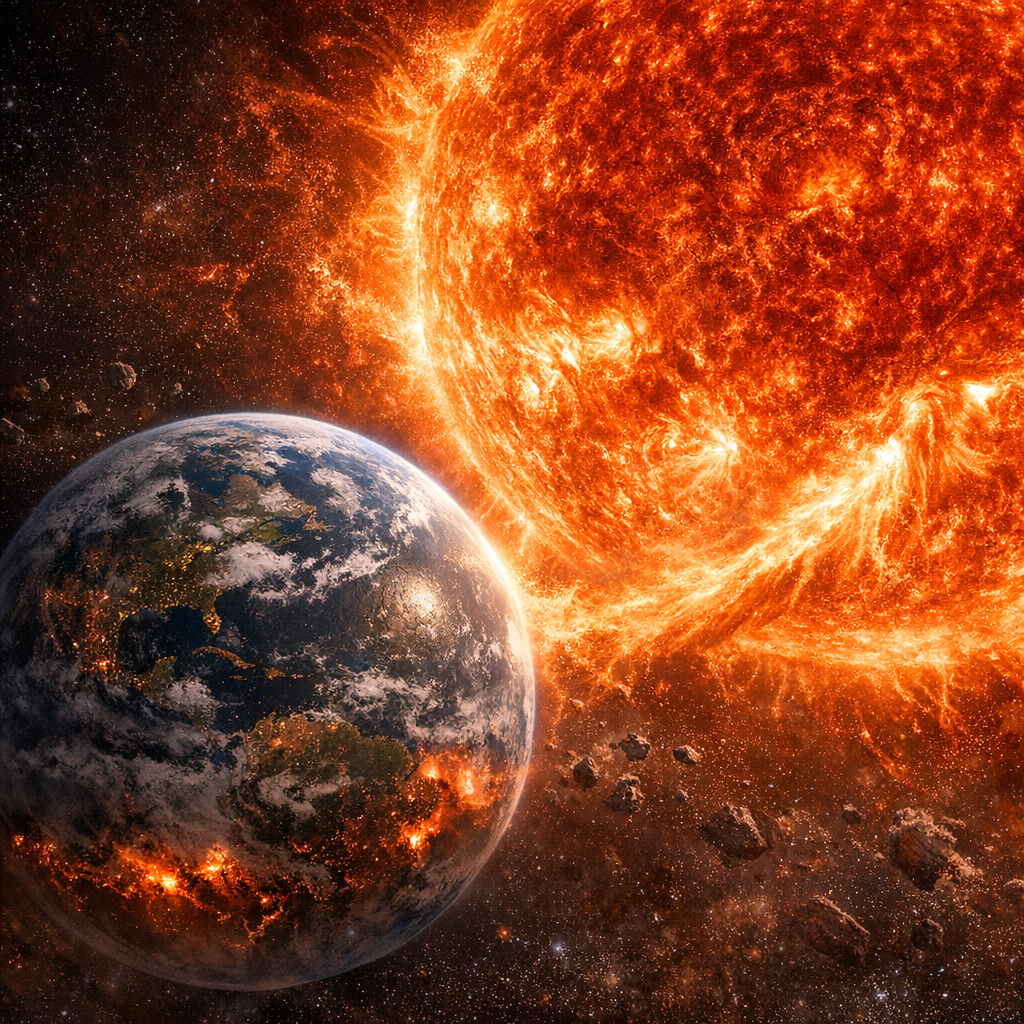
New theoretical research is reshaping one of the most familiar long-term apocalyptic scenarios: the idea that Earth will inevitably be swallowed by the Sun. As reported in Wired’s article “Good News: It Turns Out the Earth Will Never Be Swallowed by the Sun”, recent findings suggest that while the planet’s distant future remains inhospitable, outright engulfment by our star may not occur after all.
For decades, the dominant scientific consensus held that in roughly 5 billion years, the Sun would exhaust its hydrogen fuel, expand into a red giant, and extend far enough to consume the inner planets, including Earth. This projection has appeared in textbooks, documentaries, and popular science writing as a near certainty. However, newer models of stellar evolution indicate that the process may be more complex and less destructive—at least in terms of total planetary obliteration.
Researchers revisiting the Sun’s future evolution have taken into account refined data about stellar mass loss, orbital dynamics, and tidal interactions between stars and their planets. One crucial factor is that as the Sun ages and enters its red giant phase, it will lose a significant fraction of its mass. This gradual loss weakens the Sun’s gravitational hold, allowing planetary orbits, including Earth’s, to drift outward over time (see NASA’s Sun overview).
According to the updated modeling described in Wired, this outward migration could counterbalance the Sun’s expansion. Rather than being engulfed, Earth may move to a safer distance, narrowly avoiding direct consumption. The margin, however, is expected to be extremely tight, and the outcome remains sensitive to variables such as how quickly the Sun sheds mass and how strongly tidal forces act on Earth’s orbit.
Even in this comparatively optimistic scenario, the prospects for life on Earth are bleak. Long before the Sun reaches its maximum size, increasing solar luminosity will trigger a runaway greenhouse effect. Oceans will evaporate, the atmosphere will undergo profound chemical changes, and surface temperatures will soar to levels incompatible with life as we know it. In practical terms, Earth will become uninhabitable well before the question of engulfment is decided.
The revised outlook does not eliminate uncertainty. Stellar evolution over billions of years involves complex interactions that are difficult to model with complete precision. Small differences in assumptions can lead to divergent outcomes, and scientists caution that further refinements are likely. Still, the emerging consensus suggests that Earth’s fate may be less dramatic than previously imagined, shifting from certain destruction by engulfment to a more nuanced end defined by extreme environmental transformation.
The findings also highlight a broader point about astrophysical prediction: even seemingly settled questions can evolve with better data and improved models. As the Wired article underscores, the future of Earth remains harsh but not necessarily as absolute as once believed.