India’s electric two-wheeler sector is entering a period of renewed cost pressure as manufacturers confront rising raw material prices alongside growing investment demands in advanced technologies—a dynamic highlighted in the Economic Times article “Electric two-wheeler makers brace for raw material price hikes, AI infra pressure.”
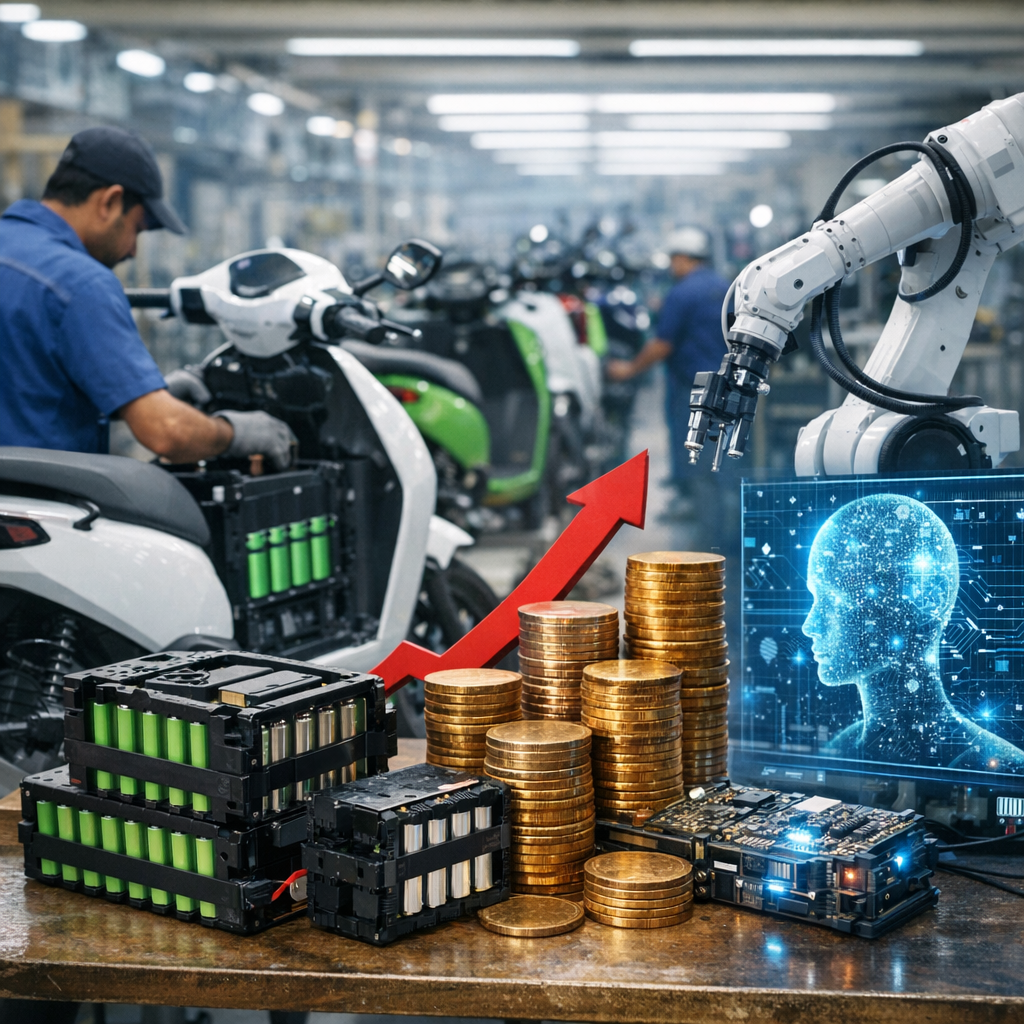
Industry executives say that input costs, particularly for key battery materials such as lithium, nickel, and cobalt, are showing signs of volatility again after a period of relative easing. While prices had moderated in 2023 and early 2024, recent global supply constraints, geopolitical uncertainties, and renewed demand for electrification have begun to push costs upward. For electric two-wheeler makers, whose margins are already thin, even modest increases in battery costs can significantly affect overall profitability.
The challenge is compounded by intensifying technological competition. Companies are now allocating larger budgets toward artificial intelligence capabilities, including predictive maintenance systems, battery management optimization, and connected vehicle ecosystems. These investments are increasingly viewed as essential rather than optional, particularly as consumers expect smarter, software-driven features alongside hardware reliability.
Executives quoted in the Economic Times report indicate that balancing these dual pressures—materials and technology—may force difficult pricing decisions. Some manufacturers are evaluating selective price increases, while others are exploring cost efficiencies through supply chain localization, long-term procurement contracts, and design optimizations aimed at reducing material dependency.
At the same time, the broader financing environment remains cautious. Venture funding into the electric mobility space has slowed compared to earlier peaks, making it harder for startups and mid-sized firms to absorb rising costs without passing them on to consumers. Larger, better-capitalized players may be better positioned to weather the current cycle, potentially accelerating consolidation within the sector.
Policy support continues to play a critical role. Government incentives under India’s electric mobility programs have helped drive adoption, but industry leaders argue that stability and clarity in policy frameworks are essential as companies plan long-term investments in manufacturing capacity and technology infrastructure.
Despite near-term headwinds, demand fundamentals for electric two-wheelers remain strong, driven by urban mobility needs, environmental concerns, and rising fuel costs. However, as the Economic Times article suggests, the next phase of growth may hinge less on rapid expansion and more on operational discipline—managing costs, investing strategically in technology, and navigating an increasingly complex global supply chain landscape.