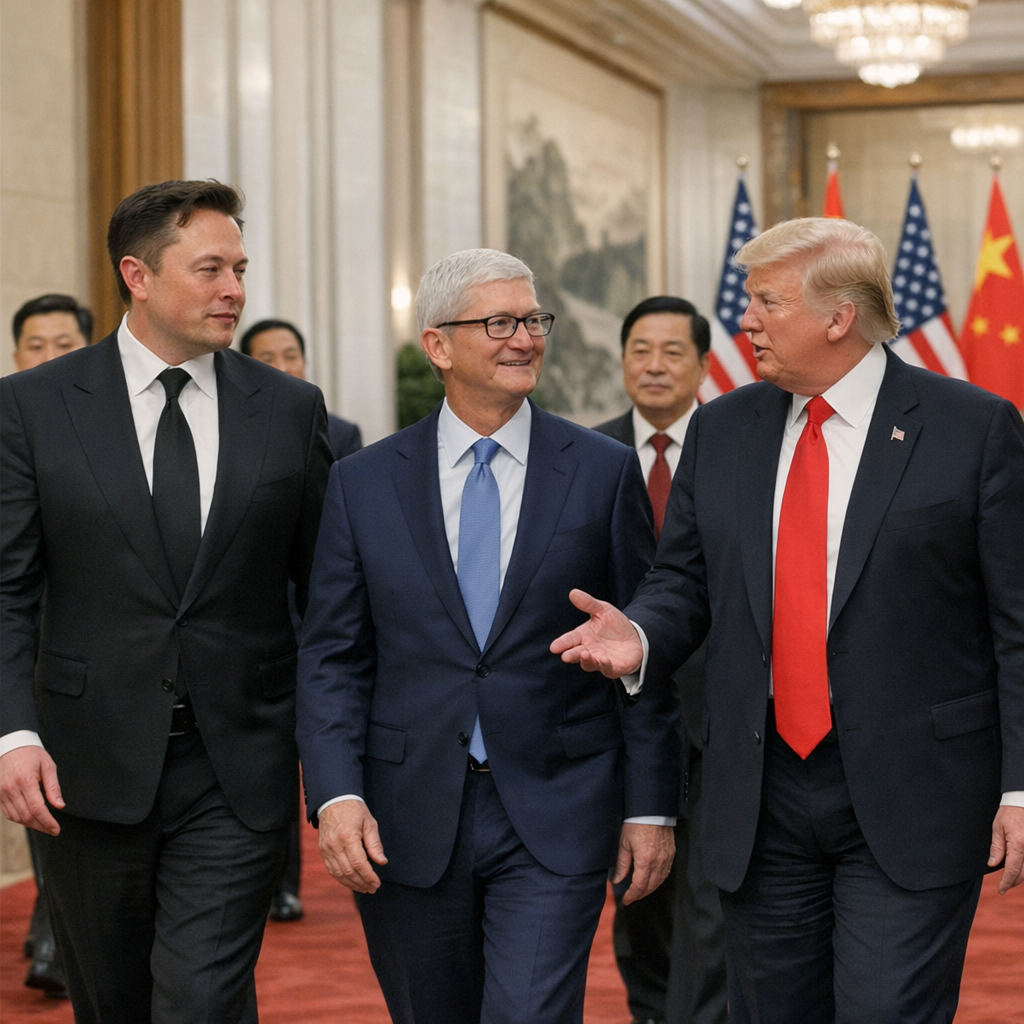
A report by The Economic Times titled “Elon Musk, Apple’s Tim Cook to head to China with Trump White House” signals a notable convergence of political authority and corporate influence as senior American business leaders prepare to accompany a high-level US delegation to China. The planned visit, which includes Tesla chief Elon Musk and Apple CEO Tim Cook, underscores the complex interdependence between the world’s two largest economies at a time of persistent geopolitical tension and economic recalibration.
According to The Economic Times, the involvement of Musk and Cook reflects Washington’s recognition that technology companies sit at the center of US-China economic relations. Both executives oversee firms with deep commercial exposure to China—Tesla through manufacturing and sales, and Apple through both its supply chain and a critical consumer market. Their participation suggests that economic diplomacy is likely to be a central pillar of the visit, alongside more traditional political and strategic concerns.
The Trump administration’s decision to include prominent corporate leaders appears designed to reinforce the message that trade, investment stability, and technological cooperation remain key priorities despite years of tariffs, export controls, and regulatory friction. By bringing figures who command significant leverage in global supply chains, the delegation may aim to advance pragmatic dialogue on issues such as market access, manufacturing continuity, and the operational challenges faced by US firms in China.
At the same time, the presence of Musk and Cook highlights the delicate balancing act required of multinational corporations. Both companies have navigated increasing scrutiny from US policymakers over reliance on Chinese manufacturing and exposure to Chinese markets, even as they continue to depend on those ties for growth and profitability. Their participation in the trip could therefore be interpreted as an effort to align corporate interests with strategic national objectives, while also safeguarding their own business positions.
The Economic Times report points to broader implications for the technology sector, where tensions have been particularly acute. Restrictions on semiconductor exports, data governance concerns, and competition in emerging technologies such as electric vehicles and artificial intelligence have fueled mistrust between Washington and Beijing. Against this backdrop, direct engagement involving industry leaders may serve as an attempt to stabilize at least some dimensions of the relationship.
For China, hosting such a delegation could provide an opportunity to signal openness to continued foreign investment and cooperation, even as it pursues greater self-reliance in critical technologies. For the United States, the visit offers a platform to advocate for fairer trade conditions and to address longstanding concerns about intellectual property, regulatory transparency, and market barriers.
The inclusion of high-profile executives also reflects a broader trend in which corporate leaders increasingly act as informal ambassadors in geopolitical contexts. Their participation can help translate policy discussions into practical business outcomes, but it also places them at the intersection of competing national priorities.
As reported by The Economic Times, the planned trip underscores that despite persistent rivalry, the US and China remain deeply intertwined economically, with major companies playing a pivotal role in shaping the contours of that relationship. Whether the visit leads to tangible progress or simply reaffirms existing complexities will depend on the substance of the discussions and the willingness of both sides to find common ground in an increasingly fragmented global landscape.