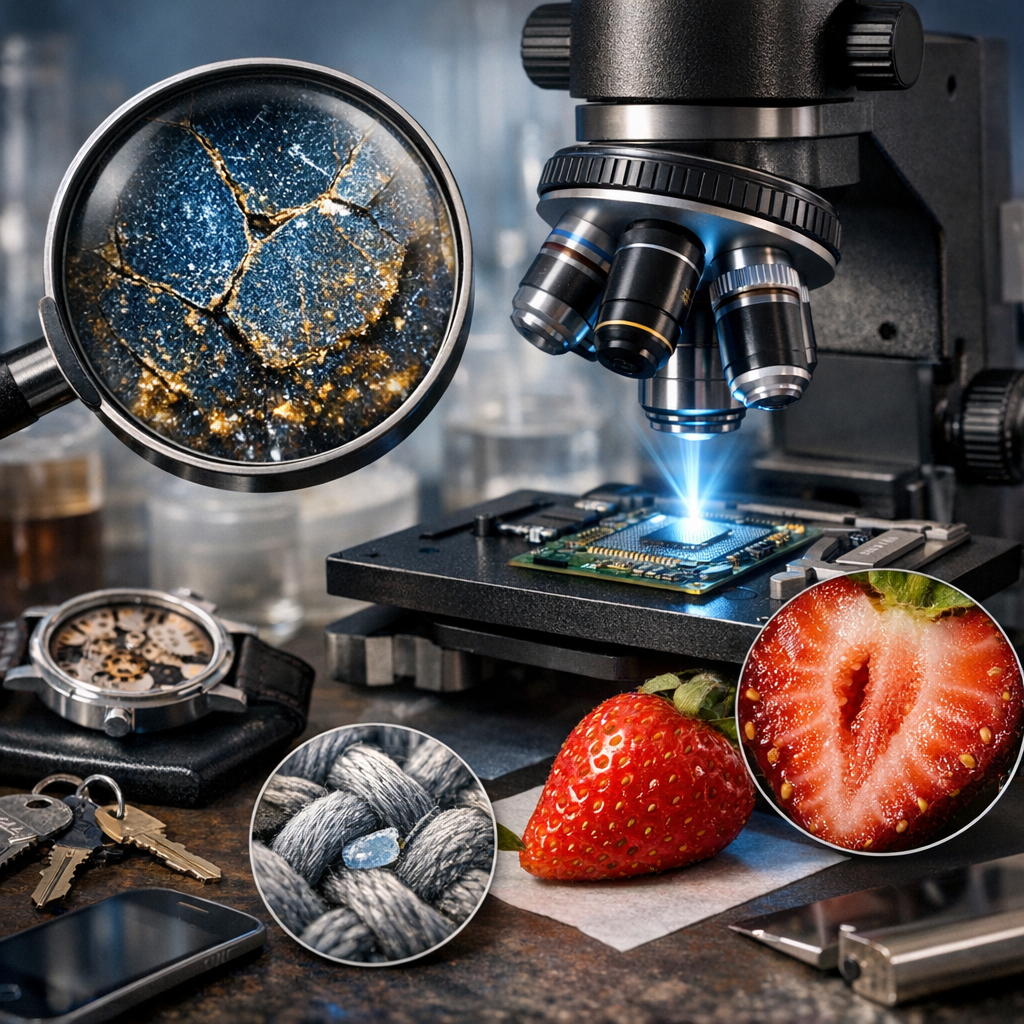
A recent report by Tech Xplore, titled “High-res imagery reveals hidden details in everyday items,” highlights a growing body of research demonstrating how advanced imaging technologies are transforming the way scientists and engineers examine common objects.
According to the article, researchers have developed and refined high-resolution imaging methods capable of capturing intricate structures in materials that would otherwise appear unremarkable to the naked eye. Using techniques such as enhanced optical microscopy and computational imaging, scientists can now visualize microscopic textures, structural flaws, and compositional variations in everyday items ranging from paper and fabrics to food products and consumer plastics.
The report emphasizes that these advances are not purely academic. By examining the fine structure of familiar materials, researchers can better understand how products wear down over time, how contaminants spread, and how manufacturing processes can be improved. For instance, subtle inconsistencies in fibers or coatings—previously undetectable—can now be linked to product durability or performance issues.
One notable aspect of the work described in the Tech Xplore article is the combination of hardware and software innovations. Imaging systems are increasingly paired with machine learning algorithms that help interpret complex visual data. These tools can automatically identify patterns or anomalies within high-resolution images, significantly reducing the time required for analysis and opening the door to large-scale quality control applications.
The implications extend beyond industry. In environmental science, such imaging can be used to track microplastics or pollutants embedded in natural materials. In healthcare, similar techniques may aid in analyzing biological samples or improving the design of medical materials. The ability to observe minute structural details with greater clarity can lead to more accurate diagnoses and more effective treatments.
Researchers cited in the article suggest that as imaging technologies become more accessible and cost-effective, their use will expand into everyday settings. Industries that rely heavily on precision, such as electronics manufacturing and food production, are likely to benefit first, but broader adoption could follow as tools become more streamlined.
The findings underscore a broader trend in science and engineering: the increasing importance of seeing the invisible. As high-resolution imaging continues to evolve, it is reshaping understanding of materials that have long been taken for granted, revealing that even the most ordinary objects can contain layers of complexity with significant practical consequences.