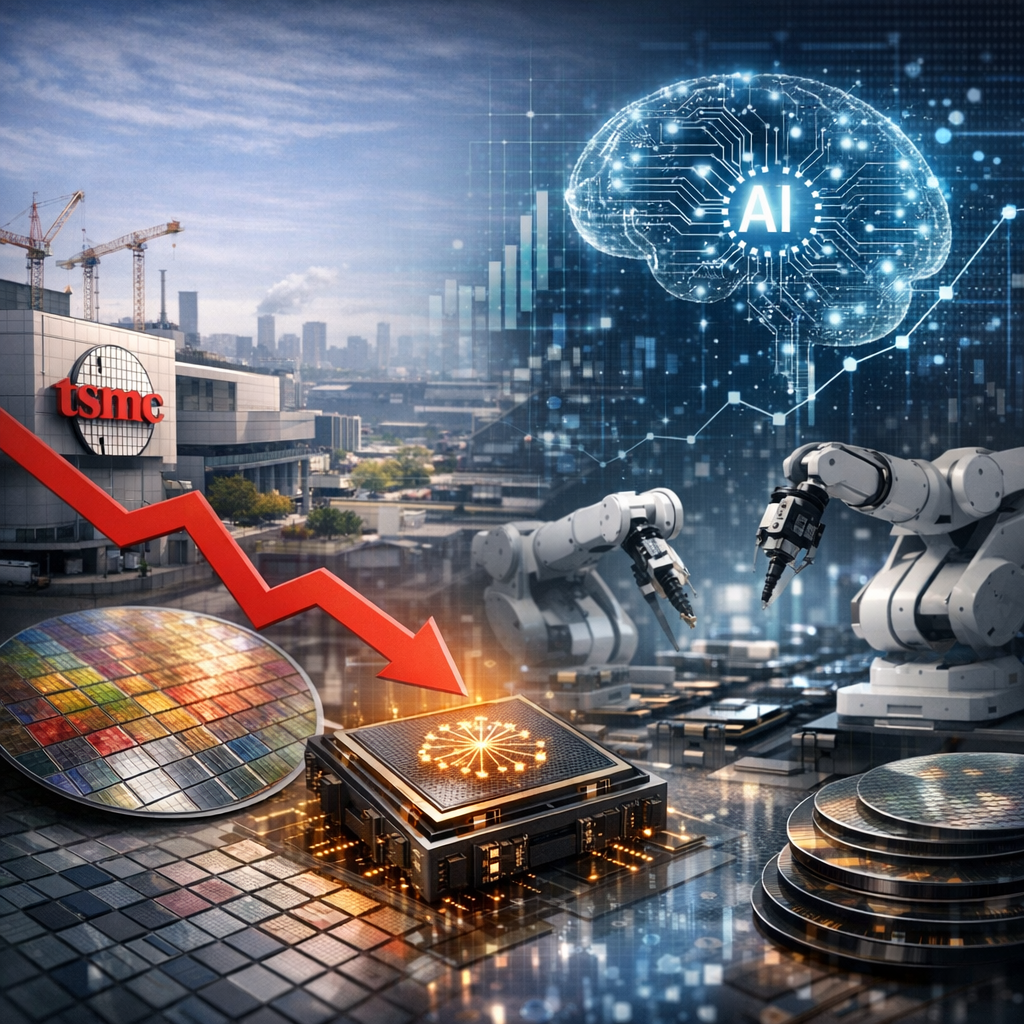
Taiwan Semiconductor Manufacturing Company (TSMC), the world’s largest contract chipmaker and a bellwether for the global technology supply chain, has reported its slowest pace of growth in six months, according to a recent report by StartupNews.fyi titled “TSMC Just Posted Its Slowest Growth in Six Months — The AI Boom Is Doing Fine.”
The figures point to a subtle but significant shift in momentum for a company that has been riding an extended surge in demand tied to artificial intelligence, high-performance computing, and advanced semiconductor manufacturing. While overall growth has decelerated, the broader narrative remains far from negative. Instead, the latest data suggest a recalibration rather than a downturn, particularly as the AI boom continues to anchor demand for cutting-edge chips.
TSMC’s performance is closely watched because it sits at the center of the global semiconductor ecosystem, producing chips for companies ranging from Apple and Nvidia to AMD and a wide array of emerging AI startups. Even marginal changes in its growth trajectory can signal shifts in global demand patterns, inventory cycles, or customer behavior.
The reported slowdown appears to reflect a combination of factors. One is the normalization of demand following a period of exceptionally strong orders tied to generative AI infrastructure and data center expansion. Another is the uneven recovery in consumer electronics, where smartphones and personal computers have not rebounded as quickly as some forecasts had suggested. These segments remain important to TSMC’s overall revenue mix, even as AI-related demand grows in prominence.
At the same time, the continued strength of AI-related workloads is providing a stabilizing force. Orders for advanced nodes used in high-performance GPUs, data center processors, and specialized AI accelerators remain robust. This divergence is increasingly defining the semiconductor landscape: legacy and consumer-driven segments show signs of moderation, while AI-focused demand continues to expand rapidly.
Industry analysts interpret TSMC’s latest figures as evidence of a maturing phase in the current semiconductor cycle rather than a peak. The company’s exposure to leading-edge manufacturing technologies places it in a comparatively strong position, particularly as AI applications demand ever more advanced chips with greater efficiency and computational power.
The StartupNews.fyi report underscores that the AI boom has not only persisted but is reshaping the industry’s growth profile. Instead of broad-based semiconductor demand rising uniformly, growth is becoming more concentrated in specialized, high-performance categories. This shift has implications for capital expenditure, supply chain prioritization, and long-term strategic planning across the sector.
For investors and policymakers alike, TSMC’s results highlight both resilience and caution. The company’s ability to maintain growth amid varying demand conditions reinforces its centrality to the tech economy. However, the moderation also signals that the breakneck expansion tied to early AI adoption may be transitioning into a more measured, though still substantial, phase.
In that context, TSMC’s latest performance may be less about weakness and more about evolution. The semiconductor industry is entering a period where AI continues to drive demand, but not uniformly enough to offset every slowdown elsewhere. As the report suggests, the boom in artificial intelligence remains intact, even as the broader market adjusts to a more complex and uneven growth environment.