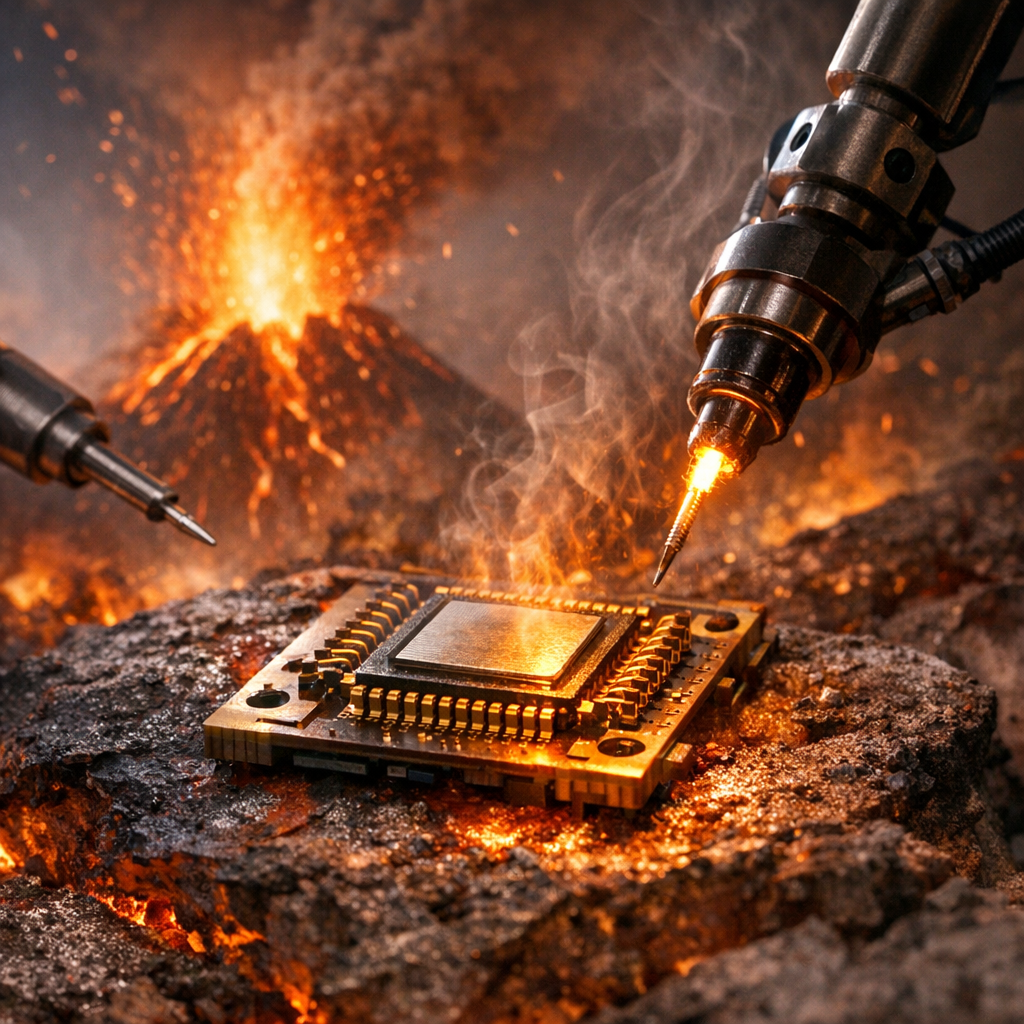
A team of researchers has developed a memory chip capable of functioning under temperatures that exceed those found in volcanic environments, a breakthrough that could expand the limits of electronics used in extreme settings. The advance, detailed in the Tech Xplore article “Memory chip survives temperatures hotter than volcano,” signals a potential shift in how data storage systems are designed for high-heat applications such as aerospace, deep drilling, and industrial processing.
Conventional silicon-based memory begins to fail when exposed to sustained high temperatures, typically beyond a few hundred degrees Celsius. This limitation has long constrained the deployment of electronics in environments where heat management is difficult or impossible. The newly reported device addresses this challenge by leveraging materials and structural techniques that remain stable at far higher temperatures, maintaining performance where traditional chips would degrade or lose stored data.
According to the report, the chip relies on a different physical mechanism for storing information than standard semiconductor memory. Instead of depending on charge states that can dissipate as heat rises, the device uses a more heat-resilient approach, allowing it to retain data integrity even when exposed to temperatures comparable to or exceeding those of molten geological conditions. Researchers tested the chip under extreme conditions and found that it not only survived but continued to operate reliably.
The implications of such durability are significant. In aerospace engineering, electronics that can tolerate intense heat could be placed closer to engines or used in planetary exploration missions where temperature extremes are unavoidable. In the energy sector, particularly in geothermal and deep-well drilling, more robust memory systems could improve data collection and monitoring at depths where current electronics often fail.
Despite the promising results, the technology remains in a developmental stage. Questions remain about scalability, manufacturing cost, and integration with existing computing systems. Researchers will need to demonstrate that the chip can be produced efficiently and operate consistently over long periods in real-world conditions.
Still, the findings suggest a path forward for electronics designed not just to endure harsh environments but to function within them. As highlighted in Tech Xplore’s coverage, the breakthrough underscores a broader trend in materials science and engineering: pushing the operational boundaries of devices to meet the demands of increasingly extreme applications.