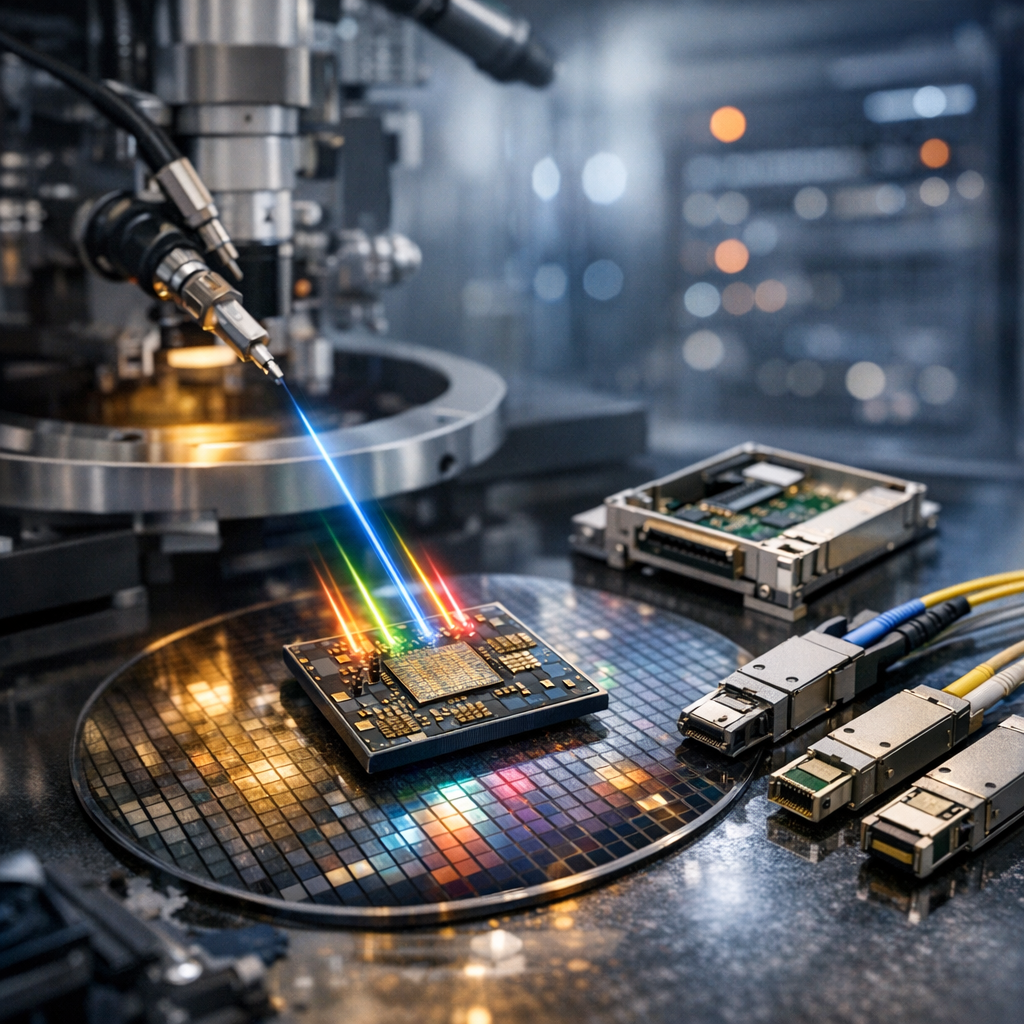
A new wave of hardware aimed at reshaping the economics of high-speed connectivity is gaining momentum as data centers, telecom operators and AI infrastructure builders grapple with rising bandwidth demands and tightening energy constraints. Against that backdrop, DustPhotonics is positioning itself as a contender in the increasingly competitive market for optical interconnects, promising to deliver higher performance at lower cost through manufacturing choices that depart from the industry’s traditional playbook.
According to Tech Time News, in an article titled “DustPhotonics-3,” the company is advancing an approach built around silicon photonics and high-volume production methods intended to make advanced optical components more scalable. The report describes a strategy focused on producing optical transceivers and related photonic building blocks in a way that can be ramped more quickly and at lower unit costs than processes that rely heavily on bespoke assembly. That proposition is drawing attention at a moment when operators are under pressure to expand capacity without simply increasing power consumption in step with throughput.
Optical transceivers sit at the heart of modern networking. They convert electrical signals to optical ones and back again, enabling data to move across racks, rows and campuses at speeds that copper can no longer support efficiently. As AI training clusters and cloud services expand, the industry’s center of gravity has shifted toward faster links and denser deployments. The resulting surge in demand has amplified scrutiny of bills of materials, yields, supply-chain resilience and roadmaps for next-generation speeds.
Tech Time News’ account of DustPhotonics’ trajectory underscores the company’s bet that photonics manufacturing can be made more industrialized. Silicon photonics, which integrates optical functions on silicon chips using techniques adapted from semiconductor fabrication, has been widely viewed as a path toward scale. Yet much of the cost and complexity in optical modules can still reside in packaging, assembly and testing. Any meaningful reduction in those friction points can translate into lower total cost of ownership for operators, especially as link counts climb into the millions across hyperscale footprints.
The market implications extend beyond price. Standardization pressures are increasing as large buyers seek interoperability and multiple sources for critical components. At the same time, technology cycles are compressing. Products that meet today’s requirements may be overtaken quickly as networks transition to higher data rates and new form factors designed to reduce power per bit. Companies that can ship at scale while keeping pace with evolving standards stand to gain, but they also face execution risk: high-volume manufacturing favors mature processes and tight quality control, leaving little room for variability.
The Tech Time News article highlights DustPhotonics as part of a broader industry push to adapt optical technologies to the demands of AI-era infrastructure. Whether the company can translate manufacturing-centric ambitions into durable market share will depend on adoption by major system vendors and operators, qualification timelines, and the ability to deliver consistent performance under real-world deployment conditions. Still, the attention on its approach reflects a clear message from the market: as bandwidth becomes a fundamental input for AI and cloud computing, the winners will be those that can supply optical connectivity not only faster, but more efficiently and at scale.