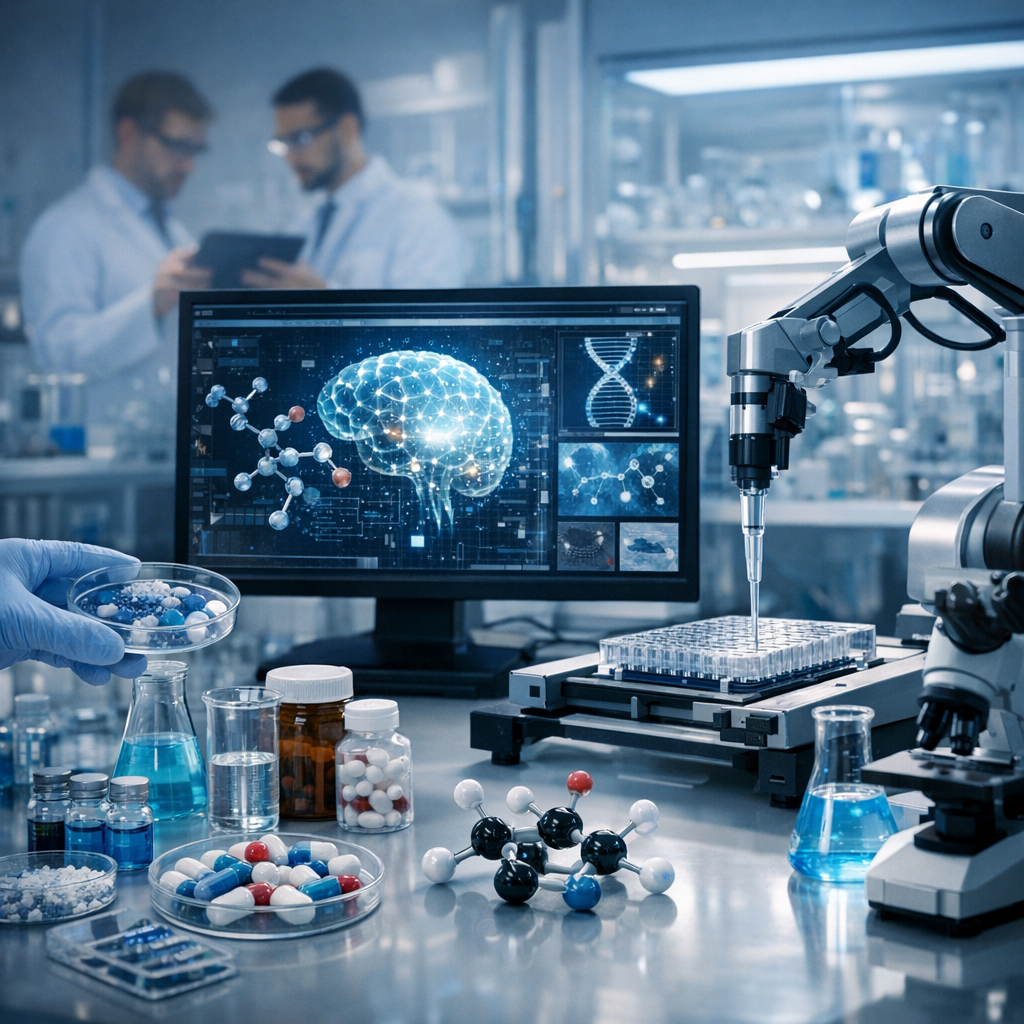
Artificial intelligence is rapidly reshaping pharmaceutical research, promising to accelerate the development of new medicines while reducing costs and failure rates. A recent article, “Wired Health 2026: How AI Is Powering Drug Discovery,” published by Wired, highlights how advances in machine learning are moving from experimental tools to central components of drug discovery pipelines.
According to the report, researchers and biotech companies are increasingly relying on AI models capable of analyzing vast biological datasets, identifying potential drug targets, and predicting how molecules will behave in the human body. These systems can process complex chemical and genomic information at a scale that would be impractical for traditional laboratory methods, significantly shortening early-stage discovery timelines.
Max Jaderberg, a leading figure in AI research cited in the Wired article, describes a shift from incremental improvements to transformative gains. Newer models are not only generating candidate molecules but also refining them through iterative simulations, allowing scientists to explore chemical spaces that were previously inaccessible. This capability is particularly valuable in addressing diseases that have long resisted conventional drug development approaches.
The article notes that AI-driven platforms are beginning to deliver tangible results. Several companies have advanced AI-designed compounds into clinical trials, a milestone that suggests the technology is maturing beyond theoretical promise. While challenges remain—such as ensuring data quality, validating predictions in real-world settings, and navigating regulatory frameworks—the trajectory points toward broader adoption across the pharmaceutical industry.
Importantly, the integration of AI does not eliminate the need for human expertise. Researchers still play a critical role in interpreting outputs, designing experiments, and ensuring that ethical considerations are addressed. Instead, AI is functioning as a powerful augmentation tool, enabling scientists to work more efficiently and with greater precision.
Wired’s reporting underscores that the convergence of computational power, data availability, and algorithmic innovation is creating a new paradigm in medicine. If current trends continue, AI could significantly expand the range of treatable conditions, streamline development pipelines, and ultimately bring therapies to patients faster than ever before.