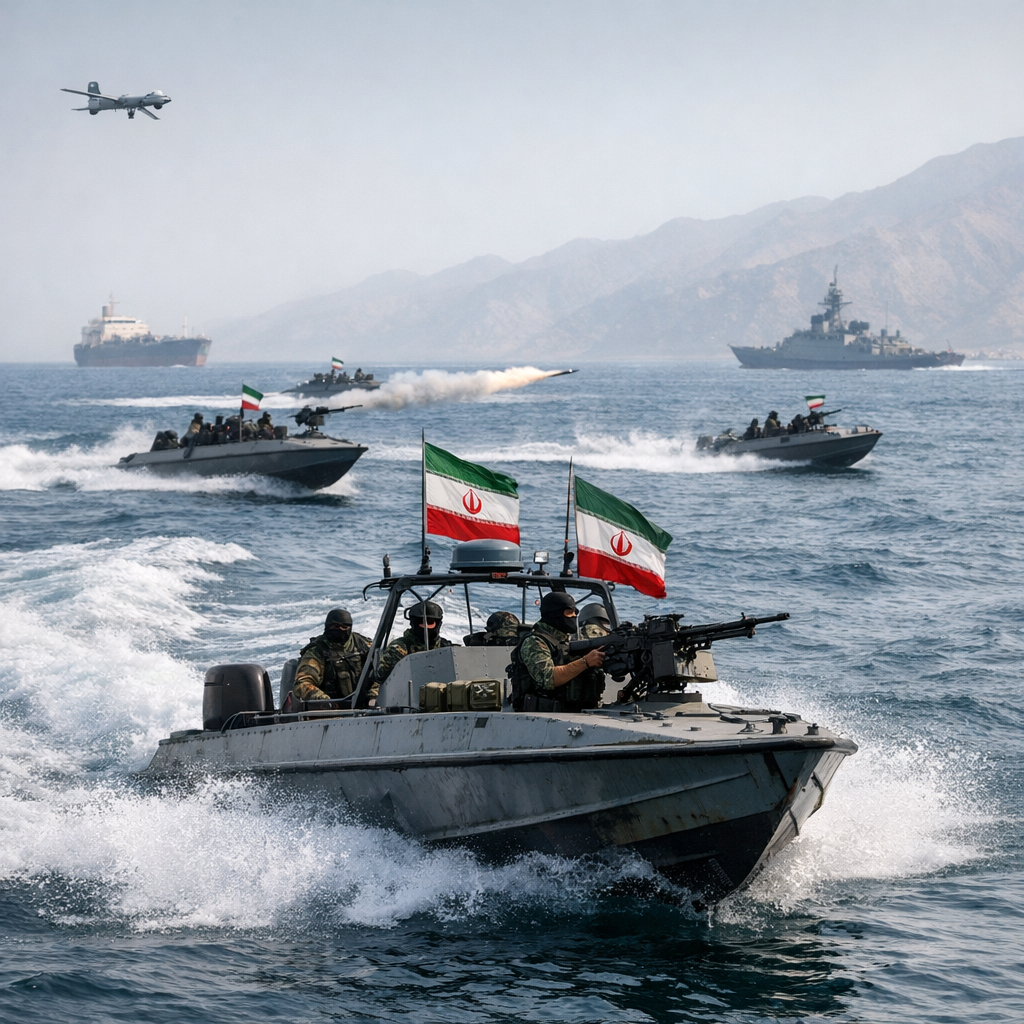
Iran is increasingly relying on small, fast attack craft—often described as “mosquito boats”—as part of a broader strategy to challenge maritime traffic through the Strait of Hormuz, one of the world’s most critical oil chokepoints. The evolving approach, examined in Wired’s article “Iran Is Using Tiny ‘Mosquito Boats’ to Shut Down the Strait of Hormuz,” reflects a shift toward asymmetric naval tactics designed to offset the conventional superiority of the United States and its regional allies.
Rather than investing heavily in large warships, Iran’s Islamic Revolutionary Guard Corps Navy has focused on swarming tactics involving fleets of compact, agile vessels equipped with missiles, rockets, and machine guns. These boats are difficult to track and can be deployed in large numbers, allowing Iran to harass or potentially overwhelm larger ships. Their small size and speed make them particularly suited to the narrow, congested waters of the Strait of Hormuz, where roughly a fifth of global oil passes each day.
Military analysts say the effectiveness of these vessels lies less in their individual firepower than in their collective use. Operating in coordinated groups, they can complicate targeting systems and create constant uncertainty for commercial shipping and naval forces alike. In a high-tension scenario, even limited disruptions could have outsized consequences for global energy markets, driving up prices and increasing geopolitical instability.
Iran’s strategy also leverages geography. The Strait of Hormuz is only about 21 miles wide at its narrowest point, with designated shipping lanes even tighter. This constrained environment reduces the maneuverability of large vessels and increases their exposure to fast-moving threats. By combining these boats with coastal missile batteries, drones, and naval mines, Iran has developed a layered approach that can threaten traffic without requiring sustained open confrontation.
Western naval forces have spent years refining countermeasures, including improved surveillance, escort operations, and the development of defensive systems capable of engaging multiple fast-moving targets. However, the challenge remains significant. Swarm tactics can stretch defensive resources and force difficult decisions about prioritizing threats.
The Wired report underscores how this approach reflects a broader doctrine within Iran’s military thinking: exploiting asymmetry to counter technologically superior adversaries. While Iran cannot match the scale or sophistication of U.S. naval power, it can impose costs and risks that alter strategic calculations.
Recent incidents in the region, including harassment of commercial vessels and periodic seizures, illustrate how these tactics extend beyond theoretical planning. Though not always involving direct conflict, such actions contribute to a persistent atmosphere of tension in the waterway.
Experts caution that while the “mosquito boat” strategy may not be capable of fully closing the Strait of Hormuz for an extended period, even temporary disruptions could have immediate and far-reaching economic consequences. Energy markets remain highly sensitive to instability in the region, and the psychological impact of perceived vulnerability can be as significant as physical blockages.
As global powers continue to monitor developments in the Gulf, the growing prominence of Iran’s small-boat fleets highlights how modern naval conflict is increasingly shaped not just by large platforms and advanced weaponry, but by adaptable, unconventional tactics that exploit local advantages.