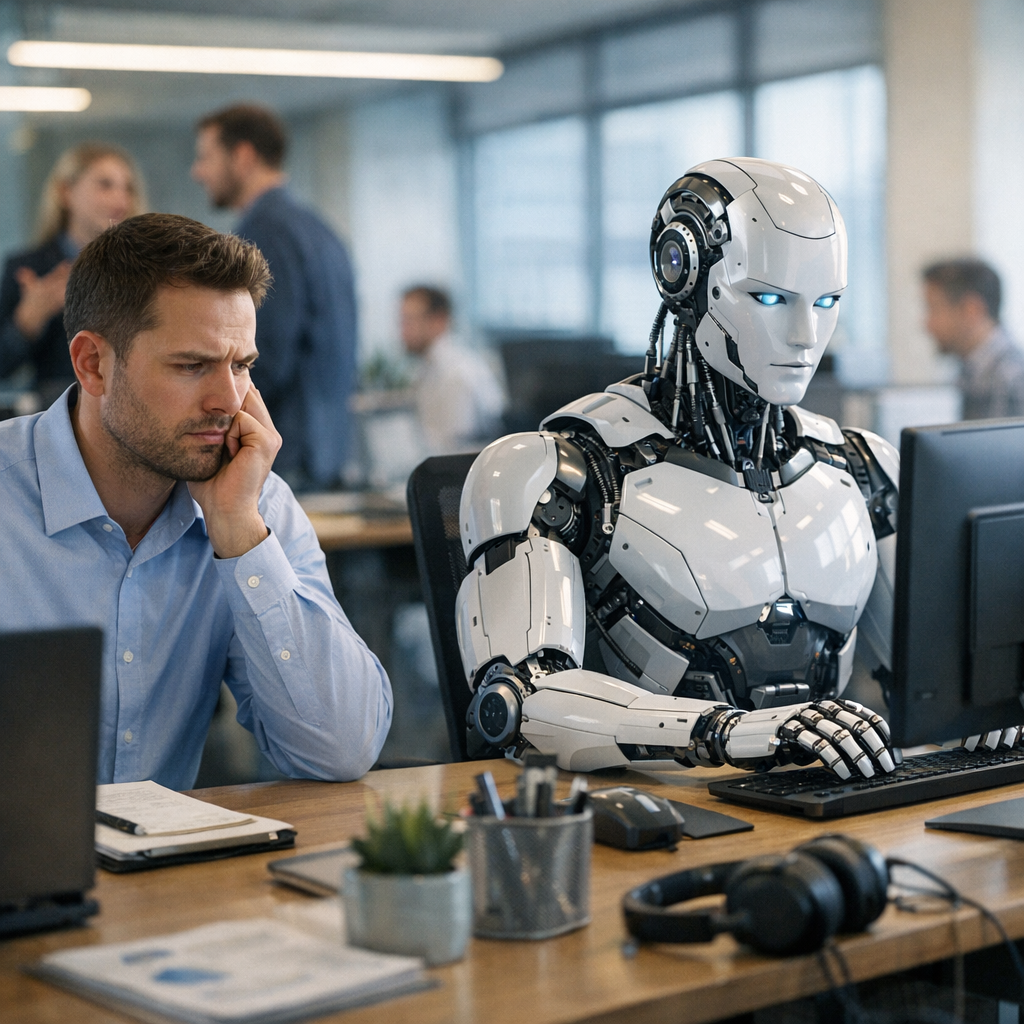
A recent report highlighted growing tensions in the workplace as artificial intelligence systems increasingly take on roles traditionally performed by humans, raising questions about job security, productivity, and the future of work. The article, “Your new co-worker might be an AI bot,” published by Tech Xplore, examines how companies are rapidly integrating AI tools into everyday operations, often blurring the line between human and machine responsibilities.
According to the report, businesses across sectors are deploying AI-driven assistants to manage customer service inquiries, analyze data, draft communications, and even participate in internal decision-making processes. These tools, once considered experimental, are now becoming embedded in standard workflows, reshaping how teams function and how work is evaluated.
Employers often frame the adoption of AI as a means to enhance efficiency rather than replace staff. However, the Tech Xplore article notes that the reality is more complex. While AI can handle repetitive or data-intensive tasks with speed and consistency, its growing capabilities are prompting concerns among workers about redundancy and the erosion of certain roles. In some cases, employees are being asked to supervise or collaborate with digital systems that may eventually supersede parts of their jobs.
The article also underscores a shift in managerial expectations. Workers are increasingly required to be proficient not only in their core responsibilities but also in using and overseeing AI tools. This hybrid skill set, combining domain expertise with technological literacy, is becoming a key determinant of professional relevance. As a result, employees who adapt quickly to AI integration may find new opportunities, while others risk being left behind.
At the same time, questions of accountability and transparency remain unresolved. AI systems can produce outputs that influence business decisions, yet their reasoning processes are often opaque. The Tech Xplore report highlights concerns among experts that overreliance on such systems could introduce errors or biases that are difficult to detect and correct, particularly in high-stakes environments.
Labor advocates cited in the article argue that clearer policies are needed to govern the use of AI in the workplace. They emphasize the importance of protecting workers from abrupt displacement and ensuring that productivity gains translate into broadly shared benefits rather than concentrated advantages for employers.
Despite these challenges, the article suggests that AI’s integration into the workplace is unlikely to slow. Companies continue to invest heavily in automation technologies, and competitive pressures may compel others to follow suit. For many organizations, the question is no longer whether to adopt AI, but how to manage its impact responsibly.
As described in “Your new co-worker might be an AI bot,” the emergence of AI colleagues marks a significant transformation in modern employment. The long-term implications for labor markets, workplace culture, and economic inequality remain uncertain, but the trajectory points toward a future where human and machine collaboration is not the exception, but the norm.