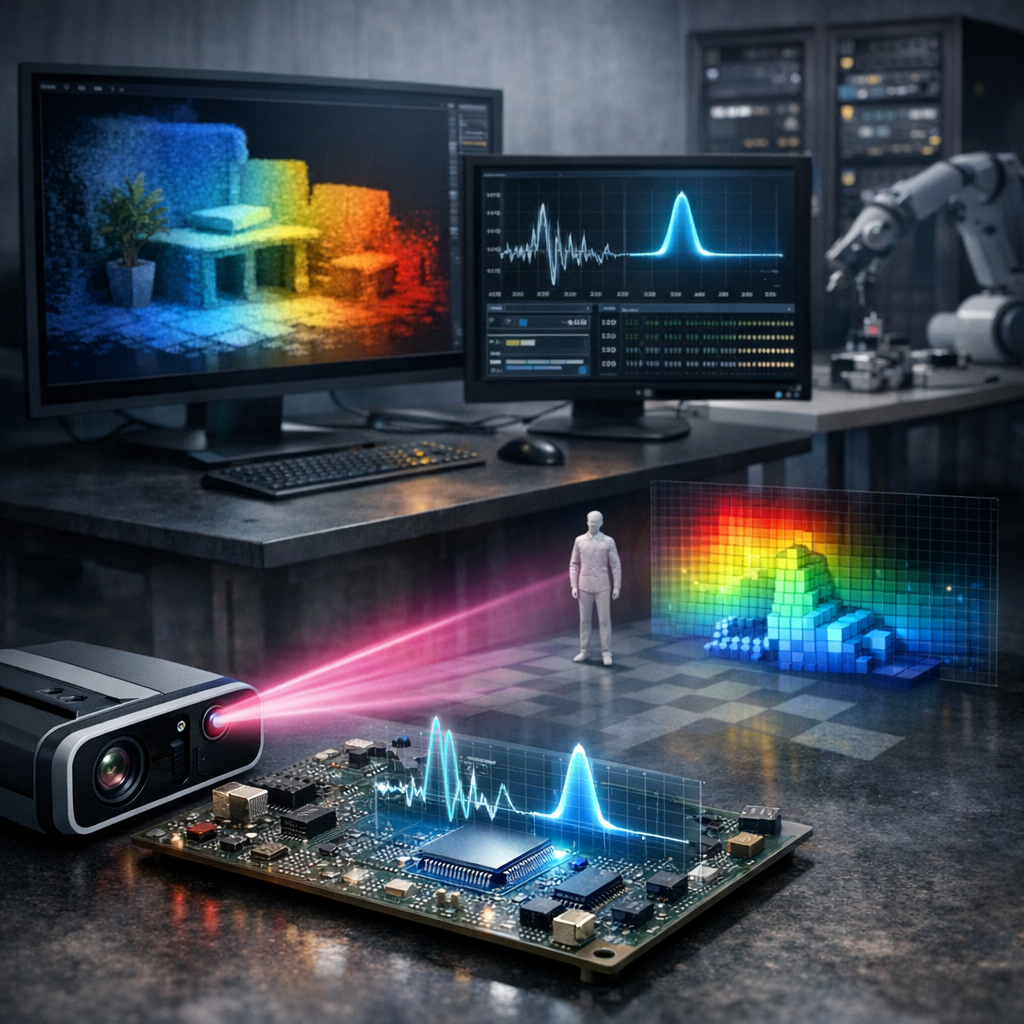
New research into indirect time-of-flight (iToF) imaging is advancing the capabilities of depth-sensing cameras, potentially making them more accurate, efficient, and adaptable across a range of technologies, according to a recent report published by TechXplore titled “New technology makes smarter indirect flight cameras.”
Indirect time-of-flight cameras, widely used in applications such as facial recognition, autonomous navigation, and augmented reality, determine depth by measuring the time it takes for emitted light to reflect off objects and return to a sensor. Unlike direct time-of-flight systems, iToF cameras infer this timing through phase shifts in modulated light signals, offering advantages in cost and integration but often facing trade-offs in accuracy and resistance to noise.
The research highlighted by TechXplore addresses longstanding challenges associated with these systems, particularly in complex environments where light interference and motion can degrade depth measurements. By refining how the cameras process reflected light signals, the new approach enables more precise depth reconstruction while improving performance under difficult lighting conditions.
Central to the development is a more advanced method of interpreting the returning light waveforms. Traditional iToF systems rely on a limited number of sampled signals to estimate distance, which can introduce ambiguity and errors, especially when multiple reflections occur. The updated technique improves signal analysis, allowing the system to distinguish between competing reflections and better isolate the true distance of objects.
The implications of these improvements are significant for industries that depend on real-time 3D sensing. In consumer electronics, enhanced iToF cameras could lead to more reliable facial recognition systems and smoother augmented reality experiences. In robotics and autonomous vehicles, increased depth accuracy may support safer navigation and better object detection, particularly in environments with reflective surfaces or variable lighting.
The work also points to gains in energy efficiency, a key consideration for mobile and embedded devices. By optimizing how light signals are processed rather than simply increasing hardware output, the technology could deliver improved performance without corresponding increases in power consumption.
While the research remains in the developmental stage, it reflects a broader trend of combining hardware innovation with more sophisticated computational methods to overcome physical limitations in sensing technologies. As demand grows for precise, real-time spatial awareness in both consumer and industrial contexts, advances such as these are expected to play a critical role in shaping next-generation imaging systems.
The findings reported by TechXplore indicate that smarter signal processing could push indirect time-of-flight cameras closer to the accuracy traditionally associated with more expensive systems, potentially expanding their adoption across a wider range of applications.