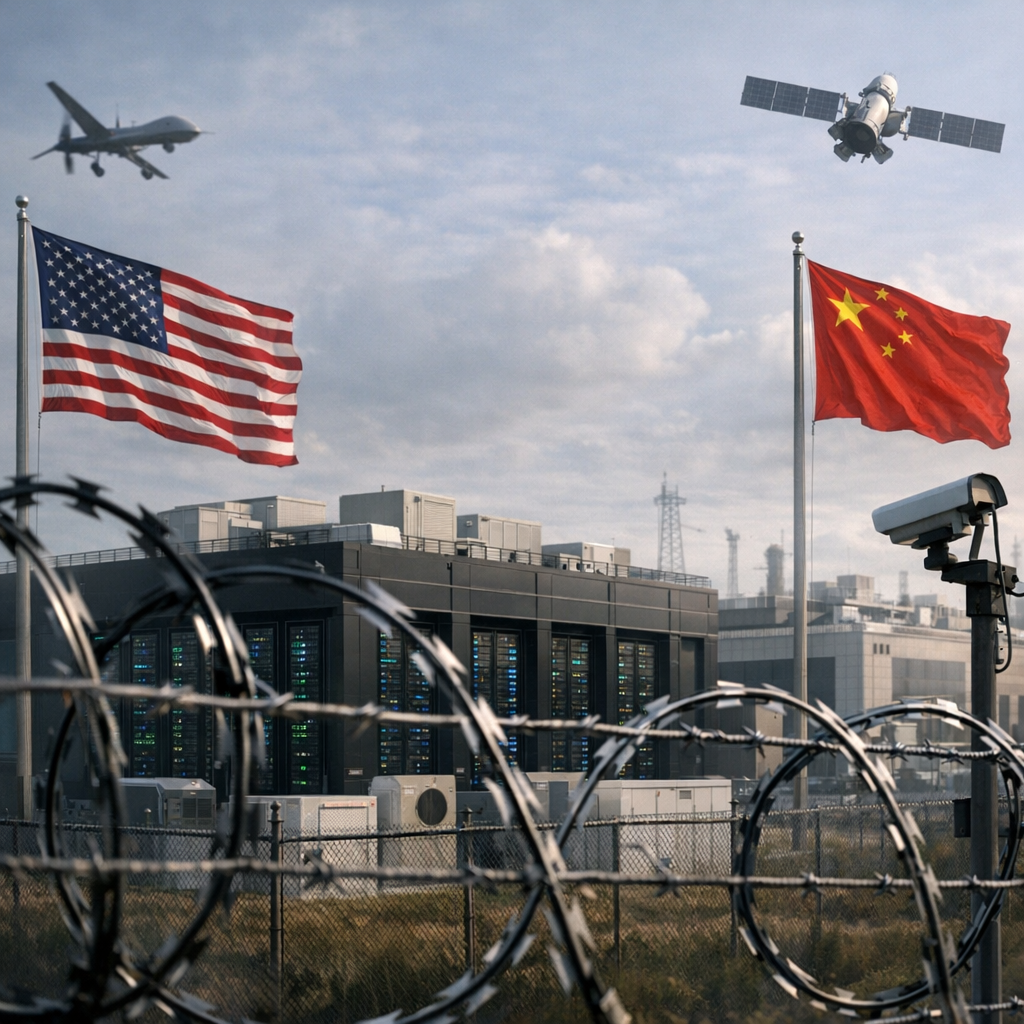
Concerns over national security, supply chain control, and digital sovereignty are intensifying as policymakers in Washington sharpen their scrutiny of Chinese-linked technology infrastructure projects within the United States. According to the Wired article “Why the US Is Opposing China-Linked Data Centers”, American officials are increasingly wary that data centers with ties to Chinese companies could expose sensitive information and create new vulnerabilities in critical digital systems.
At the center of the debate is the expanding role of data centers as essential infrastructure. These facilities store and process vast quantities of information for corporations, governments, and individuals. As reliance on cloud computing and artificial intelligence accelerates, the strategic importance of where data is housed—and who has potential access to it—has become a core geopolitical issue.
The Wired report outlines how U.S. regulators and lawmakers are responding to proposals involving Chinese investment or ownership stakes in domestic data center projects. Even when these facilities are physically located within the United States, officials remain concerned about the possibility of foreign influence through ownership structures, software dependencies, or maintenance agreements. The fear is not limited to direct data access but extends to more subtle risks, such as the potential for surveillance, cyber intrusion, or coercive leverage in times of political tension, issues often examined by bodies like the Cybersecurity and Infrastructure Security Agency (CISA).
These concerns reflect a broader shift in U.S. policy toward China, particularly in the technology sector. In recent years, Washington has imposed restrictions on telecommunications equipment, semiconductor exports, and software platforms linked to Chinese firms, with oversight from entities such as the Federal Communications Commission. Data infrastructure is now emerging as the next frontier in this ongoing strategic competition. The Wired article emphasizes that data centers, once viewed as relatively neutral commercial assets, are increasingly being treated as sensitive components of national security.
Industry stakeholders have expressed mixed reactions. Some companies argue that global investment is essential for meeting the soaring demand for data storage and processing capacity. They warn that overly restrictive policies could slow development, increase costs, and reduce competition in the market. Others, however, acknowledge the legitimacy of security concerns and are adapting by restructuring deals, limiting foreign involvement, or enhancing transparency measures to satisfy regulators, often in alignment with reviews conducted by the Committee on Foreign Investment in the United States (CFIUS).
The debate also highlights the complexity of disentangling global technology ecosystems. Many data center projects involve multinational financing, cross-border supply chains, and equipment sourced from a range of countries. Drawing clear lines between acceptable and unacceptable foreign participation is proving difficult, particularly as companies seek to balance commercial interests with compliance requirements, a challenge frequently analyzed by policy groups like the Center for Strategic and International Studies.
As Wired’s reporting suggests, the issue is unlikely to be resolved quickly. Instead, it is expected to evolve alongside broader U.S.-China relations and the continued growth of data-driven technologies. For policymakers, the challenge lies in protecting national security without stifling innovation or fragmenting the global digital economy. For companies, the stakes are equally high, as regulatory uncertainty and geopolitical tensions reshape the landscape in which they operate.
What is clear is that data, once treated primarily as an economic asset, is now firmly embedded in the calculus of national power. Decisions about where it resides and who controls the systems that manage it are becoming as consequential as traditional questions of trade and defense.