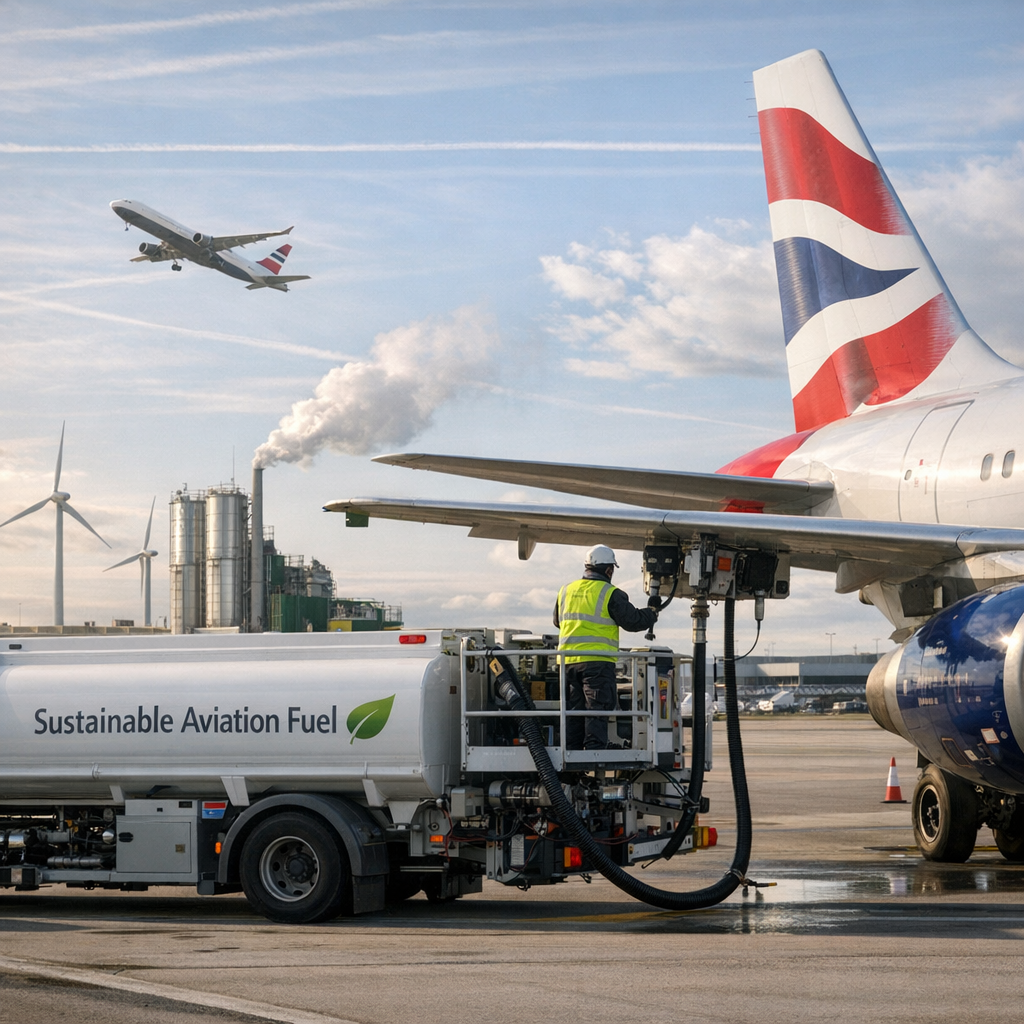
The United Kingdom has unveiled a £219 million funding package aimed at accelerating the development and commercialisation of sustainable aviation fuel (SAF), signalling a renewed push to decarbonise one of the most challenging sectors in the global economy. The move, reported in £219m UK fund to accelerate sustainable aviation fuel production by Innovation News Network, reflects growing urgency within government and industry to scale alternatives to conventional jet fuel.
The funding initiative is designed to support SAF producers, technology developers, and infrastructure projects across the UK, with the goal of increasing domestic production capacity and reducing reliance on fossil-based aviation fuels. SAF, which can be derived from waste materials, biomass, or synthetic processes using captured carbon, is widely regarded as a critical component in aviation’s pathway to net zero emissions. However, high production costs and limited supply have so far restricted its widespread adoption.
By directing substantial public investment into the sector, the UK government aims to bridge the gap between early-stage innovation and commercial viability. The funding is expected to help projects move from pilot and demonstration phases into large-scale production, while also strengthening the broader supply chain required to sustain future demand. This includes support for feedstock sourcing, refining processes, and distribution networks, areas also highlighted by the International Energy Agency’s analysis of sustainable aviation fuels.
The initiative forms part of a broader strategy to position the UK as a global leader in sustainable aviation. Policymakers are seeking not only to reduce domestic aviation emissions but also to capture economic opportunities associated with emerging green technologies. SAF production is seen as a potential source of skilled jobs and regional economic growth, particularly in areas with existing industrial infrastructure that can be repurposed or expanded, aligning with the UK government’s wider Jet Zero strategy.
Industry stakeholders have consistently highlighted that scaling SAF will require coordinated action across governments, airlines, fuel producers, and investors. While mandates and blending targets can stimulate demand, supply-side measures such as capital funding and policy certainty are considered essential to unlock private investment. According to the World Economic Forum, such coordinated efforts are key to accelerating deployment. The £219 million package is therefore being framed as a catalyst that could attract additional financing and accelerate deployment timelines.
Despite these ambitions, challenges remain. SAF currently accounts for only a small fraction of global aviation fuel use, and production costs are significantly higher than those of conventional jet fuel. Questions also persist about feedstock availability and long-term sustainability, particularly in ensuring that raw materials do not compete with food production or lead to environmental degradation, an issue explored by the Transport & Environment NGO.
Nonetheless, the UK’s latest funding commitment underscores the increasing prioritisation of aviation decarbonisation within national climate strategies. As highlighted by Innovation News Network, the initiative represents a concerted effort to turn technological promise into industrial reality, with the potential to reshape the future of air travel while contributing to broader emissions reduction goals.