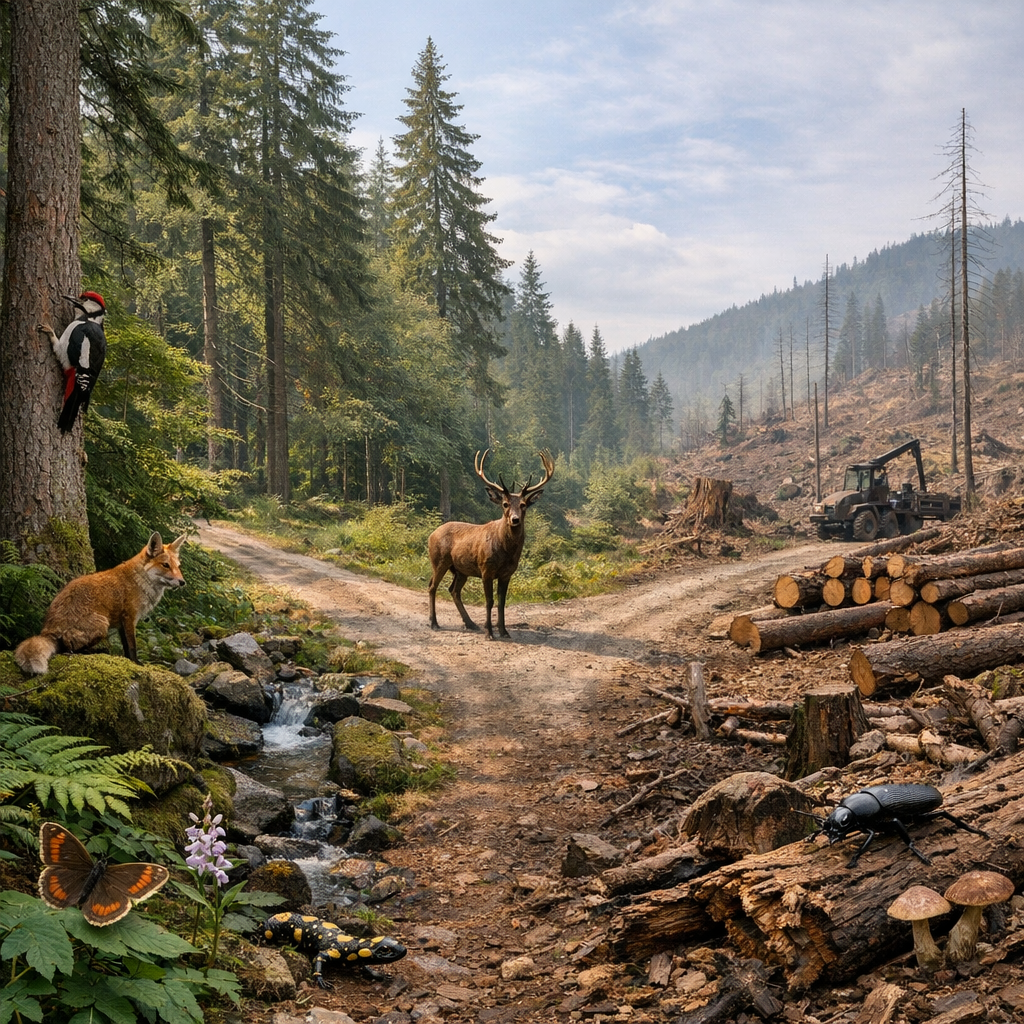
Europe’s forests are entering a decisive period, as mounting ecological pressures expose a quieter but consequential struggle over biodiversity, management practices, and the long-term resilience of woodland ecosystems. The Innovation News Network article “The hidden biodiversity battle to save Europe’s forests” highlights how this struggle is unfolding not only in policy circles but also within the soil, deadwood, and understory layers that sustain forest life.
At the center of the issue is a tension between economic use and ecological preservation. European forests have long been shaped by human intervention, particularly through timber production, which often prioritizes uniformity and efficiency. While such approaches have supported rural economies and renewable material supply chains, they have also contributed to simplified forest structures that can undermine biodiversity. The article underscores that many commercial forests lack the complexity—such as varied tree ages, species diversity, and decaying wood—that supports insects, fungi, birds, and other organisms essential to ecosystem health, a concern also highlighted by the FAO’s work on forest biodiversity.
Researchers and conservationists argue that this hidden layer of biodiversity plays a critical role in maintaining forest resilience. Deadwood, for example, is not waste but a foundation for life, hosting countless species and enabling nutrient cycling, as emphasized by the European Commission’s analysis of deadwood and forest ecosystems. Yet it is frequently removed in managed forests for aesthetic or economic reasons. According to the Innovation News Network’s reporting, this practice can erode ecological stability over time, leaving forests more vulnerable to disease, pests, and the intensifying effects of climate change.
Climate pressures are compounding the problem. Rising temperatures, prolonged droughts, and extreme weather events are already reshaping Europe’s forest landscapes, trends documented by the European Environment Agency. Monoculture plantations—often favored for their predictable yields—are particularly at risk, as their genetic uniformity limits adaptability. In contrast, biodiverse forests tend to be more resilient, with a wider range of species capable of withstanding environmental stressors, a conclusion supported by findings from the IPCC Working Group II report. The article points out that this resilience is increasingly viewed as indispensable as policymakers confront the realities of a warming climate.
Efforts are underway across Europe to reconcile these competing priorities. Some forestry strategies now incorporate closer-to-nature approaches, aiming to balance timber production with ecological integrity. These include promoting mixed-species stands, retaining deadwood, and allowing natural regeneration processes to play a greater role. Policy direction is increasingly shaped by frameworks such as the EU Forest Strategy for 2030, though the transition remains uneven, with economic incentives and regulatory frameworks often lagging behind scientific recommendations.
The article also emphasizes the importance of less visible organisms—particularly fungi and invertebrates—which are frequently overlooked in conservation planning. These species form the backbone of forest ecosystems, facilitating processes such as decomposition and nutrient exchange, themes also central to the Convention on Biological Diversity’s forest program. Their decline can trigger cascading effects that compromise the entire system. Yet because they are less conspicuous than large mammals or birds, they tend to receive less attention in public discourse and policy design.
A further challenge lies in aligning short-term economic considerations with long-term ecological goals. Forest owners and managers must navigate market demands, regulatory requirements, and environmental risks, often under conditions of uncertainty. As the Innovation News Network article makes clear, achieving meaningful progress will likely depend on integrating biodiversity metrics into forestry practices and providing incentives that reward ecological stewardship.
The broader implication is that the future of Europe’s forests may hinge on recognizing the value of what is often unseen. Protecting biodiversity is not merely a conservation objective but a prerequisite for sustaining the ecological functions that forests provide, from carbon storage to water regulation. As the pressures on these ecosystems intensify, the “hidden biodiversity battle” described in the article is becoming increasingly central to the continent’s environmental strategy.
What emerges is a picture of forests at a crossroads. Decisions made now—about how forests are managed, what is prioritized, and which forms of life are valued—will shape not only the landscapes of Europe but also their capacity to endure in a rapidly changing world.